Introduction – Poverty as a Challenge Class 9
One of India’s most significant social and economic problems is poverty. It describes a state where people are lacking the basic necessities of life, such as food, clothing, housing, medical treatment, and education.
Every day, a poor person fights for survival and faces insecurity, hunger, and a lack of dignity. Poverty includes not only a lack of money, but also the absence of opportunities, social position, and a fair level of living.
Meaning of Poverty
Poverty is a circumstance in which a person’s income is insufficient to meet their basic needs.
It has a wide-ranging impact on life:
- Poor health and nutrition
- Lack of education and skill
- Inadequate housing and sanitation
- Limited job opportunities and low income
- Social inequality and exclusion
Thus, poverty is multidimensional, not just about income, but also about quality of life.
Two Typical Cases of Poverty
1. RURAL CASE- Ram Saran’s Family (Village near Meerut, Uttar Pradesh)
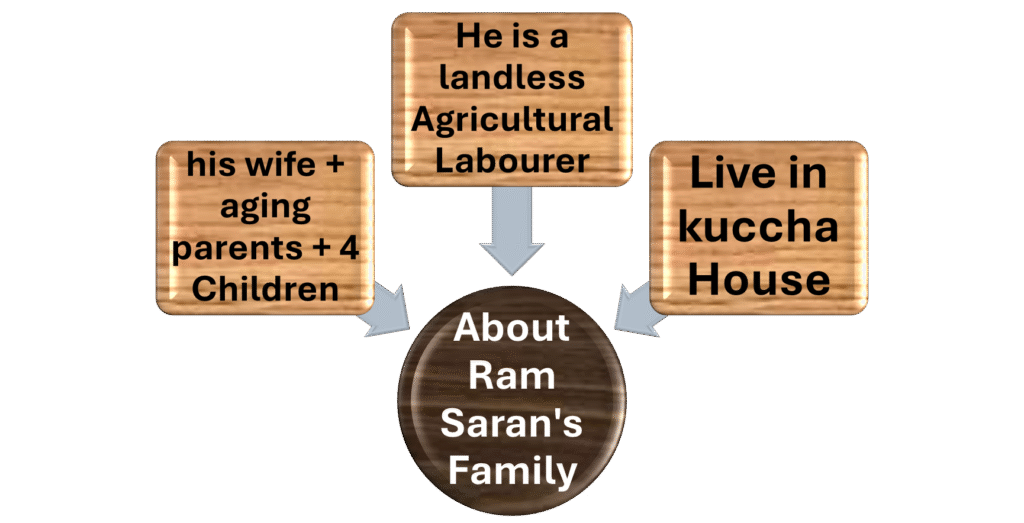
-Living Conditions:
- He is a seasonal employee. As he works on other people’s land, he earns very little, hardly enough to eat.
- During the months when he is not employed, the family has no income and often borrows money from the moneylender.
- His children do not attend school because the family cannot afford the fees, clothes, and books.
- The family has little access to healthcare, relying on local doctors even for critical illnesses.
-Conclusion (Rural Poverty Features)
- Irregular employment and low wages
- Lack of education and healthcare
- No savings
- Poor living conditions
2. URBAN CASE – Saviya Begum’s Family (Urban Area)
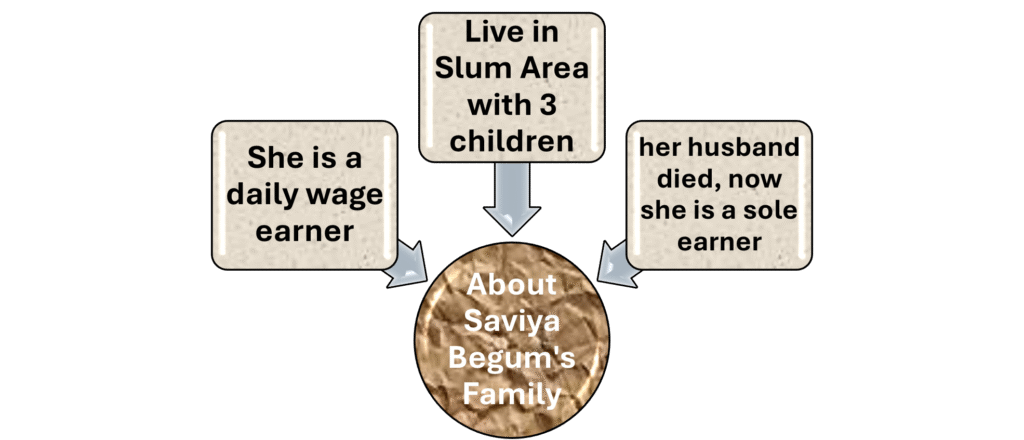
-Living Conditions:
- She works as a domestic worker. Her income is very low and uncertain
- The family lives in a temporary hut (jhuggi) that lacks clean water, sanitation, and power.
- Her children cannot attend school. They often suffer from malnutrition and illness
-Conclusion (Urban Poverty Feature)
- Insecure employment and low income
- Lack of housing and sanitation
- Health problems due to unhygienic conditions
- No access to education or social security
#NOTE:
- Despite their different situations, they face similar challenges in terms of basic needs, education, and social insecurity.
- These cases show that poverty is multidimensional, and require specific government response in both rural and urban locations.
POVERTY AS SEEN BY SOCIAL SCIENTISTS
According to social scientists, poverty is about more than just income or money. It is a multidimensional issue that include a lack of basic necessities, education, healthcare, and social justice.
Poverty means a situation where people are deprived of a decent standard of living and opportunities for development.
Social scientists identify different types of deprivations faced by poor people. These are as follow:
(i) Social Deprivation:
- Poor people are socially excluded and considered inferior in society. They are frequently victims of caste discrimination, untouchability, and gender inequality. They have unequal access to education, healthcare, and employment opportunities.
- Result: They live without dignity and face social isolation.
(ii) Economic Deprivation:
- This is the most visible form of poverty. Poor people earn very low incomes. Due to irregular work, they suffer from hunger, malnutrition, and indebtedness.
- Result: They remain trapped in the cycle of poverty — low income → low nutrition → low productivity → poverty.
(iii) Political Deprivation:
- Poor individuals are generally politically powerless. Many poor people are unaware of their rights and do not participate in elections or government programs. As a result, they are ignored in policy-making and excluded from development benefits.
- Result: Their voices remain unheard in democracy.
(iv) Health and Educational Deprivation:
- Poor people cannot afford proper medical treatment and their children cannot attend school. Low education means low skills, which results in low-paying jobs or unemployment.
- Result: they are trapped in a cycle of poverty for generations due to a lack of education and bad health.
(v) Vulnerability and Insecurity:
- Poor people live in endless fear and uncertainty. They are vulnerable to natural disasters, job loss, illness, and price increases. They frequently borrow at high interest rates, which pushing them deeper into poverty.
- Result: They live under mental stress and insecurity all their life.
POVERTY LINE
The poverty line is the minimum amount of income or consumption necessary for a person to achieve their basic necessities. People below this level are considered poor. The Planning Commission and the National Sample Survey Organisation (NSSO) conducted the survey. The poverty line is estimated periodically (normally every five years).
In India, the poverty line is estimated based on:
- Accepted Average Calorie Requirement
- Rural Areas: 2400 calories per person per day
- Urban Areas: 2100 calories per person per day.
- Calories intake in Rural is higher, as people in rural areas do more heavy physical work
- Total expenditure required per person per month (as per 2011–12)
- Rural Areas: ₹816 per person per month.
- Urban Areas: ₹1000 per person per month
- Income Expenditure in Urban area is higher, despite lower calorie need, due to higher prices of many essential products in urban areas.
POVERTY ESTIMATES
Poverty estimates show how many people are poor in the country. The Planning Commission of India calculates them based on National Sample Survey Organisation (NSSO) surveys. In India, the consumption approach is mostly used to determine if people can afford basic food and necessities.
Historical estimations suggest a falling trend in poverty:
- 1973–74 → 55% of the population below poverty line
- 1983 → 45%
- 1993–94 → 36%
- 2004–05 → 28%
- 2011–12 → 21.9%
Poverty has gradually declined, with rural areas having more poor people than urban areas.
–Limitations of Poverty Estimates
- Focus only on income or consumption
- Ignores health and education
- Does not consider housing and sanitation
- Social exclusion not included
INTER STATE POVERTY
Inter-state disparities refer to differences in poverty levels and living standards between India’s states. These disparities exist because not all states have equal resources, industries, and opportunities.
-Lower Poverty States:
States like Maharashtra, Gujarat, Punjab, Haryana, Kerala, and Tamil Nadu have lower poverty rates due to better industrial growth, improved agriculture, higher literacy rates, and better job opportunities.
-Higher Poverty States:
States such as Bihar, Uttar Pradesh, Odisha, Madhya Pradesh, and Jharkhand continue to have higher poverty rates due to slow industrial growth, poor infrastructure, low literacy, and a lack of job opportunity.
-The main causes of inter-state disparities include:
- Unequal resource distribution
- Differences in industrialization and infrastructure
- Low agricultural productivity
- Historical and social factors
- Urbanization
#NOTE: Rural poverty is higher than urban poverty in all states. Disparities affect standard of living, health, and education of people.
GLOBAL POVERTY SCENARIO
The global poverty scenario describes the extent and distribution of poverty around the world. According to the World Bank, a person earning less than $1.90 per day (in terms of purchasing power) is classified as poor under international standards.
Global poverty has decreased in recent decades, particularly since the 1980s, although it remains a serious problem in many developing and undeveloped countries. The largest concentration of poor people lives in South Asia (India, Bangladesh, Nepal, Pakistan, Sri Lanka) and Sub-Saharan Africa.
The global poverty scenario shows that, while poverty has decreased worldwide, it is still concentrated in South Asia and Africa. Countries such as China and India have made great progress.
POVERTY AND SUSTAINABLE DEVELOPMENT GOALS (SDG)
-In 2015, the United Nations approved the Sustainable Development Goals (SDGs), which aim to promote global peace, prosperity, and equality by 2030. Goal 1 – “No Poverty” aims to end all types of poverty and ensure that no one lives on less than $1.90 per day (international poverty line).
-Poverty reduction is an important component of sustainable development since it improves education, health, equality, and economic progress.
-India is committed to achieving this goal through various poverty alleviation programmes, such as:
- MGNREGA – provides rural employment.
- PM Awas Yojana – provides housing for the poor.
- Jan-Dhan Yojana – ensures financial inclusion.
- National Rural Livelihood Mission – supports self-employment and income generation.
CAUSES OF POVERTY
- Historical Causes:
- British colonial rule destroyed Indian handicrafts and industries.
- Farmers were heavily taxed, and agriculture became backward.
- Low Economic Growth:
- After Independence, economic growth was slow.
- Benefits of growth did not reach the poor sections of society.
- Unequal Distribution of Income:
- Wealth is concentrated in a few hands.
- Rich get richer while the poor remain poor.
- Dependence on Agriculture:
- Majority depend on agriculture, which is seasonal and uncertain.
- Lack of modern technology reduces productivity.
- Rapid Population Growth:
- Population rise increases pressure on limited resources.
- Leads to unemployment and low per capita income.
- Unemployment and Underemployment:
- Many people do not get regular or well-paid jobs.
- Rural areas face disguised unemployment.
- Social Factors:
- Caste system, discrimination, and gender inequality restrict opportunities.
- Lack of Education and Skills:
- Poor literacy and skill levels prevent access to better jobs and income.
ANTI-POVERTY MEASURES
To reduce poverty in India, the government has adopted two main approaches:
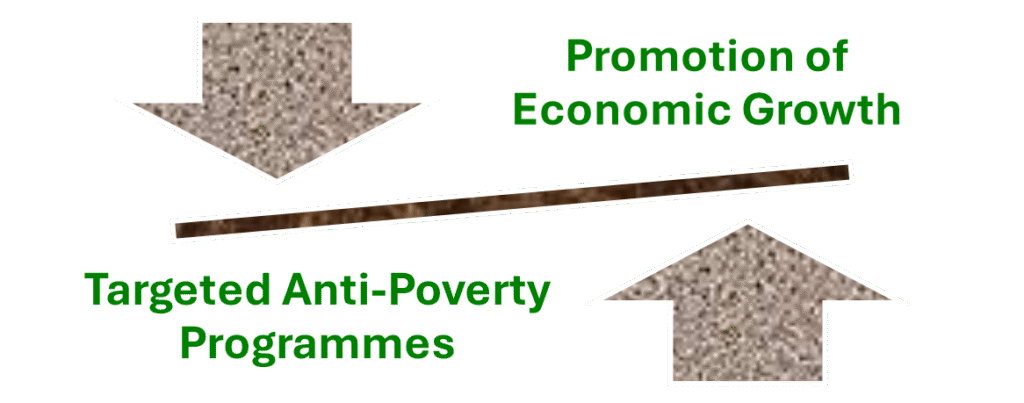
*Promotion of Economic Growth
- Economic growth creates more jobs and income, helping people rise above poverty.
- Higher growth in agriculture, industry, and services has helped reduce poverty.
- Example: Since the 1980s, India’s growth has helped reduce poverty from over 45% (1993) to about 22% (2011–12).
*Targeted Anti-Poverty Programmes
The government has launched several schemes to directly help the poor:
1. Mahatma Gandhi National Rural Employment Guarantee Act (MGNREGA), 2005
- Guarantees 100 days of wage employment to rural households.
- Aims to improve livelihood security and create durable rural assets.
2. National Rural Employment Guarantee Programme (NREGP) and National Food for Work Programme (NFFWP)
- Provide employment and food security to rural people.
3. Pradhan Mantri Awas Yojana (PMAY)
- Provides affordable housing for the poor in rural and urban areas.
4. Pradhan Mantri Gram Sadak Yojana (PMGSY)
- Connects rural areas through all-weather roads to promote development.
5. National Rural Livelihood Mission (NRLM)
- Encourages self-help groups (SHGs) to provide employment and income generation opportunities.
6. Prime Minister Jan-Dhan Yojana (PMJDY)
- Promotes financial inclusion by providing bank accounts and direct benefit transfers to poor families.
THE CHALLENGES AHEAD
Even after years of economic growth and government schemes, poverty remains a challenge in India.
These Challenges are as follow:
1. Rural Poverty
- The majority of poor people live in villages and depend on an uncertain agricultural income.
2. Unemployment and underemployment
- Many poor people are unable to find regular employment, and some work for less than they would like.
3. Population Pressure
- Rapid growth in population raises demand for jobs, food, and resources, making poverty eradication more difficult.
4. Social Inequality
- Caste, gender, and social inequality limit equal opportunities.
5. Lack of Education and Skills
- Poor literacy and skills make it difficult for people to obtain higher-paying employment.
6. Regional Disparities
- Some states remain underdeveloped, with higher poverty rates than richer states.
7. Implementation Issues
- Government programs sometimes fail to reach the poorest people owing to corruption or a lack of understanding.