MEANING OF POLITICAL PARTIES
A political party is an organised group of people with shared political views and ideologies who join together to contest elections and maintain power in government. They agree on certain policies and programmes aimed at increasing societal well-being.
Why Do We Need Political Parties?
1. Democracy Cannot Function Without Them
If there are no parties, no one will be responsible for how the country is run. And government will become unstable and directionless.
2. They Represent Different Opinions
Parties make sure that they will represent society’s diverse views, interest, and opinion.
3. They Make Policies and Run Government
Ruling party makes laws and policies for the country. Whereas, Opposition checks and criticises the ruling party. This will ensure the accountability.
4. They Provide Choices to Voters
Political parties provide citizens with different options of leaders, programmes and policies.
5. They Form a Link Between Government and People
We need Political Parties as they act like a bridge between government and citizens by raising demands and problems of the people.
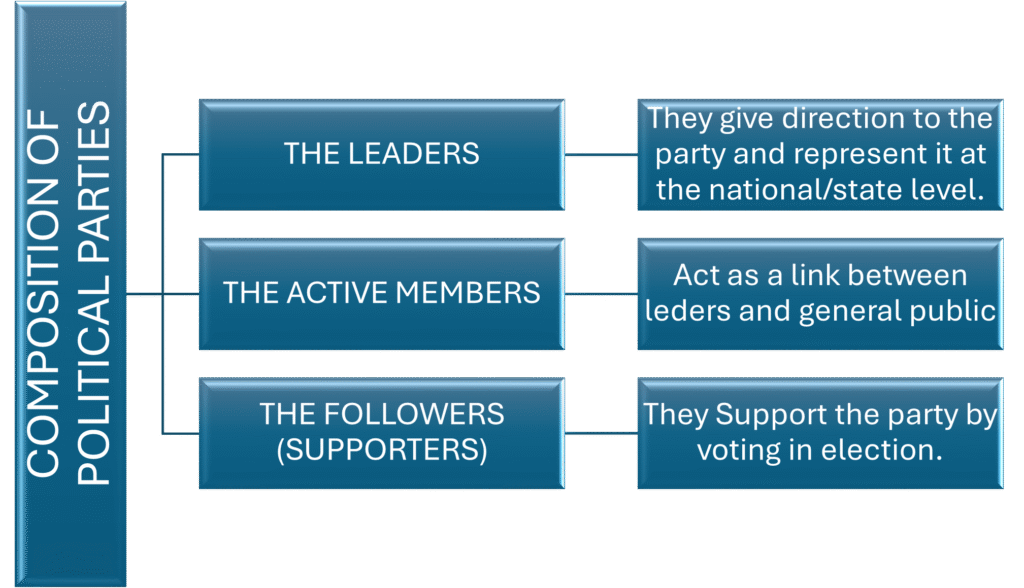
COMPONENTS OF POLITICAL PARTIES
A political party is not just its leaders but a combination of leaders + active members + followers.
All three components are necessary for the functioning and success of a party.
Functions of Political Parties
1. Contest Elections
Parties nominate and campaign for candidates to win elections and implement programs.
2. Create policies and programmes
Each party develops policies and programs to address public issues, providing voters with clear options for the country’s future direction.
3. Making Laws
Parties in power shape policies that reflects their ideology and promises.
4. Establish and Run Government
The majority party (or coalition) establishes the government, manages ministries, and implements policies, while the opposition checks its actions.
5. Shape Public Opinion
Parties employ rallies, campaigns, debates, and media to influence and guide people on important national and social issues.
6. Give people access to the government
Parties serve as bridges between the government and citizens, fighting for their needs and facilitating access to government programs and services.
Types of Party System
A party system refers to how political parties are organised and run in a country, including how many parties compete, share power, and influence policies.
Political scientists divide party systems into three categories based on the number of parties and the nature of competition:
1. One-Party System
-Definition: A system where only one political party exists or dominates all levels of government.
-Features:
- No real competition from other parties.
- Citizens do not have a genuine choice in elections.
- Policies reflect the ideology of the single party.
- Government is usually stable but not democratic in true sense.
-Examples: China (Communist Party), North Korea (Workers’ Party).
-Pros: Ensures stability
-Cons: limits freedom of choice and disagreement.
2. Two-Party System
-Definition: A system where two major parties dominate national politics.
-Features:
- Power alternates between the two parties.
- Provides voters a choice, but limited alternatives.
- Usually results in a stable government.
- Smaller parties exist but have limited influence.
-Examples: USA (Democrats & Republicans), UK (Conservatives & Labour).
-Pros: Gives political stability and clear policies, limits fragmentation of votes.
-Cons: Minorities and smaller groups may be underrepresented.
3. Multi-Party System
-Definition: A system where multiple political parties compete for power at national and state levels.
-Features:
- Several parties have significant influence.
- Encourages representation of diverse communities, regions, and interests.
- Often leads to coalition governments if no single party gets majority.
- Encourages debates, compromises, and negotiation among parties.
-Examples: India, Italy, Israel.
-Pros:
- Promotes inclusivity and wider representation.
- Encourages coalition politics and negotiation.
-Cons: Can lead to unstable governments if coalitions are weak or short-lived.
Types of Political Parties
Political parties can be classified based on their scope of influence and operation in a country. In India and most democracies, they are mainly of two kinds:

*National Party
-A national party is a political party that runs in several states and has a large national following. If these parties secure a majority of seats in the Lok Sabha, they will be able to form the central government. These political parties are referred to as “recognised political parties” because the Election Commission of India (ECI) has recognised them.
–Criteria for a National Party
A political party is recognised as a National Party in India if it has a widespread presence across the country. According to the Election Commission of India, a party can be recognised as a national party if it fulfil any one of the following:
- it wins at least 2% of seats in the Lok Sabha from at least three different states
OR
- it secures at least 6% of valid votes in four or more states in Lok Sabha or State Assembly elections.
OR
- it is recognised as a State Party in at least four states.
–National Parties in India (2024–25)
1. Bharatiya Janata Party (BJP)
- Founded in 1980
- Founder / Leader- Formed after split in Janata Party; leaders like Atal Bihari Vajpayee, L.K. Advani played key role
- Recognised as National Party in 1989
2. Indian National Congress (INC)
- Founded in 1885
- Founder / Leaders- A.O. Hume (with Dadabhai Naoroji, W.C. Bonnerjee & others)
- National Status- Always recognised as first all-India party, since independence
3. Bahujan Samaj Party (BSP)
- Founded in 1984
- Founder / Leader- Kanshi Ram, later led by Mayawati
- Recognised as National Party in 1996
4. Communist Party of India (Marxist) – CPI(M)
- Founded in 1964 (after split from Communist Party of India)
- Leader at Formation- E.M.S. Namboodiripad (first Chief Minister of Kerala)
- Recognised as National Party in 1984
5. Aam Aadmi Party (AAP)
- Founded in 2012
- Founder / Leader- Arvind Kejriwal (emerged from India Against Corruption movement)
- Recognised as National Party in 2023 (after success in Delhi, Punjab, Goa, Gujarat)
6. National People’s Party (NPP)
- Founded in 2013
- Founder / Leader- P.A. Sangma (former Lok Sabha Speaker)
- Recognised as National Party in 2019 (first party from Northeast India to get this status)
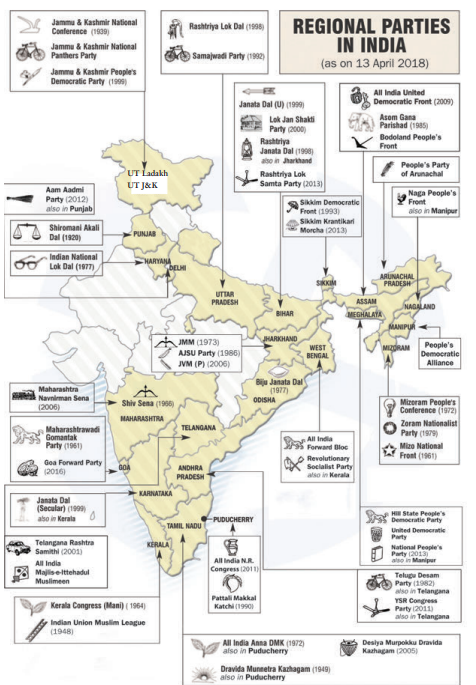
*State/Regional Party
A state party, sometimes known as a regional party, is a type of political party that is only accepted in one or a small number of Indian states. These parties primarily serve the interests of their respective states or regions, but through alliances, they can also have a significant impact on national politics.
Examples of State Parties in India
- Shiv Sena (Uddhav Balasaheb Thackeray) – Maharashtra
- Dravida Munnetra Kazhagam (DMK) – Tamil Nadu
- All India Trinamool Congress (AITC/TMC) – West Bengal
- Samajwadi Party (SP) – Uttar Pradesh
POLITICAL ALLIANCES
When two or more political parties join together to run for election and form a government, this is known as a political alliance. If they win, they agree to share power and work together on a single program.
-Examples of Alliances in India
- NDA (National Democratic Alliance) – led by BJP.
- UPA (United Progressive Alliance) – led by INC.
-Need for Alliances
- If no single party often gets a majority, then alliances helps to form stable governments.
- Allows regional parties to share power at the Centre.
- Helps combine resources, votes, and leadership of different parties.
- Strengthens coalition politics in India (e.g., NDA, UPA).
ROLE OF OPPOSITION
The party or parties that do not control the government but are well-represented in the legislature are known as the opposition parties. The Leader of the Opposition is the major party that is not in power; it is officially recognised if it holds at least 10% of the seats in the Lok Sabha.
Functions / Importance of Opposition
- Checks the Government – Criticises wrong policies and prevents misuse of power.
- Represents Alternatives – Provides alternative policies and viewpoints.
- Voice of the People – Raises public issues, protests against unjust decisions.
- Ensures Accountability – Questions ministers through debates, discussions, Question Hour.
- Protects Democracy – Keeps the ruling party under check and ensures balance of power.
- Prepares for Future Governance – Acts as a government-in-waiting.
SIGNIFICANCE OF POLITICAL PARTIES IN DEMOCRACY
Political parties are called the “backbone of democracy” because without them democracy cannot function. So, their Significance/Importance in Democracy are as follow:
- Gives Choice to Voters
- Link Between People & Government
- Helps in Formation of Government
- Provides Opposition
- Shapes Public Opinion
- Trains Leaders
- Ensures Accountability
POLITICAL PARTY REFORM
Political parties are very important in a democracy because they run governments, represent people, and give choices in elections. But sometimes, parties face problems like corruption, family rule, and misuse of money. That is why political party reforms are needed.
*Why Do We Need Political Party Reforms?
Political parties need reforms because:
- Family Rule / Dynastic Politics
- Money & Muscle Power
- No Internal Democracy
- Declining Credibility
- Unfair Influence
*How Can Political Parties Be Reformed?
1. Legal Reforms (By Law)
- Anti-defection Law: MPs or MLAs who switch parties lose their seat.
- Audit of Party Funds: Parties must keep proper accounts and show where the money comes from.
- Ban on Using Government Resources: Government facilities cannot be misused for party work.
- Restrictions on Criminals: People with serious criminal cases should not contest elections.
2. Institutional Reforms (By Election Commission & Constitution)
- Election Commission Rules: Ensures free and fair elections.
- Right to Information (RTI): Citizens can ask parties about their finances.
- Women Representation: Parties should include more women in leadership positions.
3. Voluntary / Social Reforms (By People & Parties)
- People’s Role: Citizens can vote for honest candidates and reject corrupt ones.
- Internal Party Democracy: Parties should hold internal elections and involve youth and women.
- Media & NGOs: Create awareness about corrupt practices and pressurize parties to improve.
*Some suggestions to reform political parties
- Strengthen Internal Democracy
- Reduce Dynastic Politics
- Control Money & Criminal Influence
- Promote Transparency
- Increase Accountability
- Encourage Public Participation
CHALLENGES TO POLITICAL PARIES
1. Dynastic Succession:
- Leadership often stays within families, reducing opportunities for capable leaders.
2. Money and Muscle Power:
- Influence of criminals and muscle power during campaigns which leads to corruption and unfair advantage.
3. Lack of Internal Democracy:
- Top leaders make all key decisions.
4. Influence of Rich and Powerful Groups:
- It may ignore common citizens’ welfare.
5. Corruption and Declining Credibility:
- Parties often seen as selfish and power-hungry.
6. Fragmentation of Votes:
- Emergence of regional and small parties divides votes.
7. Frequent Splits in Parties:
- Disagreements frequently cause parties to divide into sections.
8. Short-Term Focus:
- Parties focus on winning elections rather than long-term policies.
9. Lack of Accountability:
- Leaders often do not answer to party members or citizens.
10. Regionalism and Casteism:
- Some parties focus only on specific regions, caste, or community, which leads to divide the society instead of uniting it.