INTRODUCTION– Reproduction
Reproduction is the biological process by which new individuals (offspring) are produced from their parents. It ensures the continuity of life on Earth.
Reproduction is a life process, but not essential for survival of an individual — it is essential for the survival of species.
DNA (Deoxyribonucleic Acid), present in the nucleus of every cell, is the hereditary molecule that carries genetic information, gets copied during reproduction, and ensures continuity and variation in organisms.
TYPES OF REPRODUCTION

1. ASEXUAL REPRODUCTION
Asexual reproduction is the type of reproduction in which only one parent is involved and no fusion of gametes takes place.
The offspring produced are genetically identical to the parent, i.e., they are exact copies or clones of the parent.
*Characteristics of Asexual Reproduction
- It occurs mostly in unicellular organisms (like bacteria, amoeba, yeast).
- No genetic variation (except minor changes during DNA copying).
- It is fast and simple method of reproduction.
- It takes place by mitotic cell division.
*Advantages of Asexual Reproduction:
- Only one parent is needed in this type of reproduction.
- It is a Quick process, produces many offspring.
- Energy efficient (no gamete formation or fertilization).
- It Preserves good characteristics of the parent organism.
*Disadvantages of Asexual Reproduction:
- No variation, so species cannot adapt easily to changes.
- All offspring are genetically identical — more prone to extinction if environment changes.
2. SEXUAL REPRODUCTION
Sexual reproduction is the type of reproduction in which two parents (male and female) are involved and fusion of male and female gametes occurs to form a zygote, which develops into a new organism.
The offspring produced show variations because they inherit genetic material from both parents.
*Characteristics of Sexual Reproduction:
- It involves meiosis during gamete formation (reduces chromosome number).
- It results in variation among offspring.
- It is common in plants, animals, and humans.
- It is a slower and energy-consuming as compared to asexual reproduction.
*Advantages of Sexual Reproduction:
- It Produces variation in offspring.
- It helps species to adapt and evolve.
- It increases survival chances in changing environments.
*Disadvantages of Sexual Reproduction:
- Two parents required.
- More time and energy required.
- Fewer offspring produced compared to asexual reproduction.
METHODS OF ASEXUAL REPRODUCTION
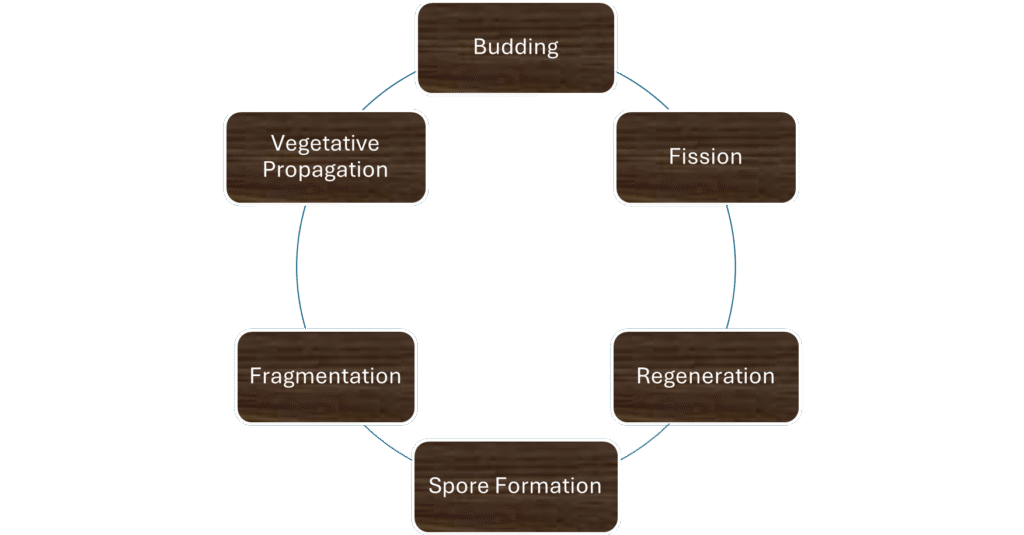
1. FISSION
In this process, a unicellular organism divides into two or more new individuals.
-There are two types of Fission: Binary Fission and Multiple Fission.
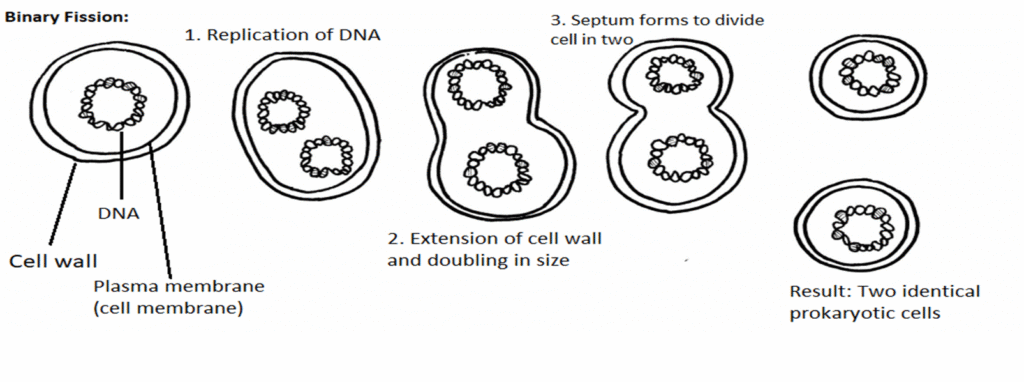
i. Binary Fission:
The parent cell divides into two equal halves. For example: Amoeba
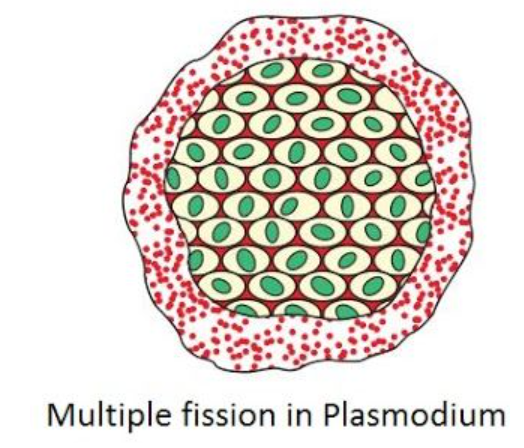
ii. Multiple Fission:
The parent cell divides into many daughter cells. It usually occurs in unfavourable conditions. For example: Plasmodium (malaria parasite)
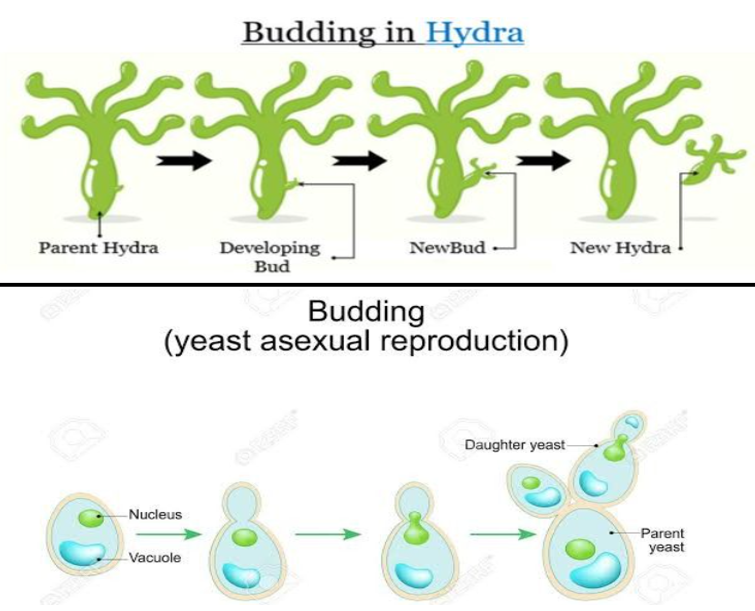
2. BUDDING
In this method, a small outgrowth (bud) develops on the parent’s body, which grows and later detaches to form a new individual.
For Example: Yeast and Hydra
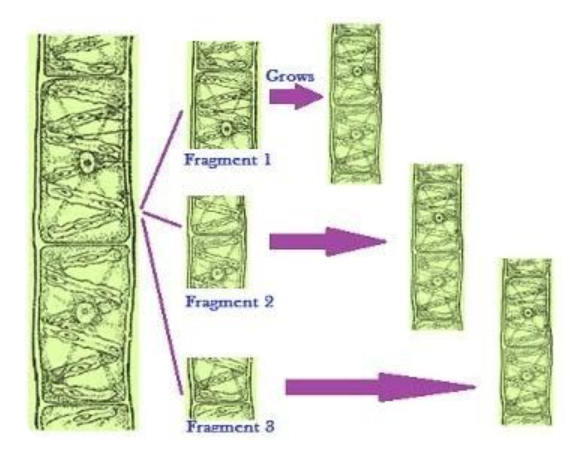
3. FRAGMENTATION
In this process, the body of the parent organism breaks into two or more fragments, and each fragment grows into a new organism. It Occurs only in simple multicellular organisms with simple body organization, not seen in complex animals or plants.
For Example: Spirogyra (algae)
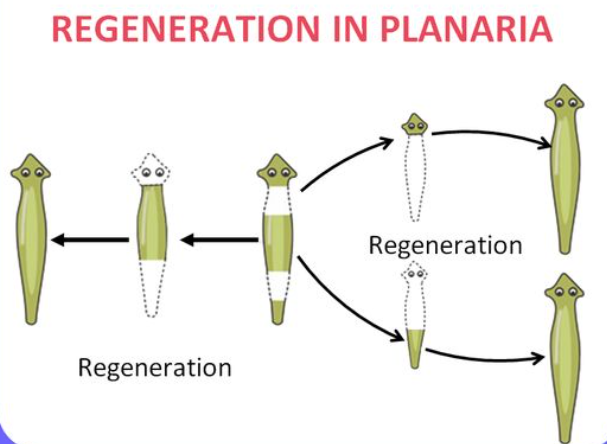
4. REGENERATION
The ability of an organism to regrow lost body parts, and sometimes a whole new organism can be formed from a body fragment. Regeneration occurs through specialized cells that divide and differentiate into new tissues.
For Example: Planaria, and Starfish
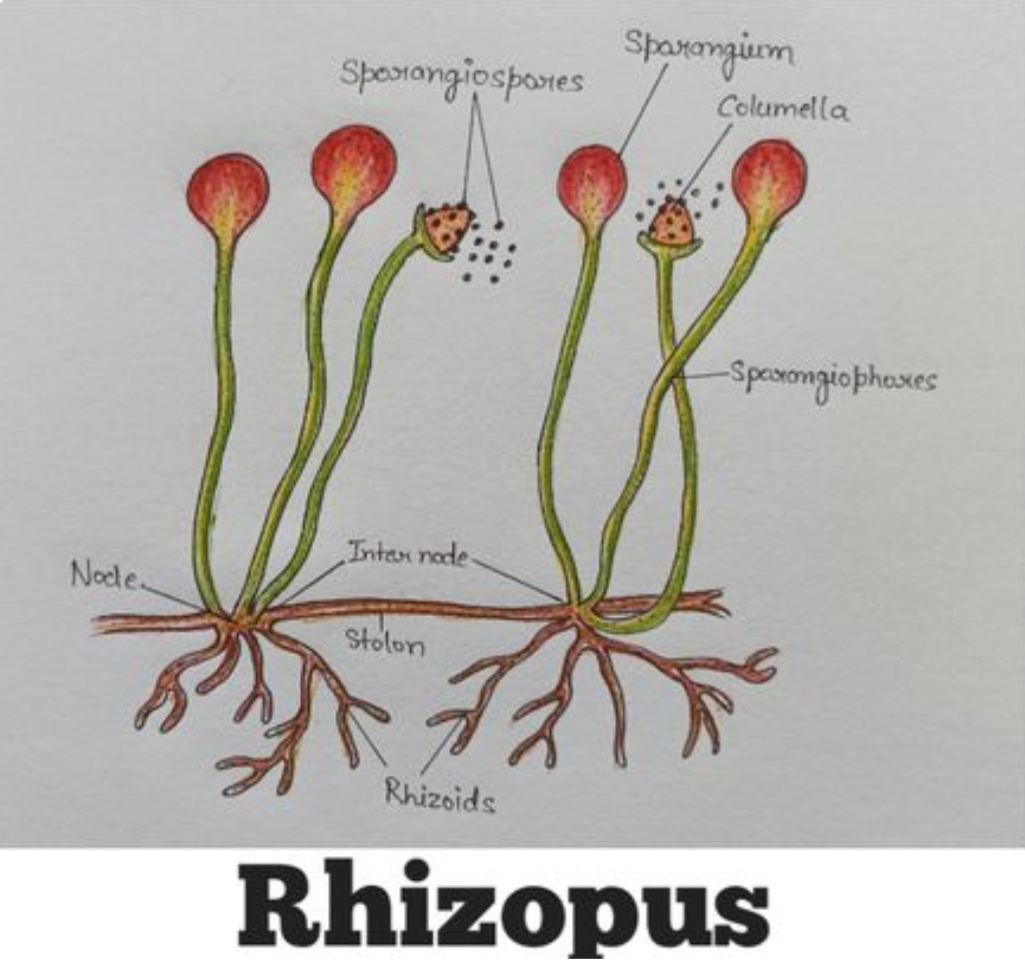
5. SPORE FORMATION
It is a method of asexual reproduction in which the parent produces tiny spherical spores inside a sporangium (spore case).
When the sporangium bursts, the spores spread and grow into new organisms under suitable conditions.
For Example: Rhizopus (Bread Mould)
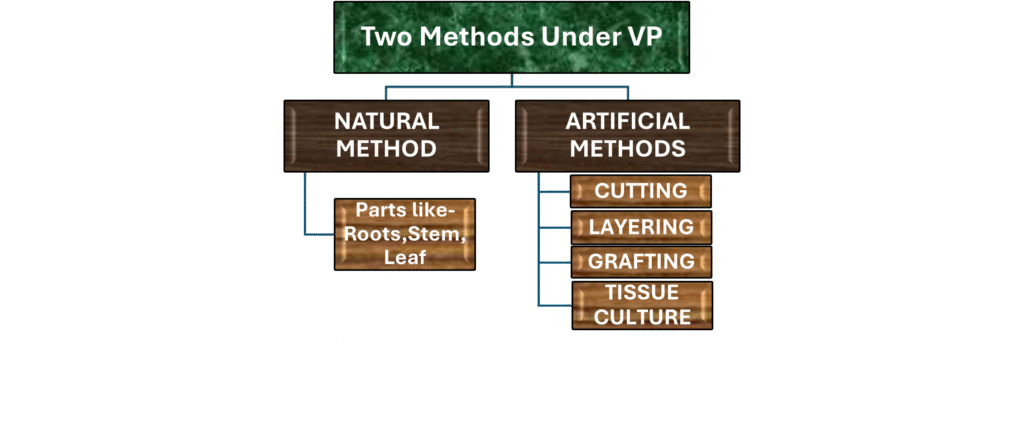
6. VEGETATIVE PROPAGATION (in plants)
It is the asexual reproduction in plants where new plants are produced from vegetative parts like root, stem, leaf, or bud, instead of seeds.
SEXUAL REPRODUCTION
Sexual reproduction is the type of reproduction in which two parents are involved, and fusion of male and female gametes occurs to form a zygote, which later develops into a new individual.
–Sexual reproduction is the most common mode of reproduction in higher plants and animals.
-It involves two parents — one male and one female.
-This process leads to the formation of genetically different offspring due to fusion of gametes and mixing of genetic material.
-It helps in variation, evolution, and survival of species.
SEXUAL REPRODUCTION IN PLANTS
Sexual reproduction in plants involves the fusion of male and female gametes, resulting in the formation of a zygote, which grows into a seed and later forms a new plant. This process ensures variation and continuity of species.
-Reproductive Organ of the Plant:
- Flower is the main reproductive part of a plant.
- It contains male and female reproductive structures.
*Structure of Male and Female Reproductive Parts
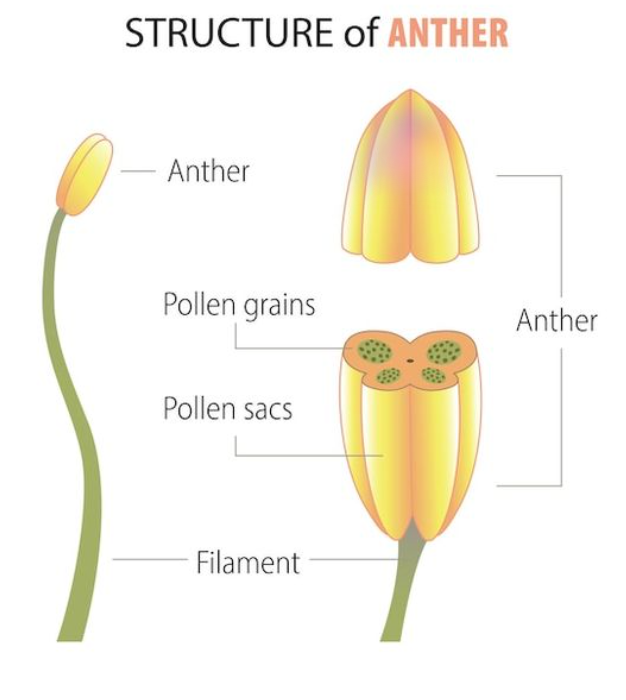
1. Male Part – Stamen
It consists of:
- Anther: Produces pollen grains, which contain male gametes.
- Filament: A stalk that supports the anther
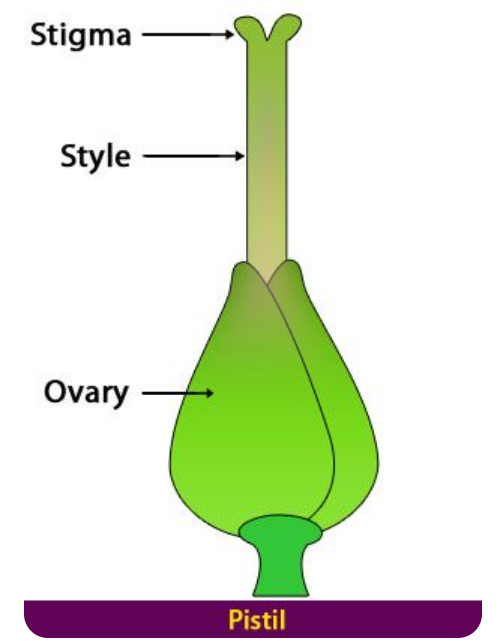
2. Female Part – Carpel / Pistil
It consists of:
- Stigma: Sticky surface to receive pollen grains.
- Style: Tube-like structure that connects stigma to ovary.
- Ovary: Contains ovules, each with an egg cell (female gamete).
*Steps involved in sexual reproduction in plants
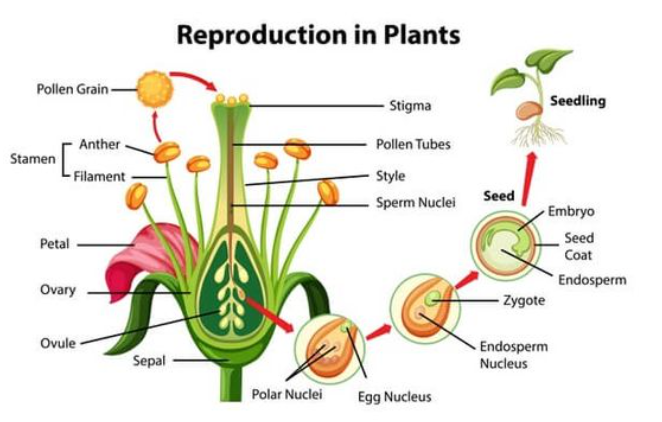
The process occurs in four main stages:
- Pollination
- Fertilization
- Fruit and Seed Formation
- Germination
STEP 1: POLLINATION
Pollination is the process of transferring pollen grains from the anther (male part) to the stigma (female part) of a flower.
– Types of Pollination:
- Self-Pollination: Pollen from the anther lands on the stigma of the same flower or another flower on the same plant.
Example: Pea, Mustard. - Cross-Pollination: Pollen is transferred from one flower to the stigma of another plant of the same species.
Example: Sunflower, Maize.
– Agents of Pollination: Pollination is carried out by wind, water, insects, or birds.
(Bees and butterflies are the most common pollinators)
STEP 2: FERTILIZATION
- When pollen lands on the stigma, it germinates and forms a pollen tube.
- The pollen tube grows down through the style and reaches the ovary.
- The male gamete travels through this tube and fuses with the egg cell (female gamete) inside the ovule.
- This fusion of male and female gametes forms a zygote — the very first cell of the new plant.
- This fusion process is called fertilization.
STEP 3: FRUIT AND SEED FORMATION
After fertilization, many changes take place inside the flower:
- the zygote develops into an embryo.
- The ovule becomes the seed, enclosing the embryo.
- The ovary enlarges and changes into a fruit.
- The fruit protects the seeds and helps in seed dispersal.
- Other floral parts (petals, sepals, stamens) wither and fall off.
- The seed is the future plant — it can germinate under suitable conditions to give rise to a new plant.
STEP 4: GERMINATION
When the seed falls on the soil and gets favourable conditions like air, water, and warmth — it germinates.
The embryo inside the seed starts growing into a new plant, completing the life cycle.
SEXUAL REPRODUCTION IN HUMAN BEING
Reproduction in human beings is a sexual mode of reproduction, involving two parents — a male and a female. It ensures the continuity of human life and the transfer of genetic information from parents to offspring.
This process involves the formation of gametes, their fusion (fertilization), and the development of a new individual from the zygote.
*PUBERTY
-Puberty is the stage when the body becomes capable of reproduction.
-It is controlled by hormones and marks physical, physiological, and emotional changes.
-Generally occurs between:
- Boys: 12–14 years
- Girls: 10–12 years
-Changes at Puberty in Males:
- Growth of hair
- Voice changes
- increase in height and muscle development.
- Reproductive organ development: Testes start producing sperms; penis and scrotum enlarge.
- Shoulders broaden
- chest muscles strengthen
- facial features mature.
- Hormone secretion: Testosterone hormone starts being secreted by testes.
– Changes at Puberty in Females:
- Menstruation begins
- Growth of hair
- Body shape changes
- Development of breasts
- Reproductive organ development: Ovaries start releasing ova
- Hormone secretion: Oestrogen and Progesterone are secreted by ovaries.
*MALE REPRODUCTIVE SYSTEM
The male reproductive system is responsible for the production, storage, and delivery of sperms (male gametes). It also produces the male sex hormone – Testosterone, which controls the development of male features and reproduction.
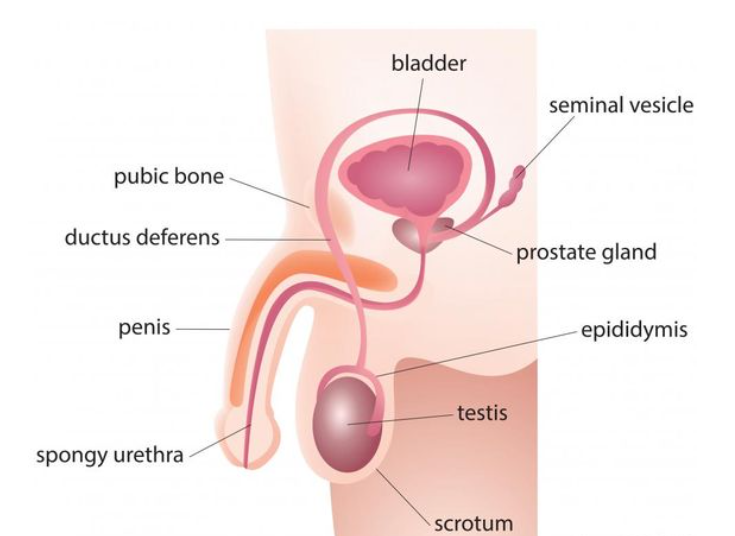
-Testes (singular: Testis):
- Two oval-shaped organs present in a pouch called scrotum outside the body.
- Function: Produce sperms and testosterone hormone.
- The scrotum keeps testes at a temperature 2–3°C lower than body temperature, essential for sperm production.
-Vas Deferens (Sperm Duct):
- A muscular tube that carries sperms from epididymis to the urethra.
- Function: Transports sperms during ejaculation.
-Urethra:
- Common passage for urine and semen.
- Function: Carries sperms and seminal fluid (together called semen) out of the body.
-Penis:
- Muscular organ through which semen is ejaculated.
- Function: Delivers sperms into the female reproductive system.
*FEMALE REPRODUCTIVE SYSTEM
The female reproductive system is designed to produce female gametes (ova or eggs), receive sperms from the male, and provide a safe environment for fertilization and development of the baby.
It also produces female hormones that control reproductive cycles and secondary sexual characteristics.
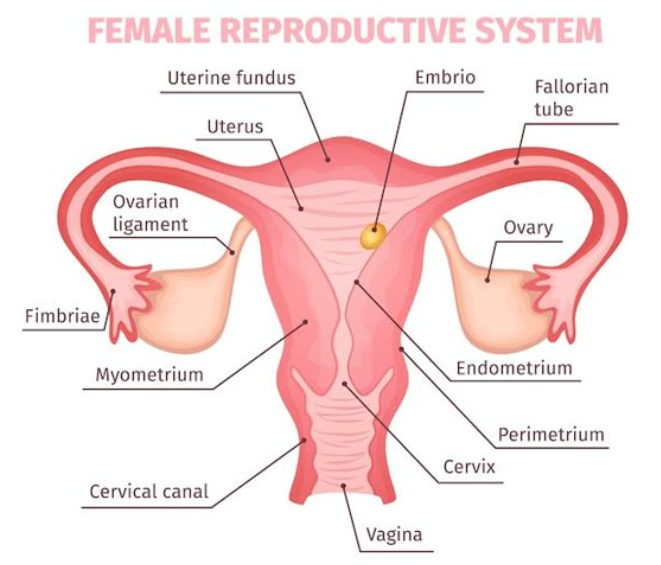
-Ovaries
- A pair of small, oval-shaped organs located in the lower abdomen.
- Functions:
- Produce female gametes (ova/eggs).
- Secrete female hormones — oestrogen and progesterone.
- Every month, one ovary releases a mature egg in a process called ovulation.
-Oviducts (Fallopian Tubes)
- Two narrow tubes that connect the ovaries to the uterus.
- The fimbriae (finger-like ends) of the tube collect the released egg.
- Site of fertilization: The fusion of sperm and egg occurs here to form a zygote.
-Uterus (Womb)
- A pear-shaped muscular organ where the zygote implants and grows into a baby.
- The inner lining (endometrium) becomes thick and spongy every month to prepare for embryo implantation.
- If fertilization does not occur, this lining sheds off during menstruation.
–Cervix
- The narrow opening between the uterus and vagina.
- It controls the passage of sperms into the uterus and holds the baby in place during pregnancy.
-Vagina
- A muscular canal that receives the sperm during sexual intercourse.
- It also serves as the birth canal during the delivery of the baby.
*FERTILIZATION OF EGG
Fertilisation is the process in which the male gamete (sperm) fuses with the female gamete (egg or ovum) to form a zygote, which is the first cell of a new individual. In humans, fertilisation occurs in the fallopian tube (oviduct) of the female reproductive system.
There are two Types of Fertilization:
- External Fertilisation: Takes place outside the body (e.g., fish, frogs).
- Internal Fertilisation: Takes place inside the female body (e.g., humans, birds, mammals).
#Humans show internal fertilisation, i.e., fertilisation takes place inside the female body.
-Process of Fertilisation:
- Ovulation: A mature egg is released from the ovary once every month.
- Sperm Reaches the Egg: Only one sperm out of millions can fuse with the egg.
- Fusion of Nuclei: The nuclei of sperm and egg fuse to form a zygote.
- Formation of Zygote: The zygote now has 46 chromosomes (23 from each parent).
-When the Egg is Fertilised
- The zygote formed starts dividing repeatedly to form a ball of cells called the embryo.
- The embryo moves to the uterus and gets attached to its wall — this process is called implantation.
- The uterine wall thickens to supply nutrients and oxygen to the growing embryo through the placenta.
- The embryo gradually develops into a foetus and then into a baby.
-When the Egg is Not Fertilised
- If no sperm reaches the egg, fertilisation does not occur.
- The unfertilised egg along with the thickened lining of the uterus breaks down and comes out of the body through the vagina.
- This process is called menstruation, which occurs every 28 days approximately.
REPRODUCTIVE HEALTH
Reproductive health means a state of physical, mental, and social well-being in all matters related to the reproductive system.
It includes awareness about safe and hygienic sexual practices, family planning, and prevention of diseases related to reproduction.
*Sexually Transmitted Diseases (STDs)
STDs are infections that spread through sexual contact with an infected person.
Some common STDs are: AIDS (Acquired Immuno Deficiency Syndrome), Hepatitis B, etc.
-Prevention of STDs:
- Avoid unsafe sexual contact.
- Use condoms during intercourse.
- Maintain personal hygiene.
- Avoid sharing needles or razors.
- Go for regular medical check-ups.
- Ensure screened blood during transfusion.
*Methods of Contraception:
The main purpose of these Methods is to prevent unwanted pregnancy, control population growth, and maintain reproductive health.
1. Barrier Methods
- Prevent sperm from reaching the egg.
- Examples:
- Condoms (for males and females)
- Diaphragms, Cervical caps (for females)
- Also protect from STDs like HIV and gonorrhoea.
2. Chemical Methods
- Use of oral pills or injections containing hormones (estrogen & progesterone).
- Prevent release of ovum (egg) and fertilization.
- Example: Oral contraceptive pills.
3. Intrauterine Devices (IUDs)
- Devices placed in the uterus.
- Example: Copper-T, Loop.
- Prevent fertilization and implantation of zygote.
4. Surgical Methods (Permanent)
- Used by couples who don’t want more children.
- Vasectomy → cutting the vas deferens in males.
- Tubectomy → cutting the fallopian tubes in females.
- Permanent and highly effective.
FEMALE FOETICIDE
Female foeticide is the illegal killing or abortion of a female fetus after determining its sex. It is done before birth and is a serious social and moral crime. It reflects gender discrimination in society.