INTRO- GRAVITATION
–Gravitation is a natural phenomenon by which every object in the universe attracts every other object with a force that acts along the line joining their centres.
-This force of mutual attraction between two masses is called the gravitational force.
-Everybody that has mass exerts an attractive force on every other body in the universe.
-The magnitude of this force depends on:
- The masses of the two bodies
- The distance between their centres.
#The greater the masses, the stronger the attraction; the larger the distance, the weaker the force.
-The idea of gravitation was explained by Sir Isaac Newton in 1687.
(He discovered that the same force that causes an apple to fall to the ground also holds the Moon in orbit around the Earth and the planets in orbit around the Sun. This inspired him to create the Universal Law of Gravitation, which mathematically defines the force.)
*Nature of the Gravitational Force
| Property | Description |
| Type of Force | Non-contact (acts without physical contact) |
| Direction | Always acts along the line joining the centres of two bodies |
| Nature | Always attractive, never repulsive |
| Range | Infinite (though becomes very weak with distance) |
| Strength | Weak compared to other fundamental forces (e.g., electromagnetic) |
*Difference Between Gravitation and Gravity
| Basis | Gravitation | Gravity |
| Definition | The universal force of attraction between any two bodies in the universe. | The gravitational force specifically exerted by the Earth on objects near its surface. |
| Scope | Universal – acts between any two masses. | Local – acts only near the Earth. |
| Example | Attraction between the Sun and Earth. | Attraction between Earth and an apple. |
Newton’s Universal Law of Gravitation
Newton’s Universal law of gravitation states that every object in the universe attracts every other object with a force that is directly proportional to the product of their masses and inversely proportional to the square of the distance between their centres.
Let two objects of masses m1 and m2 be separated by a distance .
Then, according to Newton’s law,

To remove proportionality, a constant G (the universal gravitational constant) is introduced:
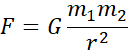
Where, G = 6.67×10⁻¹¹ Nm2/kg2
*Relation between Newton’s third law of motion and Newton’s law of gravitation
-Newton’s third law of motion: According to Newton’s third law of motion, “Every object exerts equal and opposite force on other object but in opposite direction.”
–Newton’s law of gravitation: According to Newton’s law of gravitation, “Every mass in the universe attracts every other mass.”
In case of freely falling stone and earth, stone is attracted towards earth means earth attracts the stone. But according to Newton’s third law of motion, the stone should also attract the earth.
It is true that stone also attracts the earth with the same force F = m × a but due to very less mass of the stone, the acceleration (a) in its velocity is 9.8 m/s2 and acceleration (a) of earth towards stone is 1.65×10⁻²⁴ m/s2 which is negligible and we cannot feel it.
*Importance of Universal Law of Gravitation
- It explains the existence of weight of objects on Earth.
- It explains the motion of the Moon around the Earth.
- It explains the motion of planets around the Sun.
- It helps in understanding the formation of tides in seas and oceans.
- It explains the free fall of objects towards the Earth.
FREE FALL OF AN OBJECT AND ACCELERATION DUE TO GRAVITY
Free fall is the motion of a body when it falls towards the Earth under the influence of gravitational force only, with no other force (like air resistance) acting on it.
When an object is thrown upward, it reaches certain height, then it starts falling down towards earth. It is because the earth’s gravitational force exerts on it. This fall under the influence of earth is called ‘free fall of an object’.
During this free fall direction do not change but velocity continuously changes which is called acceleration due to gravity. It is denoted by ‘g’. Its unit is same as acceleration m/s2.
*Derivation for Acceleration Due to Gravity
From Newton’s law of gravitation:
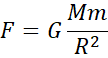
According to Newton’s second law of motion:

For a freely falling body:
Equating both forces:
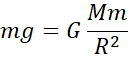
Cancelling m from both sides:

Formula:
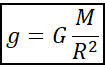
*The Value of acceleration due to gravity (g)

where,
- G= 6.67×10⁻¹¹
- M=6.0 ×1024 kg (mass of Earth)
- R= 6.4 × 10⁶ m (radius of Earth)
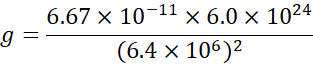
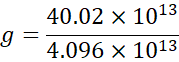
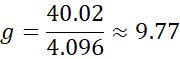

*Difference Between Gravitational constant (G) and Acceleration due to gravity (g)
| Basis of Difference | Universal Gravitational Constant (G) | Acceleration Due to Gravity (g) |
| 1. Definition | It is a constant that measures the strength of the gravitational force between any two bodies in the universe. | It is the acceleration produced in a body when it falls freely under the influence of Earth’s gravity. |
| 2. Formula | | |
| 3. Nature | It is a universal constant, same everywhere in the universe. | It varies from place to place (depends on height, depth, and latitude). |
| 4. Value | G= 6.67×10⁻¹¹ | |
| 5. Depends On | It does not depend on mass, distance, or location. | It depends on the mass and radius of the Earth. |
| 6. Type of Quantity | Scalar quantity (has only magnitude). | Vector quantity (has magnitude and direction — toward Earth’s center). |
| 7. Symbol | G | g |
| 8. Unit | N·m²/kg² | m/s² |
| 9. Discovery | Discovered by Sir Isaac Newton. | Measured experimentally on Earth. |
| 10. Variation | Remains constant throughout the universe. | Decreases with altitude and depth; increases at poles. |
*Equations of Motion for a Freely Falling Body
The same kinematic equations apply, replacing a by g:
- v = u + gt
- s = u t + ½ g t²
- v²- u² = 2 gs
#For Object Falling Downward
- g is taken as positive (+g).
#For Object Thrown Upward
- g is taken as negative (–g) because it acts opposite to the direction of motion.
*Factors Affecting the Value of g
- Altitude (Height):
g decreases with increase in height from Earth’s surface. - Depth:
g decreases slightly below the Earth’s surface. - Latitude:
g is maximum at the poles and minimum at the equator. - Shape of Earth:
Earth is not a perfect sphere (slightly flattened at poles), hence g varies.
MASS AND WEIGHT
*MASS
- Mass is the amount of matter contained in a body.
- It is a fundamental property of matter that does not change with place or position.
- Mass of a body is constant and does not change from place to place.
- Mass of a body is usually denoted by the small ‘m’.
- Mass of a body cannot be zero.
- Mass is a scalar quantity which has only magnitude but no direction.
- SI unit of mass is kg.
- Formula: m=w/g
*WEIGHT
- Weight is the gravitational force with which the Earth attracts a body towards its center.
- Weight is a Vector quantity which has both magnitude and direction.
- Weight always acts toward the center of the Earth.
- Weight changes from place to place (depends on the value of
)
- SI Unit of weight is newton (N)
- Formula: w=m x g
*Difference Between Mass and Weight
| Basis | Mass | Weight |
| Definition | Amount of matter contained in a body. | Force with which Earth attracts a body towards its center. |
| Formula | m=w/g | W = mg |
| Nature | Scalar quantity. | Vector quantity (acts downward). |
| Unit (SI) | Kilogram (kg). | Newton (N). |
| Value | Constant everywhere. | Varies from place to place (depends on (g)). |
| Measuring Instrument | Beam balance. | Spring balance. |
| Zero Condition | Never zero (matter cannot vanish). | Becomes zero where (g = 0) (e.g., space). |
| On Moon | Same as on Earth. | 1/6 of weight on Earth. |
THRUST AND PRESSURE
When a force acts perpendicularly on a surface, it creates an effect known as thrust.
The effect of thrust per unit area on a surface is called pressure.
*Thrust
- It is the normal component of force that acts on a given area.
- Thrust is a vector quantity (has both magnitude and direction).
- Direction of thrust is perpendicular to the surface.
- Greater the force, greater the thrust.
- Thrust = Force = F
- SI Unit of thrust is Newton (N)
*Pressure
- Pressure is the thrust (or force) acting per unit area of the surface.
- P = Thrust/Area
- For the same thrust, smaller area → greater pressure.
- For same area, greater thrust → greater pressure.
- Factors Affecting Pressure
- Force applied (Thrust): P∝F
- Area of Contact: P∝1/A
- SI Unit of Pressure is Pascal (Pa).
- Small area → High pressure
- Large area → Low pressure
*Examples of Pressure
- Sharp Knife – Area ↓ → Pressure ↑ → Cuts easily
- Nail / Pin – Area ↓ → Pressure ↑ → Enters wood easily
- Building / Tank Base – Area ↑ → Pressure ↓ → Doesn’t sink
- Tractor Tires – Area ↑ → Pressure ↓ → Doesn’t sink in soil
- Snow Shoes – Area ↑ → Pressure ↓ → Doesn’t sink in snow
- Bag Straps – Area ↑ → Pressure ↓ → Shoulders don’t hurt
- Needle Tip – Area ↓ → Pressure ↑ → Pierces skin easily
- Axe / Blade – Area ↓ → Pressure ↑ → Cuts easily
- Camel’s Feet – Area ↑ → Pressure ↓ → Walks easily on sand
- Dam Bottom – Depth ↑ → Pressure ↑ → Dam made thicker below
BUYONCY
The upward force exerted by a liquid (or fluid) on an object when it is partially or completely immersed in it is called buoyant force, and the property of a fluid to exert this upward force is called buoyancy.
It acts opposite to the weight of the object. The object appears lighter in water because of this buoyant force.
# If Buoyant Force = Weight of Object → Object floats.
# If Buoyant Force < Weight of Object → Object sinks.
-Factors Affecting Buoyant Force
- Volume of the object immersed in the fluid — more volume → more buoyant force.
- Density of the fluid — denser fluid → greater buoyant force.
-Examples of Buoyancy
- A ship floats on water due to buoyant force.
- A balloon rises in air due to buoyant force of air.
- An iron nail sinks but a ship (made of iron) floats because of shape and displaced water volume.
DENSITY
-Density is defined as the mass per unit volume of a substance.
-It tells how much matter (mass) is present in a given amount of space (volume).
-Density tells how tightly particles of a substance are packed.
-A substance with high density has more particles in a given volume.
-A substance with low density has fewer particles in the same volume.
-Formula: Density = mass/volume
-SI Unit of density is kg/m³
-If density of object < density of fluid → object floats.
-If density of object > density of fluid → object sinks.
ARCHIMEDES’ PRINCIPLE
When a body is partially or completely immersed in a fluid, it experiences an upward force (buoyant force) equal to the weight of the fluid displaced by the body.
*Applications of Archimedes’ Principle
- Used to design ships and submarines – ensures they float safely.
- Used to find relative density of solids and liquids.
- Used in hydrometers to measure the density of liquids.
- Explains why objects appear lighter when submerged in water.
- Used in making hot-air balloons – buoyant force of air helps them rise.
RELATIVE DENSITY
Relative Density (R.D.) is the ratio of the density of a substance to the density of water.
It shows how many times a substance is heavier or lighter than water for the same volume.

Relative density tells us how dense a material is compared to water.
- If R.D. > 1, the substance is denser than water → it sinks.
- If R.D. < 1, the substance is less dense than water → it floats.