Manufacturing

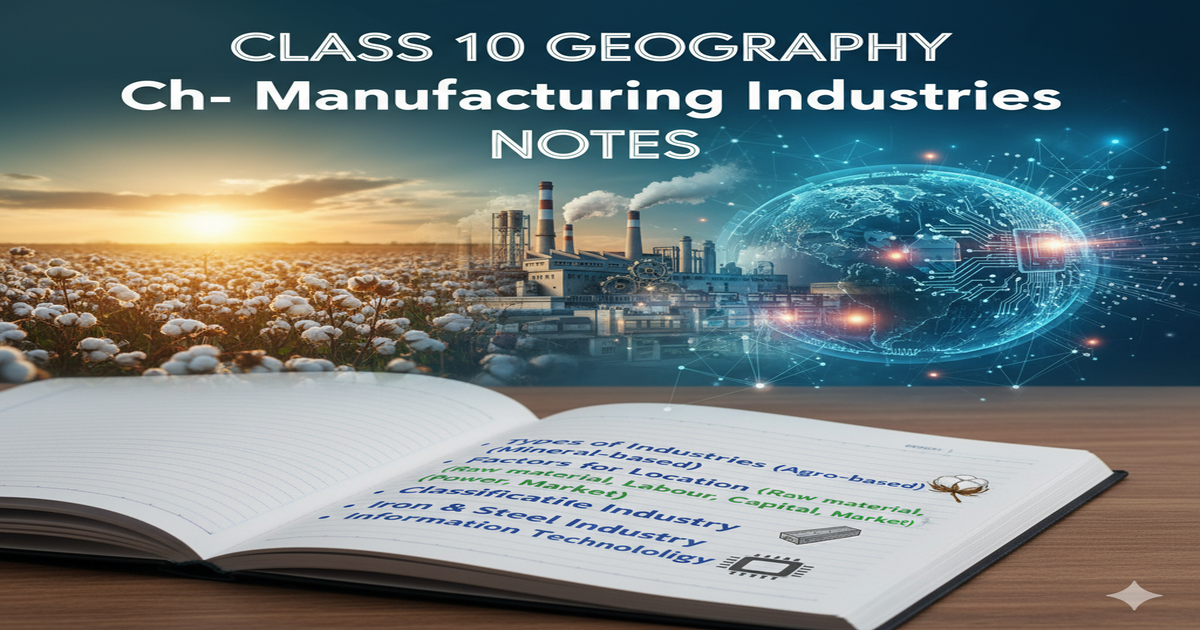
CLASS 10 GEOGRAPHY Ch- Manufacturing Industries | NOTES

INTRO- MANUFACTURING The term “Manufacturing” comes from two Latin words- ‘Manu’ means hand and ‘facture’ means to make. It means producing goods in large quantities from raw materials and adding value to them through processing, machinery, and labour. It is a secondary activity because it converts primary materials (from agriculture, mining, etc.) into finished products. *Relation Between Agriculture and Industry Agriculture and industry are interdependent:          #Both sectors support each other’s growth and sustainability. IMPORTANCE OF MANUFACTURING Manufacturing plays a vital role in the economic and social development of a nation. CONTRIBUTION OF MANUFACTURING TO NATIONAL ECONOMY INDUSTRIAL LOCATION Industrial location refers to the specific place or area where an industry is set up. Industries tend to locate where all necessary inputs are easily and cheaply available. According to Alfred Weber’s Industrial Location Theory, “An industry is located at a place where the cost of production and transportation is minimum.” *Factors Affecting the Location of Industries Industries do not grow everywhere — they develop where conditions are favourable.The major factors are given below. 1. Availability of Raw Materials 2. Labour (Manpower) 3. Power (Energy Source) 4. Capital (Investment) 5. Market 6. Transport and Communication 7. Government Policies 8. Industrial Climate (Social and Political Stability) *Industrial Clusters or Agglomeration -When several industries are set up close to each other for mutual benefit, it is called industrial agglomeration. -These areas become industrial hubs or regions. -Example: CLASSIFICATION OF INDUSTRIES Industries can be classified or grouped on different bases such as raw materials, capital investment, ownership, and size.This helps in understanding their nature, functioning, and contribution to the economy. AGRO-BASED INDUSTRIES Agro-based industries are industries that use agricultural products as raw materials. They form a strong link between agriculture and industry, and are the largest group of industries in India. These industries process agricultural raw materials into finished or semi-finished goods that can be used by consumers or other industries. 1. Textile Industry 2. Cotton Textile Industry 3. Jute Industry 4. Sugar Industry MINERAL BASED INDUSTRIES 1. Iron and Steel Industry 2. Aluminium Smelting 3. Chemical Industries 4. Fertiliser Industry 5. Cement Industry 6. Automobile Industry 7. Information Technology and Electronics Industry INDUSTRIAL POLLUTION AND ENVIRONMENTAL DEGRADATION Industrial pollution refers to the contamination of the environment due to harmful by-products released from industries into air, water, and soil.  Industries are responsible for four types of pollution: Air, Water, Land, Noise *Measures to Control Industrial Pollution To reduce pollution and promote sustainable development, the following steps are essential:

Read More
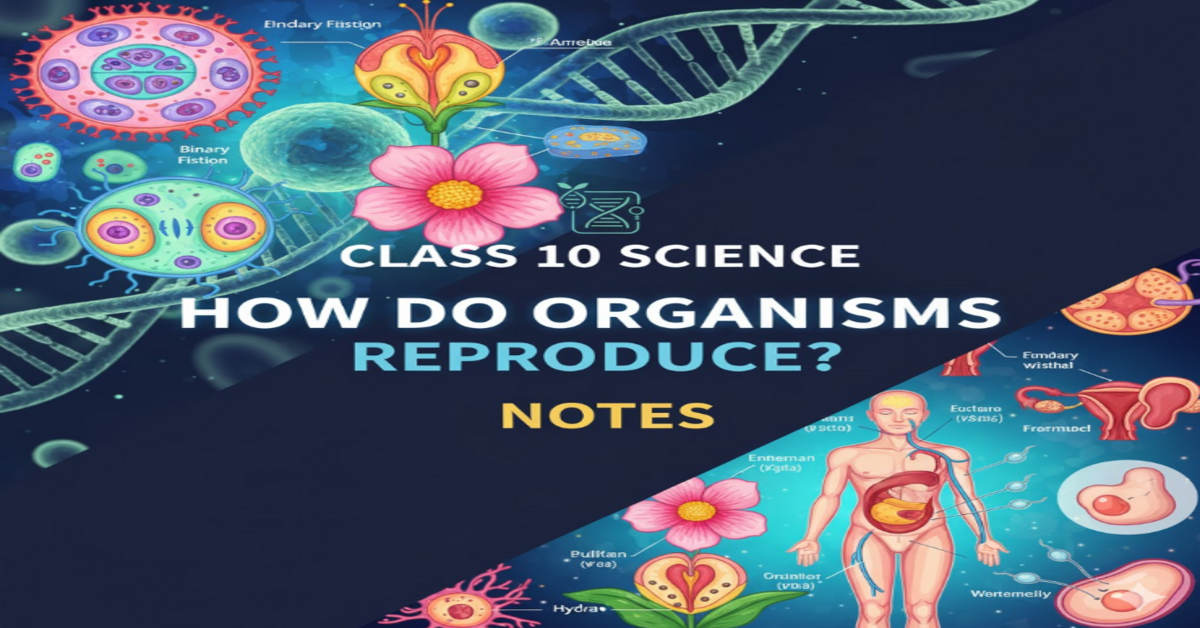
Reproduction

CLASS 10 SCIENCE Chapter- How do Organism Reproduce | NOTES

INTRODUCTION– Reproduction Reproduction is the biological process by which new individuals (offspring) are produced from their parents. It ensures the continuity of life on Earth. Reproduction is a life process, but not essential for survival of an individual — it is essential for the survival of species. DNA (Deoxyribonucleic Acid), present in the nucleus of every cell, is the hereditary molecule that carries genetic information, gets copied during reproduction, and ensures continuity and variation in organisms. TYPES OF REPRODUCTION 1. ASEXUAL REPRODUCTION Asexual reproduction is the type of reproduction in which only one parent is involved and no fusion of gametes takes place.The offspring produced are genetically identical to the parent, i.e., they are exact copies or clones of the parent. *Characteristics of Asexual Reproduction *Advantages of Asexual Reproduction: *Disadvantages of Asexual Reproduction: 2. SEXUAL REPRODUCTION Sexual reproduction is the type of reproduction in which two parents (male and female) are involved and fusion of male and female gametes occurs to form a zygote, which develops into a new organism.The offspring produced show variations because they inherit genetic material from both parents. *Characteristics of Sexual Reproduction: *Advantages of Sexual Reproduction: *Disadvantages of Sexual Reproduction: METHODS OF ASEXUAL REPRODUCTION 1. FISSION In this process, a unicellular organism divides into two or more new individuals. -There are two types of Fission: Binary Fission and Multiple Fission. i. Binary Fission: The parent cell divides into two equal halves. For example: Amoeba ii. Multiple Fission: The parent cell divides into many daughter cells. It usually occurs in unfavourable conditions. For example: Plasmodium (malaria parasite) 2. BUDDING In this method, a small outgrowth (bud) develops on the parent’s body, which grows and later detaches to form a new individual. For Example: Yeast and Hydra 3. FRAGMENTATION In this process, the body of the parent organism breaks into two or more fragments, and each fragment grows into a new organism. It Occurs only in simple multicellular organisms with simple body organization, not seen in complex animals or plants. For Example: Spirogyra (algae) 4. REGENERATION The ability of an organism to regrow lost body parts, and sometimes a whole new organism can be formed from a body fragment. Regeneration occurs through specialized cells that divide and differentiate into new tissues. For Example: Planaria, and Starfish 5. SPORE FORMATION It is a method of asexual reproduction in which the parent produces tiny spherical spores inside a sporangium (spore case).When the sporangium bursts, the spores spread and grow into new organisms under suitable conditions. For Example: Rhizopus (Bread Mould) 6. VEGETATIVE PROPAGATION (in plants) It is the asexual reproduction in plants where new plants are produced from vegetative parts like root, stem, leaf, or bud, instead of seeds. SEXUAL REPRODUCTION Sexual reproduction is the type of reproduction in which two parents are involved, and fusion of male and female gametes occurs to form a zygote, which later develops into a new individual. –Sexual reproduction is the most common mode of reproduction in higher plants and animals. -It involves two parents — one male and one female. -This process leads to the formation of genetically different offspring due to fusion of gametes and mixing of genetic material. -It helps in variation, evolution, and survival of species. SEXUAL REPRODUCTION IN PLANTS Sexual reproduction in plants involves the fusion of male and female gametes, resulting in the formation of a zygote, which grows into a seed and later forms a new plant. This process ensures variation and continuity of species. -Reproductive Organ of the Plant: *Structure of Male and Female Reproductive Parts 1. Male Part – Stamen It consists of: 2. Female Part – Carpel / Pistil It consists of: *Steps involved in sexual reproduction in plants The process occurs in four main stages: STEP 1: POLLINATION Pollination is the process of transferring pollen grains from the anther (male part) to the stigma (female part) of a flower. – Types of Pollination: – Agents of Pollination: Pollination is carried out by wind, water, insects, or birds.(Bees and butterflies are the most common pollinators) STEP 2: FERTILIZATION STEP 3: FRUIT AND SEED FORMATION After fertilization, many changes take place inside the flower: STEP 4: GERMINATION When the seed falls on the soil and gets favourable conditions like air, water, and warmth — it germinates.The embryo inside the seed starts growing into a new plant, completing the life cycle. SEXUAL REPRODUCTION IN HUMAN BEING Reproduction in human beings is a sexual mode of reproduction, involving two parents — a male and a female. It ensures the continuity of human life and the transfer of genetic information from parents to offspring. This process involves the formation of gametes, their fusion (fertilization), and the development of a new individual from the zygote. *PUBERTY -Puberty is the stage when the body becomes capable of reproduction. -It is controlled by hormones and marks physical, physiological, and emotional changes. -Generally occurs between: -Changes at Puberty in Males: – Changes at Puberty in Females: *MALE REPRODUCTIVE SYSTEM The male reproductive system is responsible for the production, storage, and delivery of sperms (male gametes). It also produces the male sex hormone – Testosterone, which controls the development of male features and reproduction. -Testes (singular: Testis): -Vas Deferens (Sperm Duct): -Urethra: -Penis: *FEMALE REPRODUCTIVE SYSTEM The female reproductive system is designed to produce female gametes (ova or eggs), receive sperms from the male, and provide a safe environment for fertilization and development of the baby.It also produces female hormones that control reproductive cycles and secondary sexual characteristics. -Ovaries -Oviducts (Fallopian Tubes) -Uterus (Womb) –Cervix -Vagina *FERTILIZATION OF EGG Fertilisation is the process in which the male gamete (sperm) fuses with the female gamete (egg or ovum) to form a zygote, which is the first cell of a new individual. In humans, fertilisation occurs in the fallopian tube (oviduct) of the female reproductive system. There are two Types of Fertilization: #Humans show internal fertilisation, i.e., fertilisation takes place inside the female body. -Process of Fertilisation: -When the Egg is Fertilised -When the…

Read More
Globalization

CLASS 10 ECONOMICS Chapter- GLOBALIZATION AND INDIAN ECONOMY | NOTES

INTRO- GLOBALIZATION Globalization means the process of integration or interconnection between countries through the movement of goods, services, people, capital (money), and information. In simple terms, it is the process that turns the world into one large market — where countries are connected economically and culturally. “Globalization is the process by which the world’s economies, societies, and cultures are becoming interconnected through increased cross-border trade, investment, and communication.” Globalization has grown to include far more than just trade. This includes: Multinational Corporations (MNCs) are the main driving force behind globalization. MNCs play a central role in connecting national economies and spreading globalization. MULTINATIONAL CORPORATIONS (MNCs) An MNC is a company that owns or controls production and business operations in more than one country. It is also known as Transnational Corporation. *Aims / Objectives of MNCs *Role of MNCs in Globalization *Benefits from MNCs to Local Companies Benefits Explanation / Example 1. Capital Investment MNCs bring foreign money that helps local companies expand business and production. 2. Transfer of Technology Local firms get access to advanced machines and modern production methods. 3. Better Skills and Standards Workers and managers learn new techniques and improve quality of work. 4. Increased Demand for Local Goods MNCs buy raw materials and parts from local suppliers, creating new business. 5. New Business Opportunities Local small businesses grow as suppliers, transporters, or service providers. 6. Access to Global Markets Collaboration with MNCs helps local firms export goods and enter global trade. 7. Improved Competitiveness Local companies upgrade quality and efficiency to compete globally. IMPACT OF GLOBALIZATION Positive Impacts Negative Impacts 1. More foreign investment 1. Unequal benefits 2. Expanded markets 2. Loss to small industries 3. Advanced technology 3. Job insecurity 4. More employment 4. Environmental damage 5. Growth of Indian companies 5. Cultural erosion 6. Better quality & lower prices 6. Rural sector left behind 7. Global exchange of ideas 7. Economic dependence FACTORS THAT ENABLED GLOBALIZATION 1. Rapid Improvement in Technology 2. Liberalization of Foreign Trade and Investment Policy 3. Role of Multinational Companies (MNCs) 4. Growth of Communication Networks 5. Development of Global Financial Systems 6. Trade Agreements and International Organizations 7. Political and Economic Reforms in Developing Countries NEW ECONOMIC POLICY 1991 It was Introduced in 1991 by the government of India under Prime Minister P. V. Narasimha Rao and Finance Minister Dr. Manmohan Singh. The New Economic Policy of 1991 marked a major turning point in India’s economic history. It shifted India from a closed and controlled economy to an open and market-oriented economy. Reason: India faced a serious economic crisis – low foreign exchange, high inflation, and high debt. The main feature of NEP 1991 was LPG policy – Liberalization, Privatization, Globalization.

Read More
Political Parties class 10 notes

CLASS 10 CIVICS Chapter-4 POLITICAL PARTIES | NOTES

MEANING OF POLITICAL PARTIES A political party is an organised group of people with shared political views and ideologies who join together to contest elections and maintain power in government. They agree on certain policies and programmes aimed at increasing societal well-being. Why Do We Need Political Parties? 1. Democracy Cannot Function Without Them If there are no parties, no one will be responsible for how the country is run. And     government will become unstable and directionless. 2. They Represent Different Opinions Parties make sure that they will represent society’s diverse views, interest, and opinion. 3. They Make Policies and Run Government Ruling party makes laws and policies for the country. Whereas, Opposition checks and criticises the ruling party. This will ensure the accountability. 4. They Provide Choices to Voters Political parties provide citizens with different options of leaders, programmes and policies. 5. They Form a Link Between Government and People We need Political Parties as they act like a bridge between government and citizens by raising demands and problems of the people. COMPONENTS OF POLITICAL PARTIES A political party is not just its leaders but a combination of leaders + active members + followers. All three components are necessary for the functioning and success of a party. Functions of Political Parties 1. Contest ElectionsParties nominate and campaign for candidates to win elections and implement programs. 2. Create policies and programmesEach party develops policies and programs to address public issues, providing voters with clear options for the country’s future direction. 3. Making LawsParties in power shape policies that reflects their ideology and promises. 4. Establish and Run GovernmentThe majority party (or coalition) establishes the government, manages ministries, and implements policies, while the opposition checks its actions. 5. Shape Public OpinionParties employ rallies, campaigns, debates, and media to influence and guide people on important national and social issues. 6. Give people access to the governmentParties serve as bridges between the government and citizens, fighting for their needs and facilitating access to government programs and services. Types of Party System A party system refers to how political parties are organised and run in a country, including how many parties compete, share power, and influence policies. Political scientists divide party systems into three categories based on the number of parties and the nature of competition: 1. One-Party System -Definition: A system where only one political party exists or dominates all levels of government. -Features: -Examples: China (Communist Party), North Korea (Workers’ Party). -Pros: Ensures stability -Cons: limits freedom of choice and disagreement. 2. Two-Party System -Definition: A system where two major parties dominate national politics. -Features: -Examples: USA (Democrats & Republicans), UK (Conservatives & Labour). -Pros: Gives political stability and clear policies, limits fragmentation of votes. -Cons: Minorities and smaller groups may be underrepresented. 3. Multi-Party System -Definition: A system where multiple political parties compete for power at national and state levels. -Features: -Examples: India, Italy, Israel. -Pros: -Cons: Can lead to unstable governments if coalitions are weak or short-lived. Types of Political Parties Political parties can be classified based on their scope of influence and operation in a country. In India and most democracies, they are mainly of two kinds: *National Party -A national party is a political party that runs in several states and has a large national following. If these parties secure a majority of seats in the Lok Sabha, they will be able to form the central government. These political parties are referred to as “recognised political parties” because the Election Commission of India (ECI) has recognised them. –Criteria for a National Party A political party is recognised as a National Party in India if it has a widespread presence across the country. According to the Election Commission of India, a party can be recognised as a national party if it fulfil any one of the following: OR  OR –National Parties in India (2024–25) 1. Bharatiya Janata Party (BJP) 2. Indian National Congress (INC) 3. Bahujan Samaj Party (BSP) 4. Communist Party of India (Marxist) – CPI(M) 5. Aam Aadmi Party (AAP) 6. National People’s Party (NPP) *State/Regional Party A state party, sometimes known as a regional party, is a type of political party that is only accepted in one or a small number of Indian states. These parties primarily serve the interests of their respective states or regions, but through alliances, they can also have a significant impact on national politics. Examples of State Parties in India POLITICAL ALLIANCES When two or more political parties join together to run for election and form a government, this is known as a political alliance. If they win, they agree to share power and work together on a single program. -Examples of Alliances in India -Need for Alliances ROLE OF OPPOSITION The party or parties that do not control the government but are well-represented in the legislature are known as the opposition parties. The Leader of the Opposition is the major party that is not in power; it is officially recognised if it holds at least 10% of the seats in the Lok Sabha. Functions / Importance of Opposition SIGNIFICANCE OF POLITICAL PARTIES IN DEMOCRACY Political parties are called the “backbone of democracy” because without them democracy cannot function. So, their Significance/Importance in Democracy are as follow: POLITICAL PARTY REFORM Political parties are very important in a democracy because they run governments, represent people, and give choices in elections. But sometimes, parties face problems like corruption, family rule, and misuse of money. That is why political party reforms are needed. *Why Do We Need Political Party Reforms? Political parties need reforms because: *How Can Political Parties Be Reformed? 1. Legal Reforms (By Law) 2. Institutional Reforms (By Election Commission & Constitution) 3. Voluntary / Social Reforms (By People & Parties) *Some suggestions to reform political parties CHALLENGES TO POLITICAL PARIES 1. Dynastic Succession: 2. Money and Muscle Power: 3. Lack of Internal Democracy: 4. Influence of Rich and Powerful Groups: 5. Corruption and Declining Credibility: 6. Fragmentation of Votes: 7. Frequent Splits in Parties: 8.…

Read More
CLASS 10 Science Chapter- HUMAN EYE and Colourful World

CLASS 10 Science | Chapter- HUMAN EYE and Colourful World | NOTES

INTRODUCTION: HUMAN EYE -The human eye is a sensory organ that allows us to see objects around us. -It operates like a camera, forming an image of an item on the retina. -The retina is the eye’s light-sensitive screen, where images are created. -The image created is real, inverted, and smaller in size; but our brain interprets it as upright. -The eye lens is convex in shape, and the focus length may be changed to observe both nearby and distant things. -The average adult human eye has a focus length of around 2 cm and a diameter of approximately 2.3 cm. -The human eye can see objects clearly from around 25 cm (near point) to infinity (far point). Check out related Question-Answers: Visit QnA.Gyanora.in or PARTS OF HUMAN EYE Cornea Iris Pupil Eye Lens Retina Ciliary Muscles Optic Nerve Aqueous Humour Vitreous Humour Check out related Question-Answers: Visit QnA.Gyanora.in or HUMAN EYE WORK AS A CAMERA The human eye works like a camera in many ways, like: 1.The Lens of the Eye: Just as a camera lens focusses light, your cornea and eye lens bend light rays to create a sharp image inside. 2. The Aperture: The aperture in a camera determines how much light enters. The pupil in your eye performs this function. The pupil contracts in bright sunshine and expands in low light. 3. The shutter: Cameras employ shutters to open and close. Your eyelids act as natural shutters, shielding your eyes and providing slumber. 4. The Film or Screen: Camera capture images on a film or sensor. Your eye contains a retina, a particular light-sensitive screen that collects images. 5. The Focus System: In cameras, we can adjust the focus manually or automatically. The ciliary muscles in your eyes do this instantly. They change the lens to allow you to view both your book and the stars. 6. The Brain as a Memory Card: Just like a camera stores photographs on a memory card, your optic nerve transports image information to the brain, where they are stored and processed. Check out related Question-Answers: Visit QnA.Gyanora.in or NEAR POINT OR LEAST DISTANCE OF DISTINCT VISION -The near point of the human eye is the shortest distance at which an item can be clearly perceived without effort. -It is also known as the minimum distance of clear eyesight. -The near point for a normal healthy adult is about 25 cm away. -Objects closer than 25 cm appear blurred because the eye lens is unable to correctly focus light on the retina. -At the nearest point: -Symbolically, D = 25 cm. *Accommodation of the Eye:   Check out related Question-Answers: Visit QnA.Gyanora.in or DEFECT OF VISION AND CORRECTION 1.MYOPIA (Near Sightedness) –Myopia, also referred to as near sightedness, is a vision condition in which a person is able to see nearby object but distant objects appear blurry. –The eye lens focusses light in front of the retina rather than onto it. –causes: It happens because of: -Correction: 2.HYPERMETROPIA (Far Sightedness) -Hypermetropia, also referred to as far sightedness, is an eye disorder that causes a person to view far objects clearly but near objects to appear blurry. -The eye lens directs light behind the retina rather than onto it. -Causes: It happens because of: –Correction: 3.PRESBYOPIA –Presbyopia is an age-related vision condition in which the eye loses the capacity to focus on nearby objects. -Cause: -Symptoms: -Correction: Check out related Question-Answers: Visit QnA.Gyanora.in or ADVANTAGES OF THE EYE IN FRONT OF THE FACE 1. Binocular vision: 2. Improved Depth Perception: 3. Wide Range of Vision: 4. Protection and coordination: REFRACTION THROUGH A PRISM *What is a Prism? *Refraction through a Prism *Angle of Deviation (δ) DISPERSION OF WHITE LIGHT -The process by which white light breaks into its individual colours as it travels through a prism or any other refracting material is known as dispersion. -The spectrum’s seven colours are VIBGYOR à violet, indigo, blue, green, yellow, orange, and red. -Why Does Dispersion Happen? *Recombination of the Spectrum of White Light –After dispersion, the seven colours of white light can be combined again to form white light. This process is called recombination of the spectrum. -Isaac Newton first showed recombination using two prisms: -Observations: TOTAL INTERNAL REFLECTION Total Internal Reflection is the phenomenon in which a light ray, traveling from a denser medium to a rarer medium, is completely reflected back into the denser medium at the boundary, instead of refracting out. -Conditions for TIR:  TIR occurs only when both requirements are met. -TIR is used in: *HOW IS RAINBOW FORMED Rainbow is formed due to the combined effect of:Refraction + Dispersion + Internal Reflection 1. The presence of raindrops 2. Refraction and Dispersion 3. Internal Reflection 4. Emergence (Refraction Again) 5. Rainbow Formation ATMOSPHERIC REFRACTION -Atmospheric refraction refers to the bending of light as it passes through the Earth’s atmosphere, which is made up of layers of varied density. -Air’s refractive index varies with temperature and pressure, leading to this phenomenon. -The atmosphere is composed of multiple layers of air with different densities. -Light from a distant object bends gradually as it travels through these layers. 1. Twinkling of Stars -Stars are far away and appear as point sources of light. -Starlight passes through the Earth’s atmosphere, which has uneven air layers of various densities. -Because of atmospheric refraction, the path of starlight is always shifting. -The star’s apparent position and brightness fluctuate, giving the appearance of twinkling. # Why Planets Don’t Twinkle 2. Stars’ Apparent Position -The real position of a star is different from where we see it in the sky. -This happens because of atmospheric refraction -Starlight passes through the Earth’s atmosphere, which has layers of air with different densities. -As light bends continuously towards the normal while moving from rarer to denser layers, the star appears slightly higher than its actual position. 3. Advance Sunrise and Delayed Sunset -We see the Sun earlier than its actual rise and longer after its actual set. -This is due…

Read More