INTRODUCTION: ENVIRONMENT The environment includes everything that surrounds us and has an impact on our lives, whether directly or indirectly. It includes live species like plants, animals, and humans, as well as non-living elements like air, water, soil, sunlight, and temperature. All of these components are interrelated, resulting in a balanced system that supports life on Earth. Humans are an essential part of the ecosystem. However, the ecosystem is suffering as a result of fast population expansion, industrialization, urbanization, and abuse of natural resources. To comprehend these difficulties and discover answers, it is critical to learn the concepts of environment and ecosystems. ECOSYSTEM An ecosystem is a self-sustaining functional unit of nature in which living organisms (plants, animals, and microorganisms) interact with one another and with the non-living components (air, water, soil, light, and temperature) of their environment through energy flow and nutrient cycling. These interactions ensure the flow of energy and the cycling of nutrients, making life possible on Earth. In simple words, an ecosystem includes plants, animals, microorganisms, and their physical environment working together as a system. *DIFFERENCE BETWEEN ENVIRONMENT AND ECOSYSTEM The terms environment and ecosystem are frequently used together, however they do not refer to the same thing. Both are closely similar ideas in the chapter Our Environment, but they have different scopes, structures, and functions. Environment: The environment refers to the entire surroundings in which living organisms exist. It includes all living and non-living components that affect life on Earth. Ecosystem: An ecosystem is a specific functional unit of the environment where living organisms interact with each other and with non-living components through energy flow and nutrient cycling. Basis Environment Ecosystem Meaning Surroundings in which organisms live Functional unit of interaction between living and non-living components Scope Broad and extensive Limited and specific Interaction Interaction may or may not be direct Interaction is always present Structure Includes many ecosystems Part of the environment Focus Overall conditions affecting life Energy flow and nutrient cycling Example Earth, atmosphere Pond, forest, aquarium # Environment is the whole, and ecosystem is a part of it. TYPES OF ECOSYSTEM Based on their origin and characteristics, ecosystems are broadly classified into natural ecosystems and artificial ecosystems. 1. Natural Ecosystem A natural ecosystem is formed by nature without any human intervention. These ecosystems are self-regulating and maintain balance through natural processes such as food chains, energy flow, and nutrient cycling. Natural ecosystems are further divided into terrestrial and aquatic ecosystems. 2. Artificial Ecosystem An artificial ecosystem is created and maintained by humans to fulfill specific needs. These ecosystems depend heavily on human care and management and cannot sustain themselves naturally for a long time. Examples of artificial ecosystems include crop fields, gardens, parks, and aquariums. In a crop field, humans decide which plants to grow, provide water and fertilizers, and control pests. Although artificial ecosystems are productive, they usually have low biodiversity compared to natural ecosystems. TYPES OF ORGANISMS Living species in an ecosystem perform various jobs depending on how they gather energy and nutrients. These organisms are generically classed as producers, consumers, and decomposers. Each species of organism has a distinct purpose, and together they maintain the efficient flow of energy and nutrient recycling in the ecosystem. 1. PRODUCRS Producers are organisms that can produce their own food from simple inorganic substances. They prepare food by photosynthesis, which uses sunlight, carbon dioxide, and water. Because they produce food for themselves and other organisms, they are the base of all ecosystems. Green plants are the most common producers. In aquatic ecosystems, algae and phytoplankton serve as producers. Some bacteria can also produce food using chemical energy, a process known as chemosynthesis. Producers are important because they: 2. CONSUMERS Consumers are organisms that are unable to produce their own food and therefore rely on other organisms for energy. They receive their food either directly from plants or indirectly from animals. Some consumers live on or inside other species and get sustenance from them. Consumers are further segmented according to their feeding habits. a) Herbivores (Primary Consumers): These organisms feed directly on plants. Examples include deer, cow, goat, and rabbit. They form the second level of the food chain. b) Carnivores (Secondary and Tertiary Consumers): Carnivores feed on other animals. Animals like frogs and lizards are secondary consumers, while lions, tigers, and eagles are top consumers. c) Omnivores: Omnivores feed on both plants and animals. Human beings, bears, and crows are common examples. d) Parasites: Parasites are organisms that live on or inside another organism (host) and obtain food from it, usually harming the host. Examples include tapeworms, lice, ticks, and leeches. Parasites are considered consumers because they depend entirely on other organisms for nutrition. Consumers are important because they help in: 3. DECOMPOSERS Decomposers are organisms that break down dead plants, animals, and organic waste into simpler substances. Bacteria and fungi are the main decomposers in an ecosystem. Decomposers are important because: Without decomposers, nutrients would remain locked in dead organisms, and the ecosystem would collapse. FOOD CHAIN All living organisms require food in order to exist, grow, and carry out life activities. However, no organism lives in isolation. Everyone depends on others for food, either directly or indirectly. The transfer of food and energy from one organism to another creates a food chain. A food chain is a linear sequence of organisms through which food and energy pass as one organism eats another. It shows who eats whom in an ecosystem and explains the movement of energy from producers to consumers. In every food chain, energy flows in one direction only, starting from the Sun and ending with top consumers. Example of a Food Chain A common example of a food chain is: Grass → Deer → Lion In this chain: This simple chain shows how energy moves from plants to animals. *Types of Food Chains Food chains can be of different types depending on the source of energy. 1. Grazing Food Chain: This food chain starts with green plants and…
Read MoreHEREDITY Heredity is a biological process through which parents pass their characteristics to their children. Every living organism, whether a plant, animal, or human, inherits traits from its previous generations. It explains why we share similarities with our family — such as facial features, height, voice, or even certain habits. Heredity is controlled by genes, which are tiny units of information present inside our cells. Because of heredity, the continuity of characteristics is maintained in a species, meaning that the next generation shares many common characteristics with the previous one. VARIATION The process of heredity also brings variations, so even though we resemble our parents, we are not exact copies of them. Variation means the differences in traits or characteristics among individuals of the same species. *Importance of Variation Variations are essential because they: TRAITS Traits are the specific characteristics or features of an organism. They decide how an organism looks, behaves, or functions. Each trait is determined by a pair of genes. Examples: Eye colour, height, hair type, skin colour, blood group, etc. *Difference Between Inherited Traits and Acquired Traits Basis Inherited Traits Acquired Traits Meaning Traits that are passed from parents to offspring through genes. Traits that an organism develops during its lifetime due to environment or experience. Cause Caused by genetic information (DNA). Caused by environment, habits, lifestyle, training, etc. Present From Birth Yes, inherited traits are present from birth. No, they develop after birth. Transfer to Next Generation Yes, inherited traits can be passed to offspring. No, acquired traits are not passed to offspring. Examples Eye colour, hair type, height tendency, blood group. Learning to swim, bodybuilding, scars, tanning of skin. Role in Evolution Play a major role in evolution as they are heritable. Play little or no role in evolution because they aren’t inherited. Based On Genes and alleles. Environment and personal experience. Controlled By Genes on chromosomes. External factors and lifestyle. SOME IMPORTANT TERMS DNA DNA stands for Deoxyribonucleic Acid. DNA is the chemical substance present in the nucleus of every cell. It is a double stranded thread like structure. DNA carries all genetic information that decides the traits of an organism. DNA is made up of – Sugar, Phosphate, and Nitrogenous Bases. It passes from one generation to another. Chromatin and Chromosomes When DNA is in scattered form – this structure is called Chromatin. At the time of Cell Division, Chromatin get condensed. This structure of DNA is called Chromosomes. Basis Chromatin Chromosomes Definition Long, thin, thread-like structure made of DNA and proteins. Condensed, thick, rod-like structure formed from chromatin. Appearance Looks like loose threads. Looks like thick rods. Visibility Not visible clearly under a microscope. Clearly visible during cell division. State of Cell Present in non-dividing cells. Present during cell division (mitosis/meiosis). Structure Uncoiled and extended. Highly coiled and condensed. Function Allows gene expression, DNA replication, and packaging. Ensures accurate distribution of DNA to daughter cells. Composition DNA + proteins (histones). Tightly packed chromatin fibres. Genes Genes are present but loosely arranged. Genes are arranged in a fixed order along chromosome arms. *Chromosome Number – Chromosome number helps in maintaining genetic stability across generations. – Humans have 46 chromosomes (arranged in 23 pairs) – Out of these: – All Cells of Human body are Diploid except Gametes. – Gametes (sperm cell and egg cell) are Haploid Cells. HAPLOID AND DIPLOID A living organism’s cells have a set number of chromosomes. This number determines whether a cell is haploid (n) or diploid (2n). *Haploid *Diploid GENES A gene is a unit of heredity composed of DNA that regulates the expression of a specific trait in an organism. Genes are hereditary units on chromosomes that contain coded information (DNA instructions) for protein production, which determines an organism’s traits and characteristics. In simple words, Genes are small segments of DNA that carry information for a specific trait and are passed from parents to their children. A gene is basically a set of instructions that tells the body how to acquire a particular trait (such as eye color, height, hair type, and so on). Genes are found inside the nucleus of every cell and sit on chromosomes in a fixed, specific position called a locus. Humans have 20,000 to 25,000 genes approximately. These are spread across 23 pairs of chromosomes. ALLELES In genetics, every trait in our body is controlled by two types of a gene called alleles—one inherited from the mother and the other from the father. Allele is an alternative version or form of a gene. These are different variants of a gene that share the same location (locus) on homologous chromosomes. They are paired versions of a gene inherited from parents, with each allele carrying slightly different information, resulting in the formation of distinct features such as eye color, height, or hair type. We have alleles because we inherit one chromosome from our mother and one from our father, and the genes on them are also paired. Genes are the traits, whereas Alleles are Variations of the trait. Difference Between Genes and Alleles Basis Genes Alleles Meaning A gene is a unit of heredity that controls a specific trait. Alleles are different forms or versions of the same gene. Role Determines a particular character (like eye colour). Determines the different expressions of that character (brown/blue eyes). Count Each trait has one gene. Each gene exists in two allelic forms (one from each parent). Location Found at a fixed position on chromosomes. Found at the same position (locus) on homologous chromosomes. Examples Gene for eye colour, gene for height. B & b (brown and blue eye alleles), T & t (tall and short alleles). Nature General information-carrying unit. Specific variations of that information. Function Controls basic development of traits. Controls which form of the trait will be expressed. Dominant Allele Dominant Allele is the stronger one from the two Alleles. It is the stronger form of a gene that expresses its trait even if only one copy is present. It is always written…
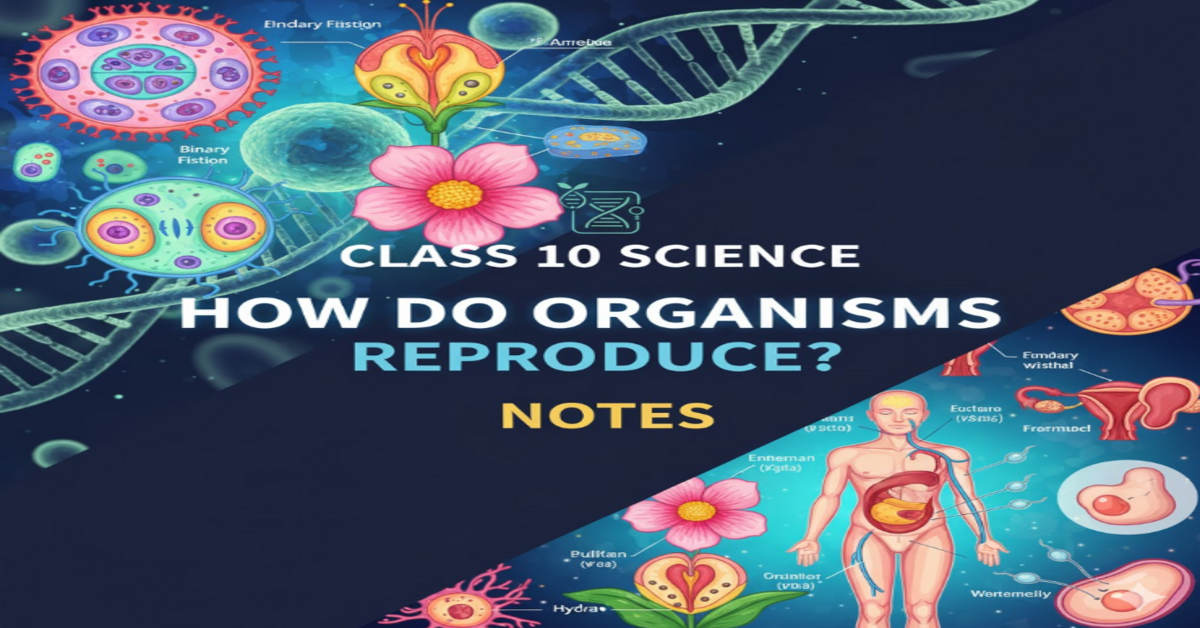
Read MoreINTRODUCTION– Reproduction Reproduction is the biological process by which new individuals (offspring) are produced from their parents. It ensures the continuity of life on Earth. Reproduction is a life process, but not essential for survival of an individual — it is essential for the survival of species. DNA (Deoxyribonucleic Acid), present in the nucleus of every cell, is the hereditary molecule that carries genetic information, gets copied during reproduction, and ensures continuity and variation in organisms. TYPES OF REPRODUCTION 1. ASEXUAL REPRODUCTION Asexual reproduction is the type of reproduction in which only one parent is involved and no fusion of gametes takes place.The offspring produced are genetically identical to the parent, i.e., they are exact copies or clones of the parent. *Characteristics of Asexual Reproduction *Advantages of Asexual Reproduction: *Disadvantages of Asexual Reproduction: 2. SEXUAL REPRODUCTION Sexual reproduction is the type of reproduction in which two parents (male and female) are involved and fusion of male and female gametes occurs to form a zygote, which develops into a new organism.The offspring produced show variations because they inherit genetic material from both parents. *Characteristics of Sexual Reproduction: *Advantages of Sexual Reproduction: *Disadvantages of Sexual Reproduction: METHODS OF ASEXUAL REPRODUCTION 1. FISSION In this process, a unicellular organism divides into two or more new individuals. -There are two types of Fission: Binary Fission and Multiple Fission. i. Binary Fission: The parent cell divides into two equal halves. For example: Amoeba ii. Multiple Fission: The parent cell divides into many daughter cells. It usually occurs in unfavourable conditions. For example: Plasmodium (malaria parasite) 2. BUDDING In this method, a small outgrowth (bud) develops on the parent’s body, which grows and later detaches to form a new individual. For Example: Yeast and Hydra 3. FRAGMENTATION In this process, the body of the parent organism breaks into two or more fragments, and each fragment grows into a new organism. It Occurs only in simple multicellular organisms with simple body organization, not seen in complex animals or plants. For Example: Spirogyra (algae) 4. REGENERATION The ability of an organism to regrow lost body parts, and sometimes a whole new organism can be formed from a body fragment. Regeneration occurs through specialized cells that divide and differentiate into new tissues. For Example: Planaria, and Starfish 5. SPORE FORMATION It is a method of asexual reproduction in which the parent produces tiny spherical spores inside a sporangium (spore case).When the sporangium bursts, the spores spread and grow into new organisms under suitable conditions. For Example: Rhizopus (Bread Mould) 6. VEGETATIVE PROPAGATION (in plants) It is the asexual reproduction in plants where new plants are produced from vegetative parts like root, stem, leaf, or bud, instead of seeds. SEXUAL REPRODUCTION Sexual reproduction is the type of reproduction in which two parents are involved, and fusion of male and female gametes occurs to form a zygote, which later develops into a new individual. –Sexual reproduction is the most common mode of reproduction in higher plants and animals. -It involves two parents — one male and one female. -This process leads to the formation of genetically different offspring due to fusion of gametes and mixing of genetic material. -It helps in variation, evolution, and survival of species. SEXUAL REPRODUCTION IN PLANTS Sexual reproduction in plants involves the fusion of male and female gametes, resulting in the formation of a zygote, which grows into a seed and later forms a new plant. This process ensures variation and continuity of species. -Reproductive Organ of the Plant: *Structure of Male and Female Reproductive Parts 1. Male Part – Stamen It consists of: 2. Female Part – Carpel / Pistil It consists of: *Steps involved in sexual reproduction in plants The process occurs in four main stages: STEP 1: POLLINATION Pollination is the process of transferring pollen grains from the anther (male part) to the stigma (female part) of a flower. – Types of Pollination: – Agents of Pollination: Pollination is carried out by wind, water, insects, or birds.(Bees and butterflies are the most common pollinators) STEP 2: FERTILIZATION STEP 3: FRUIT AND SEED FORMATION After fertilization, many changes take place inside the flower: STEP 4: GERMINATION When the seed falls on the soil and gets favourable conditions like air, water, and warmth — it germinates.The embryo inside the seed starts growing into a new plant, completing the life cycle. SEXUAL REPRODUCTION IN HUMAN BEING Reproduction in human beings is a sexual mode of reproduction, involving two parents — a male and a female. It ensures the continuity of human life and the transfer of genetic information from parents to offspring. This process involves the formation of gametes, their fusion (fertilization), and the development of a new individual from the zygote. *PUBERTY -Puberty is the stage when the body becomes capable of reproduction. -It is controlled by hormones and marks physical, physiological, and emotional changes. -Generally occurs between: -Changes at Puberty in Males: – Changes at Puberty in Females: *MALE REPRODUCTIVE SYSTEM The male reproductive system is responsible for the production, storage, and delivery of sperms (male gametes). It also produces the male sex hormone – Testosterone, which controls the development of male features and reproduction. -Testes (singular: Testis): -Vas Deferens (Sperm Duct): -Urethra: -Penis: *FEMALE REPRODUCTIVE SYSTEM The female reproductive system is designed to produce female gametes (ova or eggs), receive sperms from the male, and provide a safe environment for fertilization and development of the baby.It also produces female hormones that control reproductive cycles and secondary sexual characteristics. -Ovaries -Oviducts (Fallopian Tubes) -Uterus (Womb) –Cervix -Vagina *FERTILIZATION OF EGG Fertilisation is the process in which the male gamete (sperm) fuses with the female gamete (egg or ovum) to form a zygote, which is the first cell of a new individual. In humans, fertilisation occurs in the fallopian tube (oviduct) of the female reproductive system. There are two Types of Fertilization: #Humans show internal fertilisation, i.e., fertilisation takes place inside the female body. -Process of Fertilisation: -When the Egg is Fertilised -When the…
Read MoreINTRODUCTION: HUMAN EYE -The human eye is a sensory organ that allows us to see objects around us. -It operates like a camera, forming an image of an item on the retina. -The retina is the eye’s light-sensitive screen, where images are created. -The image created is real, inverted, and smaller in size; but our brain interprets it as upright. -The eye lens is convex in shape, and the focus length may be changed to observe both nearby and distant things. -The average adult human eye has a focus length of around 2 cm and a diameter of approximately 2.3 cm. -The human eye can see objects clearly from around 25 cm (near point) to infinity (far point). Check out related Question-Answers: Visit QnA.Gyanora.in or PARTS OF HUMAN EYE Cornea Iris Pupil Eye Lens Retina Ciliary Muscles Optic Nerve Aqueous Humour Vitreous Humour Check out related Question-Answers: Visit QnA.Gyanora.in or HUMAN EYE WORK AS A CAMERA The human eye works like a camera in many ways, like: 1.The Lens of the Eye: Just as a camera lens focusses light, your cornea and eye lens bend light rays to create a sharp image inside. 2. The Aperture: The aperture in a camera determines how much light enters. The pupil in your eye performs this function. The pupil contracts in bright sunshine and expands in low light. 3. The shutter: Cameras employ shutters to open and close. Your eyelids act as natural shutters, shielding your eyes and providing slumber. 4. The Film or Screen: Camera capture images on a film or sensor. Your eye contains a retina, a particular light-sensitive screen that collects images. 5. The Focus System: In cameras, we can adjust the focus manually or automatically. The ciliary muscles in your eyes do this instantly. They change the lens to allow you to view both your book and the stars. 6. The Brain as a Memory Card: Just like a camera stores photographs on a memory card, your optic nerve transports image information to the brain, where they are stored and processed. Check out related Question-Answers: Visit QnA.Gyanora.in or NEAR POINT OR LEAST DISTANCE OF DISTINCT VISION -The near point of the human eye is the shortest distance at which an item can be clearly perceived without effort. -It is also known as the minimum distance of clear eyesight. -The near point for a normal healthy adult is about 25 cm away. -Objects closer than 25 cm appear blurred because the eye lens is unable to correctly focus light on the retina. -At the nearest point: -Symbolically, D = 25 cm. *Accommodation of the Eye: Check out related Question-Answers: Visit QnA.Gyanora.in or DEFECT OF VISION AND CORRECTION 1.MYOPIA (Near Sightedness) –Myopia, also referred to as near sightedness, is a vision condition in which a person is able to see nearby object but distant objects appear blurry. –The eye lens focusses light in front of the retina rather than onto it. –causes: It happens because of: -Correction: 2.HYPERMETROPIA (Far Sightedness) -Hypermetropia, also referred to as far sightedness, is an eye disorder that causes a person to view far objects clearly but near objects to appear blurry. -The eye lens directs light behind the retina rather than onto it. -Causes: It happens because of: –Correction: 3.PRESBYOPIA –Presbyopia is an age-related vision condition in which the eye loses the capacity to focus on nearby objects. -Cause: -Symptoms: -Correction: Check out related Question-Answers: Visit QnA.Gyanora.in or ADVANTAGES OF THE EYE IN FRONT OF THE FACE 1. Binocular vision: 2. Improved Depth Perception: 3. Wide Range of Vision: 4. Protection and coordination: REFRACTION THROUGH A PRISM *What is a Prism? *Refraction through a Prism *Angle of Deviation (δ) DISPERSION OF WHITE LIGHT -The process by which white light breaks into its individual colours as it travels through a prism or any other refracting material is known as dispersion. -The spectrum’s seven colours are VIBGYOR à violet, indigo, blue, green, yellow, orange, and red. -Why Does Dispersion Happen? *Recombination of the Spectrum of White Light –After dispersion, the seven colours of white light can be combined again to form white light. This process is called recombination of the spectrum. -Isaac Newton first showed recombination using two prisms: -Observations: TOTAL INTERNAL REFLECTION Total Internal Reflection is the phenomenon in which a light ray, traveling from a denser medium to a rarer medium, is completely reflected back into the denser medium at the boundary, instead of refracting out. -Conditions for TIR: TIR occurs only when both requirements are met. -TIR is used in: *HOW IS RAINBOW FORMED Rainbow is formed due to the combined effect of:Refraction + Dispersion + Internal Reflection 1. The presence of raindrops 2. Refraction and Dispersion 3. Internal Reflection 4. Emergence (Refraction Again) 5. Rainbow Formation ATMOSPHERIC REFRACTION -Atmospheric refraction refers to the bending of light as it passes through the Earth’s atmosphere, which is made up of layers of varied density. -Air’s refractive index varies with temperature and pressure, leading to this phenomenon. -The atmosphere is composed of multiple layers of air with different densities. -Light from a distant object bends gradually as it travels through these layers. 1. Twinkling of Stars -Stars are far away and appear as point sources of light. -Starlight passes through the Earth’s atmosphere, which has uneven air layers of various densities. -Because of atmospheric refraction, the path of starlight is always shifting. -The star’s apparent position and brightness fluctuate, giving the appearance of twinkling. # Why Planets Don’t Twinkle 2. Stars’ Apparent Position -The real position of a star is different from where we see it in the sky. -This happens because of atmospheric refraction -Starlight passes through the Earth’s atmosphere, which has layers of air with different densities. -As light bends continuously towards the normal while moving from rarer to denser layers, the star appears slightly higher than its actual position. 3. Advance Sunrise and Delayed Sunset -We see the Sun earlier than its actual rise and longer after its actual set. -This is due…
Read More