INTRODUCTION: HUMAN EYE
-The human eye is a sensory organ that allows us to see objects around us.
-It operates like a camera, forming an image of an item on the retina.
-The retina is the eye’s light-sensitive screen, where images are created.
-The image created is real, inverted, and smaller in size; but our brain interprets it as upright.
-The eye lens is convex in shape, and the focus length may be changed to observe both nearby and distant things.
-The average adult human eye has a focus length of around 2 cm and a diameter of approximately 2.3 cm.
-The human eye can see objects clearly from around 25 cm (near point) to infinity (far point).
Check out related Question-Answers: Visit QnA.Gyanora.in
or
PARTS OF HUMAN EYE
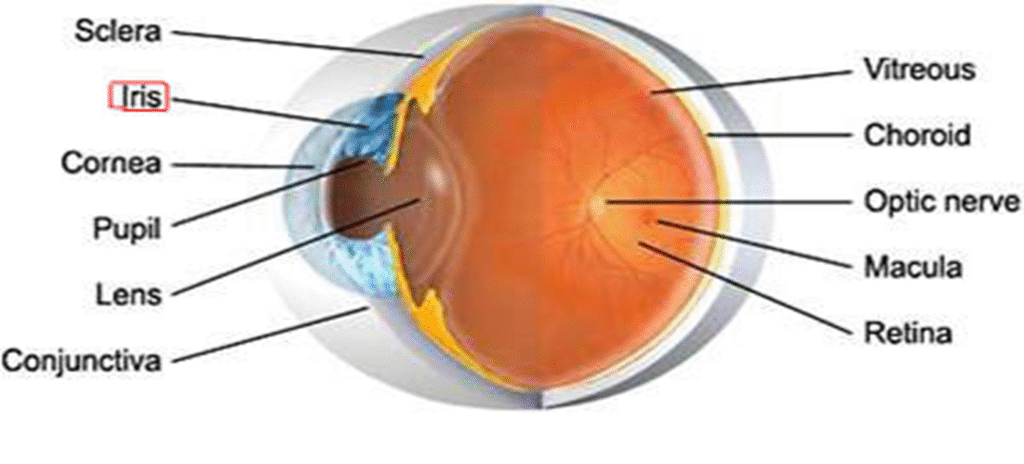
Cornea
- Transparent, curved front part of the eye.
- Refracts most of the light entering the eye.
Iris
- Coloured part of the eye (brown, black, blue, etc.).
- Controls the size of the pupil to regulate the amount of light entering.
Pupil
- Dark circular opening in the centre of the iris.
- Works like a camera shutter – becomes small in bright light and large in dim light.
Eye Lens
- Transparent, convex lens behind the pupil.
- Focuses light rays onto the retina.
- Its focal length can change to focus near or distant objects (accommodation).
Retina
- Inner light-sensitive layer of the eye.
- Contains rods and cones (special cells to detect light and colours).
- Forms a real, inverted image of objects.
Ciliary Muscles
- Hold the eye lens in position.
- Adjust the curvature of the lens to change its focal length.
Optic Nerve
- Connects the eye to the brain.
- Transmits visual information as electrical signals to the brain.
Aqueous Humour
- Transparent fluid between cornea and lens.
- Provides nutrients and maintains pressure of the eye.
Vitreous Humour
- Jelly-like substance behind the lens.
- Helps maintain the shape of the eyeball.
Check out related Question-Answers: Visit QnA.Gyanora.in
or
HUMAN EYE WORK AS A CAMERA
The human eye works like a camera in many ways, like:
- Cornea and Eye Lens → Camera Lens
- Iris and Pupil → Camera Aperture
- Retina → Camera Film/Screen
- Ciliary Muscles → Focusing Mechanism
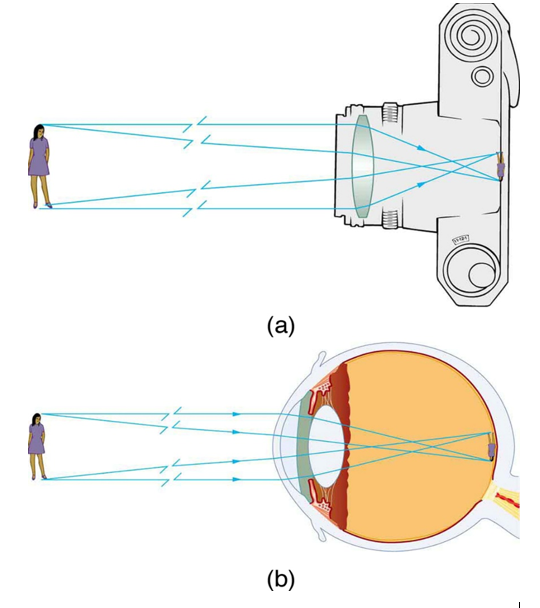
1.The Lens of the Eye: Just as a camera lens focusses light, your cornea and eye lens bend light rays to create a sharp image inside.
2. The Aperture: The aperture in a camera determines how much light enters. The pupil in your eye performs this function. The pupil contracts in bright sunshine and expands in low light.
3. The shutter: Cameras employ shutters to open and close. Your eyelids act as natural shutters, shielding your eyes and providing slumber.
4. The Film or Screen: Camera capture images on a film or sensor. Your eye contains a retina, a particular light-sensitive screen that collects images.
5. The Focus System: In cameras, we can adjust the focus manually or automatically. The ciliary muscles in your eyes do this instantly. They change the lens to allow you to view both your book and the stars.
6. The Brain as a Memory Card: Just like a camera stores photographs on a memory card, your optic nerve transports image information to the brain, where they are stored and processed.
Check out related Question-Answers: Visit QnA.Gyanora.in
or
NEAR POINT OR LEAST DISTANCE OF DISTINCT VISION
-The near point of the human eye is the shortest distance at which an item can be clearly perceived without effort.
-It is also known as the minimum distance of clear eyesight.
-The near point for a normal healthy adult is about 25 cm away.
-Objects closer than 25 cm appear blurred because the eye lens is unable to correctly focus light on the retina.
-At the nearest point:
- The ciliary muscles are maximum contracted.
- The eye lens thickens to concentrate the image on the retina.
-Symbolically, D = 25 cm.
*Accommodation of the Eye:
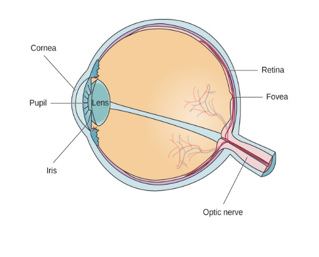
- Accommodation is the ability of the eye lens to adjust its focal length in order to focus on things at different distances.
- Mechanism of Accommodation:
- To view nearby objects:
-Ciliary muscles contract.
-The lens becomes thicker and more convex. - To view faraway objects:
-Ciliary muscles relax.
- To view nearby objects:
- – Lenses become thinner and less convex.
- Accommodation enables the eye to properly concentrate light rays onto the retina, resulting in clear vision.
Check out related Question-Answers: Visit QnA.Gyanora.in
or
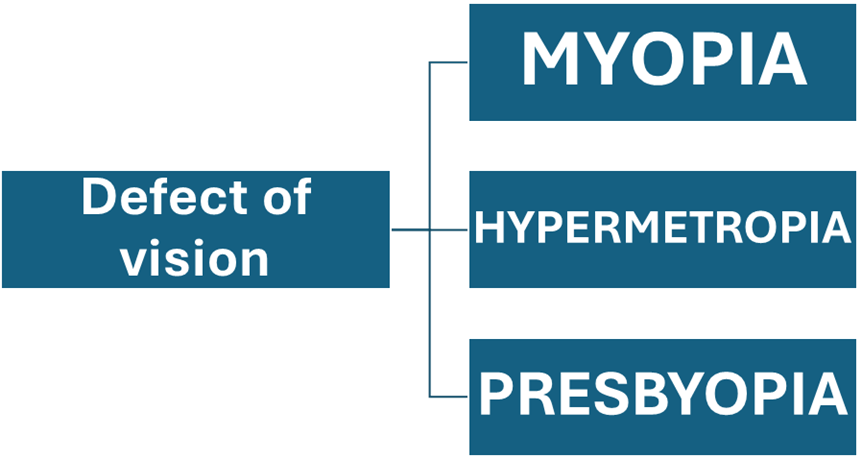
DEFECT OF VISION AND CORRECTION
1.MYOPIA (Near Sightedness)
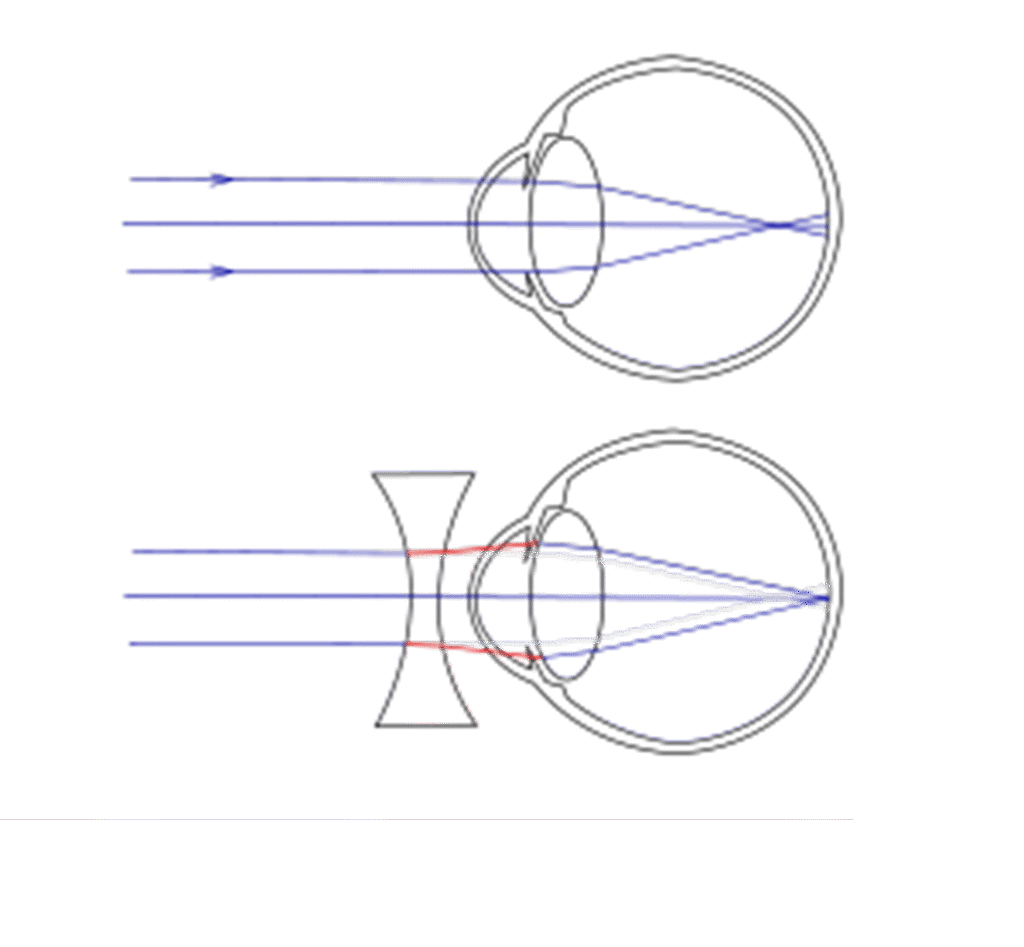
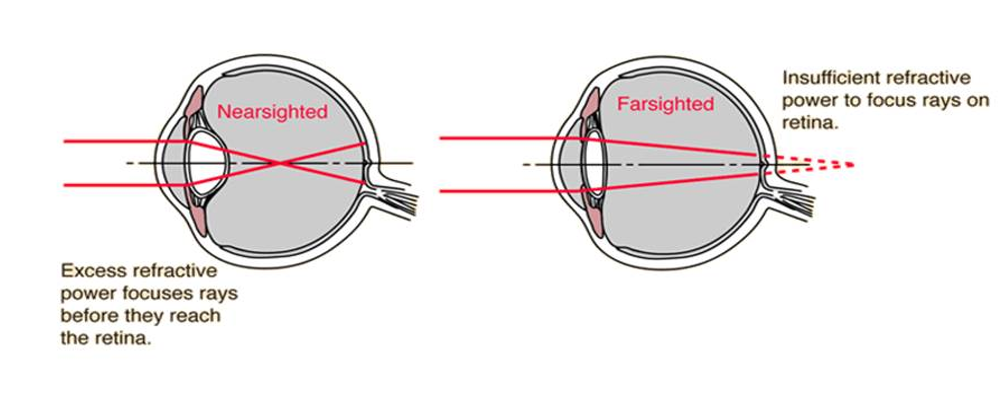
–Myopia, also referred to as near sightedness, is a vision condition in which a person is able to see nearby object but distant objects appear blurry.
–The eye lens focusses light in front of the retina rather than onto it.
–causes: It happens because of:
- Elongated eyeball (axial length is longer than normal).
- Excessively powerful lens (high refractive power).
-Correction:
- Use a concave lens (diverging lens) with appropriate power.
- The lens diverges light rays, causing the picture to land on the retina.
- Concave lens was used (focal length is negative).
2.HYPERMETROPIA (Far Sightedness)
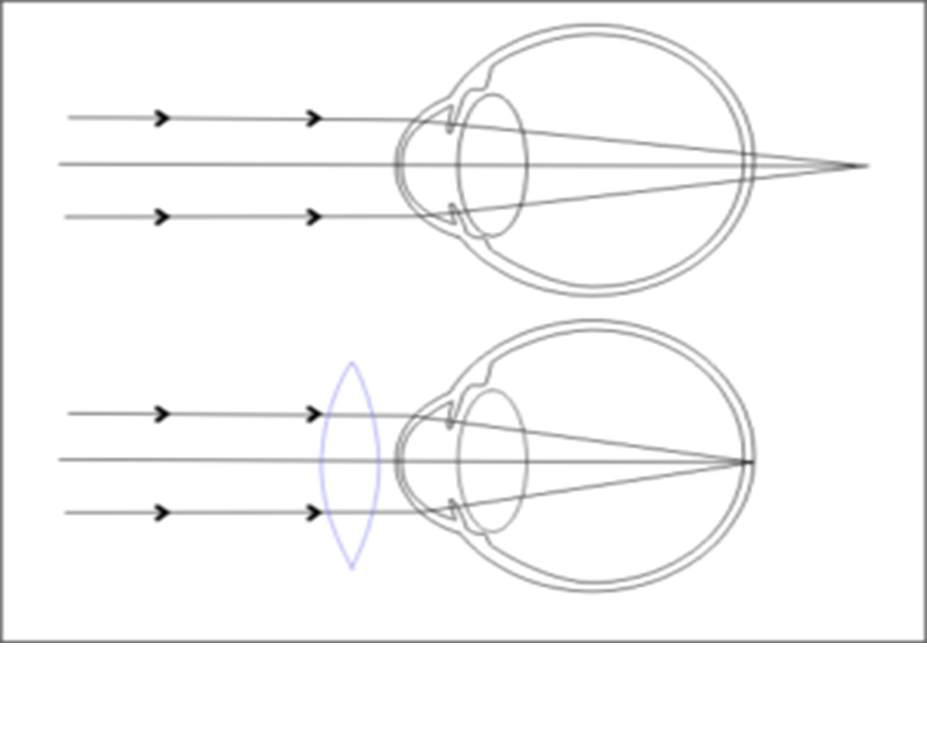
-Hypermetropia, also referred to as far sightedness, is an eye disorder that causes a person to view far objects clearly but near objects to appear blurry.
-The eye lens directs light behind the retina rather than onto it.
-Causes: It happens because of:
- Shortened eyeball (axial length is shorter than normal).
- Weak lens (lower refractive power).
–Correction:
- Use a convex (converging) lens of appropriate power.
- The lens focusses the light rays so that the image falls on the retina.
- Convex lens (with a longer focal length).
3.PRESBYOPIA
–Presbyopia is an age-related vision condition in which the eye loses the capacity to focus on nearby objects.
-Cause:
- The eye lens loses flexibility as we age.
- The ciliary muscles weaken, preventing the lens from becoming thick enough to focus on adjacent objects.
-Symptoms:
- Difficulty reading small print and seeing objects up close.
- People over the age of 40 are more likely to experience this.
-Correction:
- To focus the image on the retina, use a convex lens (reading glasses) with appropriate power.
- Convex lens (with a longer focal length).
Check out related Question-Answers: Visit QnA.Gyanora.in
or
ADVANTAGES OF THE EYE IN FRONT OF THE FACE
1. Binocular vision:
- Both eyes perceive the same item.
- This overlapping perspective allows the brain to sense depth and distance, resulting in a 3D view of the world.
2. Improved Depth Perception:
- Front-facing eyes enable people to judge distances accurately, which is useful for activities such as walking, driving, and sports.
3. Wide Range of Vision:
- Although front eyes are slightly smaller than side eyes, they provide a more concentrated and coordinated range of vision.
4. Protection and coordination:
- Eyelids, eyelashes, and brows protect front-facing eyes from dust, light, and harm.
- The front position allows both eyes to operate simultaneously, which improves focus and coordination.
REFRACTION THROUGH A PRISM
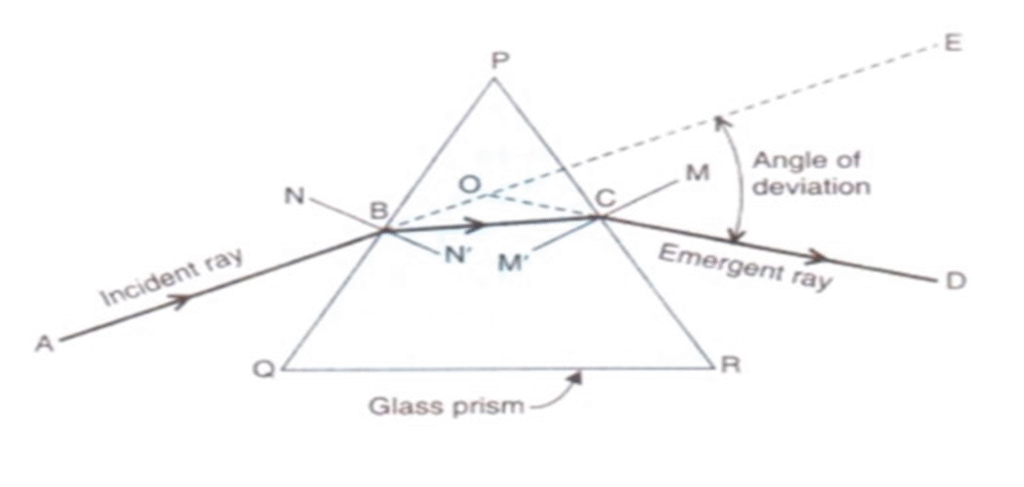
*What is a Prism?
- A prism is a transparent object with two plane surfaces inclined at an angle (refracting angle).
- Most commonly studied prism is triangular prism.
*Refraction through a Prism
- When a ray of light passes from air into a prism, it bends towards the base of the prism.
- Inside the prism, the ray travels in a straight line.
- On emerging from the other side, the light bends away from the base.
- The emergent ray is deviated from its original path.
*Angle of Deviation (δ)
- When a ray of light passes through a prism, it bends at both surfaces.
- The angle between the incident ray (original path) and the emergent ray (after passing through prism) is called the angle of deviation (δ).
- Deviation Depends On: Refractive index of the prism material, Angle of incidence of the light ray, Refracting angle (A) of the prism.
- Angle of deviation ∝ 1/wavelength
DISPERSION OF WHITE LIGHT
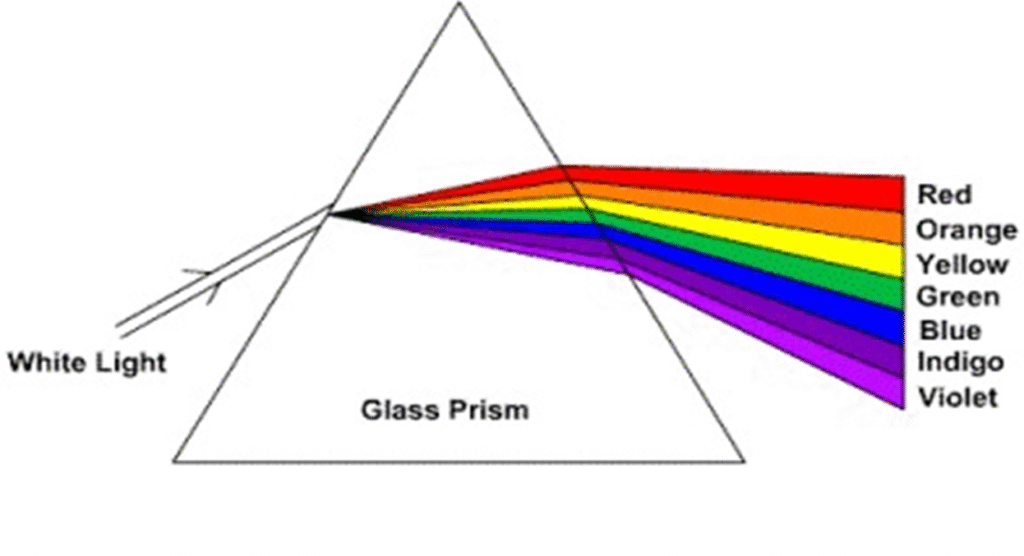
-The process by which white light breaks into its individual colours as it travels through a prism or any other refracting material is known as dispersion.
-The spectrum’s seven colours are VIBGYOR à violet, indigo, blue, green, yellow, orange, and red.
-Why Does Dispersion Happen?
- White light is made up of seven colours, each with a different wavelength.
- When white light enters a prism, each colour refracts (bends) differently because each has a different refractive index.
- Violet bends the most (shortest wavelength).
- Red bends the least (longest wavelength).
*Recombination of the Spectrum of White Light
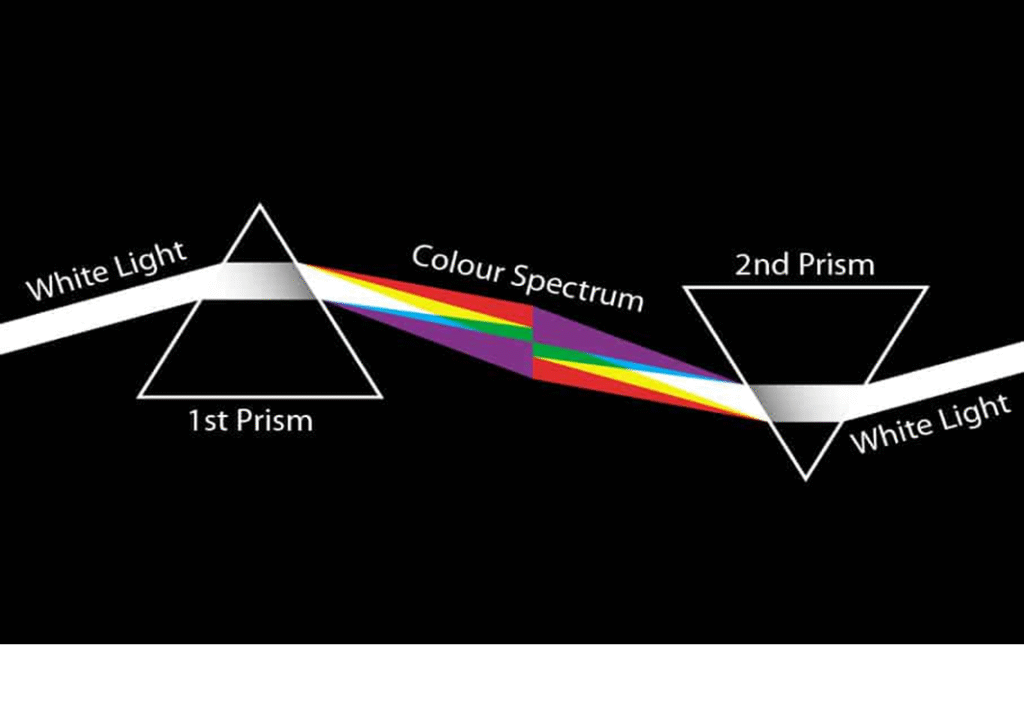
–After dispersion, the seven colours of white light can be combined again to form white light. This process is called recombination of the spectrum.
-Isaac Newton first showed recombination using two prisms:
- The first prism disperses white light into a spectrum (VIBGYOR).
- The second prism, placed inverted and upside down, recombines the spectrum back into white light.
-Observations:
- Dispersion by the first prism proves that white light is made up of seven colours.
- Recombination by the second prism proves that these colours together form white light again.
- This shows that colours are a property of light and not of the prism.
TOTAL INTERNAL REFLECTION
Total Internal Reflection is the phenomenon in which a light ray, traveling from a denser medium to a rarer medium, is completely reflected back into the denser medium at the boundary, instead of refracting out.
-Conditions for TIR: TIR occurs only when both requirements are met.
- Light must pass through a denser medium (such as glass or water) to a rarer media (such as air).
- The angle of incidence in the denser medium must be greater than the critical angle for that pair of media.
-TIR is used in:
- Rainbow formation à here TIR occurs inside water droplets after dispersion.
- Mirage in deserts à an optical illusion due to TIR in layers of hot air.
- Shining of diamonds à diamonds sparkle due to TIR.
*HOW IS RAINBOW FORMED
Rainbow is formed due to the combined effect of:
Refraction + Dispersion + Internal Reflection
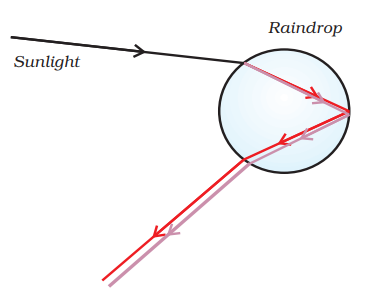
1. The presence of raindrops
- After rain, the atmosphere is full of tiny water droplets that behave as miniature prisms.
2. Refraction and Dispersion
- Sunlight enters each droplet from air into water.
- At this point, light bends (refraction) and separates into seven colours (dispersion).
3. Internal Reflection
- The dividing colours hit the droplet’s inner surface.
- They undergo internal reflection and bounce back into the drop.
4. Emergence (Refraction Again)
- When the rays leave the raindrop, they bend again (refraction from water to air).
- The colours spread out to form a spectrum (VIBGYOR)
5. Rainbow Formation
- Millions of such droplets combine to deliver diffused light towards the observer’s eyes.
- The observer sees a seven-colour circular arc, with red on the outside and violet on the inside.
ATMOSPHERIC REFRACTION
-Atmospheric refraction refers to the bending of light as it passes through the Earth’s atmosphere, which is made up of layers of varied density.
-Air’s refractive index varies with temperature and pressure, leading to this phenomenon.
-The atmosphere is composed of multiple layers of air with different densities.
-Light from a distant object bends gradually as it travels through these layers.
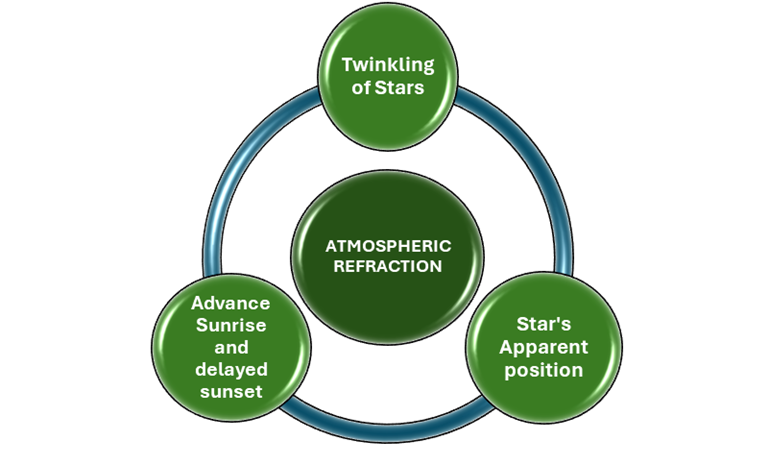
1. Twinkling of Stars
-Stars are far away and appear as point sources of light.
-Starlight passes through the Earth’s atmosphere, which has uneven air layers of various densities.
-Because of atmospheric refraction, the path of starlight is always shifting.
-The star’s apparent position and brightness fluctuate, giving the appearance of twinkling.
# Why Planets Don’t Twinkle
- Planets are significantly closer to Earth and appear as stretched sources of light (rather than point sources).
- The variation in light from different parts cancel each other out, so planets glow consistently without twinkling.
2. Stars’ Apparent Position
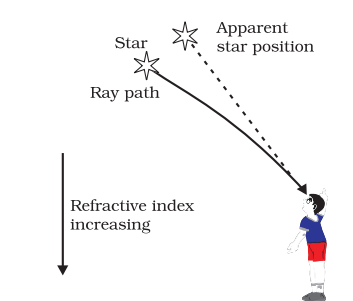
-The real position of a star is different from where we see it in the sky.
-This happens because of atmospheric refraction
-Starlight passes through the Earth’s atmosphere, which has layers of air with different densities.
-As light bends continuously towards the normal while moving from rarer to denser layers, the star appears slightly higher than its actual position.
3. Advance Sunrise and Delayed Sunset
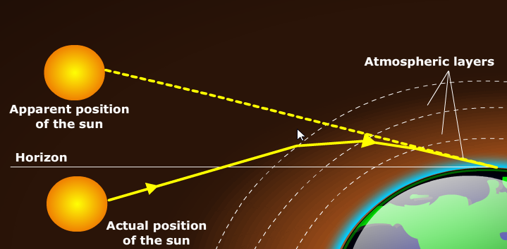
-We see the Sun earlier than its actual rise and longer after its actual set.
-This is due to atmospheric refraction of sunlight.
-Earth’s atmosphere bends (refracts) the Sun’s rays.
-When the Sun is just below the horizon, its light bends towards the Earth and reaches our eyes.
-As a result:
- The Sun appears to rise about 2 minutes earlier.
- The Sun appears to set about 2 minutes later.
SCATTERING OF LIGHT
Scattering of light is the phenomenon in which a beam of light is redirected in different directions when it strikes tiny particles (dust, gas molecules, water vapour) suspended in the atmosphere.
-Different particle sizes scatter different colours (wavelengths) of light differently.
-Smaller particles result in increased scattering of shorter wavelengths (blue and violet).
*Tyndall Effect
- Scattering of light by colloidal particles in a solution
- For example: light beam visible in a dark room through a window
*Blue colour of sky
- The atmosphere contains extremely small particles that refract shorter wavelengths (blue/violet) more than longer wavelengths (red).
- Our eyes are more sensitive to blue, so the sky appears blue.
*Red colour of the sun during sunrise and sunset.
- When the Sun is near the horizon, it passes through a thicker atmosphere.
- Blue light is dispersed, leaving only red/orange (longer wavelengths) visible to our eyes, causing the sun to appear reddish.
*Clouds appear white
- Clouds are made up of tiny water droplets and ice crystals.
- These particles are larger than the wavelength of visible light.
- Such large particles scatter all wavelengths (colours) of sunlight equally
- Since all seven colours (VIBGYOR) are scattered almost equally, the combined effect is white light.
- Hence, clouds appear white or greyish depending on their thickness and density.
*Danger Signs Made with Red Colour
-This makes red light easily visible even from far away and in bad weather conditions (fog/rain).
–Red light has the longest wavelength among visible light.
-Because of its long wavelength, red light is least scattered
-Red colour can travel the longest distance without getting scattered.
Check out related Question-Answers: Visit QnA.Gyanora.in