INTRO – MARGINALISATION
Marginalisation is the process by which certain individuals or groups are denied major participation in social, economic, political, and cultural life. These groups are frequently denied access to authority and decision-making, which contributes to structural disadvantage and inequality.
*Marginalisation V/s Marginalised
– Marginalisation: Marginalisation is the process.
It means pushing a group of people to the edge of society, where they do not get equal rights, opportunities, or respect.
So, marginalisation is the action or the situation that creates inequality.
– Marginalised: It is an individual or a group.
Marginalised refers to the people who are affected by marginalisation.
These are the communities who are left out, ignored, or treated unfairly in society.
So, marginalised are the individuals or groups who experience the effects of marginalisation.
CAUSES OF MARGINALISATION
1. Historical Inequality
- Many communities faced discrimination in the past—because of their caste, culture, or lifestyle.
2. Social Discrimination
- Some groups are treated as “less important” due to caste, religion, tribe, or customs.
This unfair treatment prevents them from participating equally in schools, workplaces, and society.
3. Lack of Education
- When people don’t get proper education, they Miss job opportunities, and Can not understand their rights. This keeps them stuck in a cycle of inequality.
4. Economic Problems
- Poverty is a major cause of marginalisation.
- Poor families struggle to afford – Healthcare, Schooling, and Basic needs. Because of this, they remain behind others.
5. Cultural Differences
- Communities like Adivasis have different languages, lifestyles, and traditions.
- Sometimes people misunderstand or look down upon these differences, which leads to social exclusion.
6. Political Exclusion
- When marginalised groups don’t have a voice in politics, their needs and rights are often ignored.
7. Stereotypes
- Wrong beliefs and negative attitudes create fear, disrespect, and distance. These stereotypes make society treat them unfairly.
8. Loss of Land and Resources
- When the land, forests, or homes are taken away, people’s entire way of life becomes threatened.
MARGINALISED SECTIONS OF OUR SOCIETY
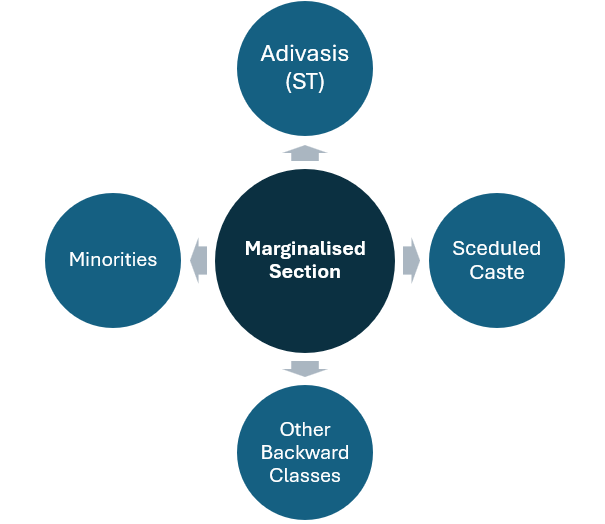
THE ADIVASIS
“Adivasi” means original inhabitants. Adivasis are one of the most important and diverse communities of India. They are known as the original or indigenous people of our country.
India has more than 500 Adivasi groups. They comprise of around 8% of India’s population.
The legal term used by the Indian government for Adivasis is Scheduled Tribes.
Adivasis have a deep connection with forests, wildlife, rivers, and land.
Their entire lifestyle revolves around nature, which they respect and protect.
They have – Distinct languages, Colorful festivals, Traditional music and dance, Unique food habits, Strong community bonds.
*Why Are Adivasis Marginalised?
- Loss of Land and Forests: Large projects like dams, mining, industries, and roads have taken away Adivasi land.
- Displacement: Thousands of Adivasi families are forced to leave their land without proper rehabilitation.
- Lack of Education and Healthcare: Many Adivasi areas do not have good schools, hospitals, or transport.
- Stereotypes: Adivasis are often wrongly seen as “backward” or “uncivilised”, which leads to unfair treatment and discrimination.
- Political Under-representation: They have very little voice in decision-making.
*Stereotyping the Adivasis
– A stereotype is a generalized belief about a particular category of people. It ignores the real diversity and individuality of the community.
– Many people wrongly believe that Adivasis are – Backward, Uneducated, Uncivilised, always living in forests, and Unwilling to change or modernise.
– Why Are These Stereotypes Wrong?
- Adivasis are culturally rich
- They are not “backward”
- They adapt to change
- Their lifestyle is different, not inferior
*Displacement of Adivasis
Displacement means forcing people to leave their home or land and move somewhere else, usually because of reasons like construction projects, natural disasters, mining, or conflicts.
– Causes of Displacement of Adivasis
- Construction of Large Dams
- Mining and Industrial Projects
- Development Projects
- Commercial Forest Use
- Wildlife Sanctuaries and National Parks
– Effects of Displacement on Adivasis
- Loss of Home and Livelihood
- Breakdown of Community Life
- Poverty and Unemployment
- Loss of Culture and Identity
- Poor Living Conditions
- Emotional and Mental Stress
MINORITIES AND MARGINALISATION
A minority is a group that is smaller in population, culture, or language compared to others.
In India, religious minorities include – Muslims, Christians, Sikhs, Buddhists, Jains, Parsis.
– Why Do Minorities Face Marginalisation?
- Smaller Population
- Cultural Differences
- Lack of Representation
- Negative Stereotypes
- Historical Inequality
MUSLIMS AND MARGINALISATION
According to 2001 census, Muslims are 13.4 per cent of India’s population and are considered to be a marginalised community in India.
*Reasons that show Muslims Considered a Marginalised Community
1. Lower Literacy Levels
- This affects their opportunities in higher education and professional jobs.
2. Limited Access to Good Jobs
- Many Muslim families rely on small trades like embroidery, tailoring, mechanics, carpentry, leather work, etc.