
Weather Vs Climate
Before studying India’s climate, it is important to understand two basic terms: weather and climate.
Weather tells us what the atmosphere is like right now, while climate tells us what the atmosphere of a place is like most of the time over many years.
For example:
- If it suddenly rains today, that is weather.
- If a place usually remains hot throughout the year, that is its climate.
The Difference between Weather and Climate are as follow:
| Weather | Climate |
| Weather is the day-to-day condition of the atmosphere of a place. | Climate is the average weather pattern of a place over 30–40 years. |
| It can change quickly – within minutes or hours. | It changes very slowly over a long period. |
| Includes daily changes in temperature, rainfall, humidity, wind, etc. | Shows long-term patterns like hot/dry climate, cold/wet climate, etc. |
| Describes the atmosphere at a particular time. | Describes the general atmospheric conditions of a place for many years. |
| Example: Today it is sunny, tomorrow it may rain. | Example: Rajasthan has a hot, dry climate; Kerala has a hot, wet climate. |
| Helpful for short-term planning (clothes for the day, carrying an umbrella). | Helpful for long-term planning (crop selection, construction, tourism). |
*Elements of Weather and Climate
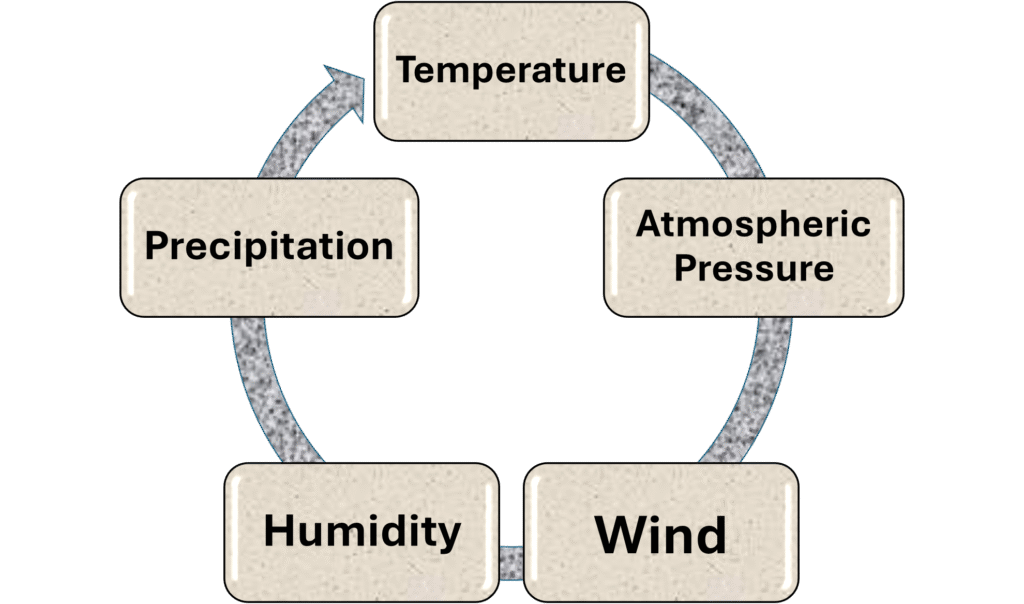
1. Temperature
- Temperature tells us how hot or cold the atmosphere is.
- It affects all other elements of weather such as pressure, wind, and rainfall.
- High Altitudes (at hight) – low temperature (cooler)
- Low Altitude (near equator) – high temperature (hotter)
2. Atmospheric Pressure
- It is the weight of air over a particular area.
- High temperature → Low pressure
- Low temperature → High pressure
- Air always moves from high pressure to low pressure, which creates winds and influences rainfall.
3. Wind
- Wind is the movement of air from high pressure areas to low pressure areas.
- Winds decide:
- How much rain a place receives
- How fast weather changes
- Seasonal changes (e.g., monsoon winds)
4. Humidity
- Humidity is the amount of water vapour present in the air.
- High humidity makes the air feel warmer and sticky.
- It plays a major role in:
- Cloud formation
- Fog
- Rainfall
5. Precipitation (Rainfall, Snow, Hail)
- When the air becomes fully saturated with water vapour, it leads to precipitation.
- Precipitation is water falling from the atmosphere to the Earth’s surface.
- It may be in the form of rain, snow, sleet, or hail.
India’s Climate: Monsoon Type
The term monsoon comes from the Arabic word “mausim”, meaning season. This tells us that monsoons are seasonal winds that bring major changes in temperature and rainfall.
India is known for its monsoon type of climate, which makes our weather pattern very different from many other countries.
* Why is India’s Climate Called Monsoon Type?
India receives most of its rainfall from seasonal winds—the Southwest Monsoon and Northeast Monsoon.
These winds reverse their direction depending on the season, leading to very clear changes in India’s climate.
*Key Features of India’s Monsoon Type Climate
- Clear summer, winter, and rainy seasons
- Heavy rainfall concentrated in a few months (June–September)
- Great variation in rainfall from region to region
- Strong influence on agriculture, rivers, forests, and human life
FACTORS AFFECTING INDIA’s CLIMATE
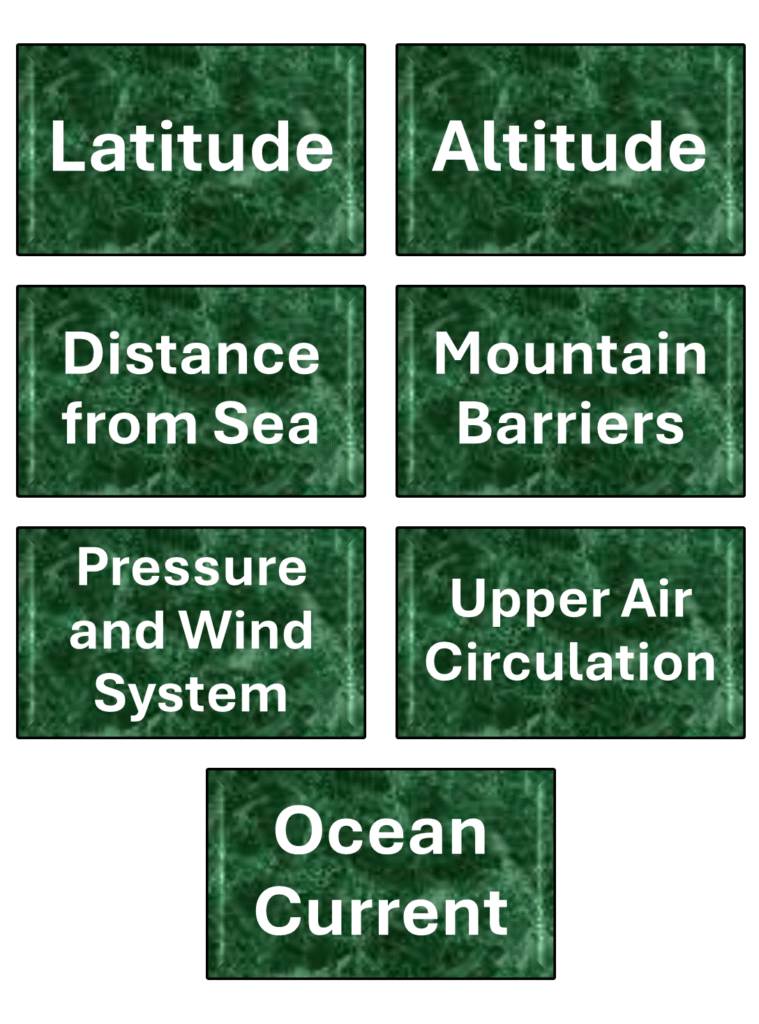
1. Latitude
Latitude means how far a place is from the Equator.
- India is divided by the Tropic of Cancer (23½° N).
- Places south of this line lie in the Torrid Zone → receive direct sunlight → hot climate.
- Places north of it lie in the Temperate Zone → receive slanting sunlight → cooler climate.
2. Altitude (Height Above Sea Level)
Temperature decreases with height.
For every 165 m rise in altitude, temperature drops by 1°C.
So, higher places are always cooler.
3. Distance from the Sea
The sea affects the climate of nearby areas.
- Coastal areas → Moderate climate (not too hot, not too cold)
- Inland areas → Extreme climate (very hot in summer, very cold in winter)
4. Mountain Barriers
Mountains play a major role in controlling temperature, wind, and rainfall.
Himalayas
- Block cold winds from Central Asia → prevent freezing temperatures in North India.
- Force monsoon winds to rise → cause heavy rainfall on the windward side.
5. Pressure and Wind Systems
The movement of air (winds) depends on pressure conditions.
- Low pressure → Winds move towards the area
- High pressure → Winds move away from the area
6. Upper Air Circulation (Jet Streams)
Jet streams are fast-moving winds in the upper atmosphere.
- Westerly Jet Stream: Influences winter weather in North India and brings Western Disturbances (winter rainfall).
- Easterly Jet Stream: Helps in the onset of the monsoon over India.
7. Ocean Currents
Ocean currents are continuous flows of warm or cold water in the oceans.
- Warm currents → Warm the coastal regions
- Cold currents → Cool the coastal regions
This affects the temperature and sometimes rainfall of coastal areas.
THE SEASONS
India’s climate is known for its different seasonal patterns. Unlike many other nations, which have simply summer and winter, India has a strongly seasonal climate due to the monsoon system and its tropical-subtropical position.
The Indian Meteorological Department (IMD) divides the year into four major seasons:
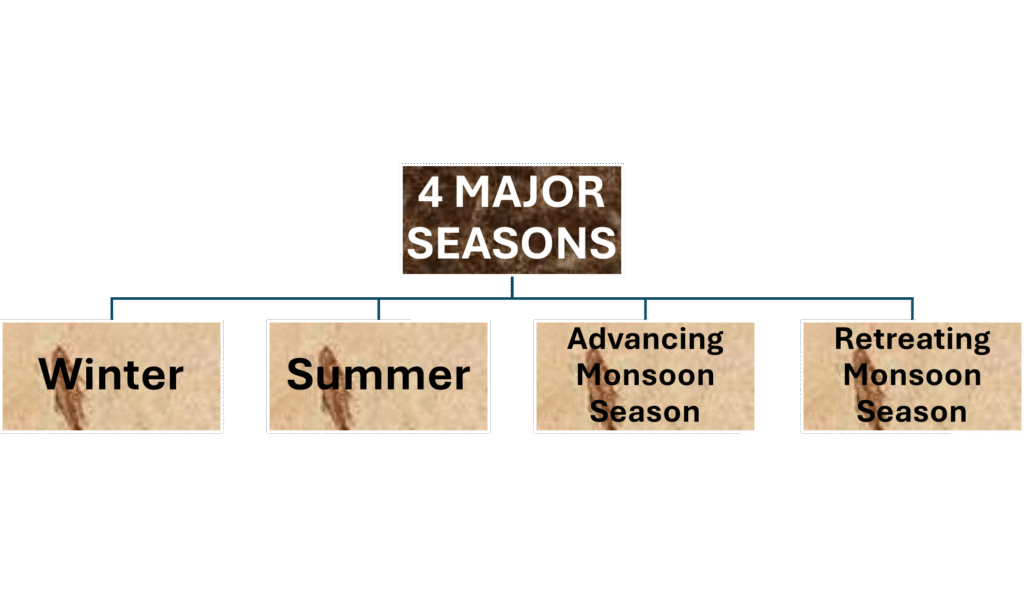
1. The Cold Weather Season (Winter) – December to February
- Temperatures are low in north India and mild in the south.
- Cold, dry winds blow from the northwest.
- Skies remain clear, and the air is dry.
- Western Disturbances bring light rain in – Punjab, Haryana, Delhi, Western Uttar Pradesh
2. The Hot Weather Season (Summer) – March to May
- Sun is overhead in summer.
- Land heats faster than water → creates low pressure, preparing for monsoon entry.
- Temperatures rise sharply, especially in – Rajasthan, Central India, Deccan Plateau
3. The Advancing Monsoon Season – June to September
- The low-pressure area over north India pulls moist winds from the Indian Ocean.
- Southwest monsoon winds bring heavy rainfall across the country.
- Rainfall distribution first hits Kerala around 1 June.
4. The Retreating Monsoon Season – October to November
- The monsoon begins to withdraw from northern India.
- Winds become dry, and rainfall decreases.
- Tamil Nadu, Puducherry, and parts of Andhra Pradesh get rain from the Northeast Monsoon. This is because winds pick up moisture from the Bay of Bengal.
DISTRIBUTION OF RAINFALL IN INDIA
Rainfall in India varies throughout the country. Some areas have heavy rainfall, while others receive very little. This uneven or irregular pattern is known as distribution of rainfall.
1. Areas of Heavy Rainfall (More than 200 cm annually)
- These regions receive very high rainfall because they lie in the path of the moist monsoon winds.
- Moist monsoon winds hit the Western Ghats
- Moist winds get trapped by Himalayan hills
- Areas covered under this:
- Western Coast (including Kerala, Karnataka, Goa, Maharashtra Coast)
- North eastern States: Meghalaya, Assam, Arunachal Pradesh
- Foothills of the Himalayas (e.g., Uttarakhand, North Bengal, Sikkim)
2. Areas of Moderate Rainfall (100–200 cm annually)
- These regions receive monsoon rains, but the intensity decreases as winds move inland.
- Areas covered under this – Northern Plains, Parts of Central India, Eastern Coastal Plains
3. Areas of Low Rainfall (Less than 100 cm annually)
- These Areas are far from the sea
- Monsoon winds get weak by the time they reach interior regions
- Areas covered under this – Western Rajasthan (Thar Desert), Gujarat & Haryana (some parts), Deccan Plateau interior areas.
4. Regions of Very Low Rainfall (Below 25 cm annually)
- These Areas are surrounded by high mountains → very little moisture
- Experiences Cold and dry winds
- Areas covered under this – Cold desert regions of Ladakh, Jaisalmer & Barmer (Rajasthan)
MONSOON AS A UNIFYING BOND
India has a huge variety of climates, landforms, languages, and cultures, the monsoon binds the whole country together.
It is one of the most important features of India’s climate and affects almost every part of the nation.
There are some reasons that shows that Monsoon is a Unifying Force:
1. Seasonal Rhythm Shared by Entire Country
The monsoon follows a distinct seasonal pattern—the arrival, progress, and withdrawal of rains. This pattern is felt across India, giving people everywhere a common climatic experience.
2. Whole Country Awaits Its Arrival
Every year, after the intense summer heat, the entire nation waits for the monsoon.
The excitement of the first rain is felt from Kerala to Kashmir and from Gujarat to Assam.
3. Monsoon Affects Agriculture All Over India
India’s agriculture is heavily monsoon-dependent. The monsoon influences the whole economy, connecting all regions.
4. Water Availability Everywhere Depends on Monsoon
Rivers, lakes, ponds, and groundwater are mainly recharged by monsoon rainfall. So, all states rely on monsoon rains.
5. Monsoon Creates a Sense of Cultural Unity
Many festivals, songs, and traditions in India are linked to the monsoon. This gives India a shared cultural identity during the rainy season.
6. Monsoon Winds Cover the Entire Subcontinent
The Southwest Monsoon and the Retreating Monsoon touch almost every part of India