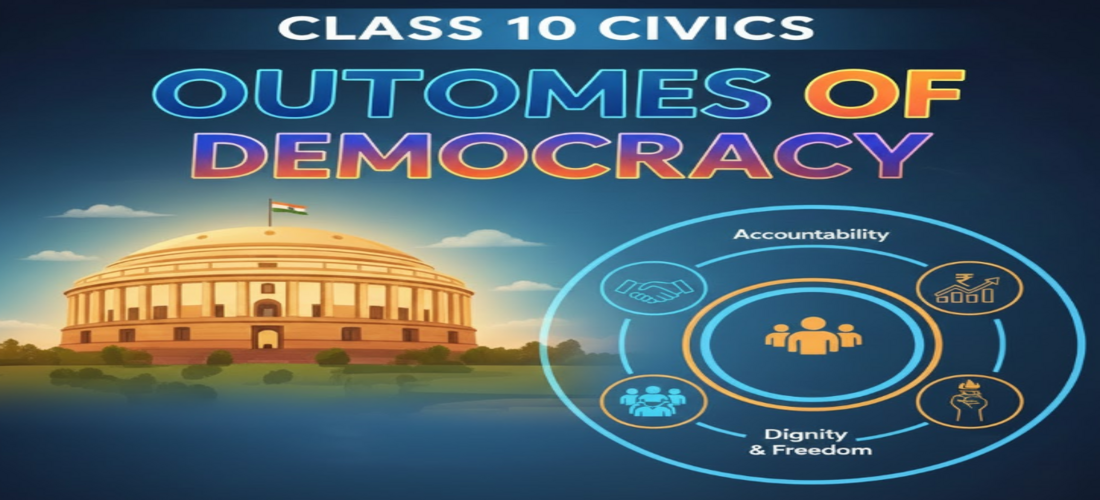
INTRO – OUTCOMES OF DEMOCRACY
Democracy is not just a term; it is a promise. A promise of liberty, equality, and a government that is responsive to its citizens. Democracy is widely regarded as the most trustworthy form of government. But have you ever thought why we have such high expectations from it?
HOW DO WE ASSESS OUTCOMES OF DEMOCRACY
Assessing democracy is like checking the “report card” of a country. We know that democracy is popular over the world, but to determine whether it is actually successful, we must look at how it works in reality rather than just what it promises.
1. Democracy is judged by its actual performance
- The democracy should not be evaluated only on the basis of elections or institutions. We must look at – how democratic government works, how decisions are made, and how citizens experience these decisions. This helps us understand the real results of democracy.
2. People have different expectations from democracy
- Different groups of people expect different things. As expectations vary, people may judge democracy differently.
3. Democracy must be assessed collectively, not individually
- One person’s opinion cannot decide whether democracy is good or bad. We need – surveys, studies, public opinion, and collective data. This gives a fair and balanced picture of democracy.
4. Democracy involves a long and complex decision-making process
- This process may be slow, but it ensures decisions are more acceptable and involve wider participation.
5. We need proper criteria to judge democracy
- Democracy must be evaluated on – Political outcomes, Social outcomes, and Economic outcomes. These criteria help us understand whether democracy is meeting people’s expectations.
6. Democracy allows room for correction
- Democracy may not guarantee perfect decisions, but it provides – space for correcting mistakes, peaceful change of rulers, and possibility of improvement. This makes democracy a system that keeps improving over time.
ACCOUNTABLE, RESPONSIVE, AND LEGITIMATE GOVERNMENT
One of the most important outcomes of democracy is that it aims to create a government that is accountable, responsive, and legitimate.
*Democracy Ensures an Accountable Government
- A democratic government is answerable to the people.
- It is accountable because:
- leaders are elected by citizens,
- they have to explain and justify their decisions,
- they can be removed by the public in the next election,
- mistakes can be discussed openly and corrected.
- In democracy, people have the power to question the government through – elections, debates, media, and public opinion.
- This makes rulers more careful while making decisions.
*Democracy Works as a Responsive Government
- A responsive government listens to the needs and problems of the people.
- Democracy becomes responsive because:
- it encourages public participation,
- it considers different viewpoints,
- it tries to provide basic services like education, healthcare, and security,
- it changes policies based on public demands.
- The Democratic governments may be slow, but they try to respond to people’s expectations.
*Democracy Provides a Legitimate Government
- A legitimate government is one that is accepted by the people.
- In democracy:
- power is gained through free and fair elections
- the government follows the Constitution
- it rules based on the consent of the people
- citizens have trust in the system
- Even if democracy does not always provide ideal results, people believe it is the most acceptable form of government due to its emphasis on participation and consent.
————————————————————————————————–
*Case Study from NCERT: Transparency
The cartoon shows a very large telescope pointed from the government’s side towards the public.
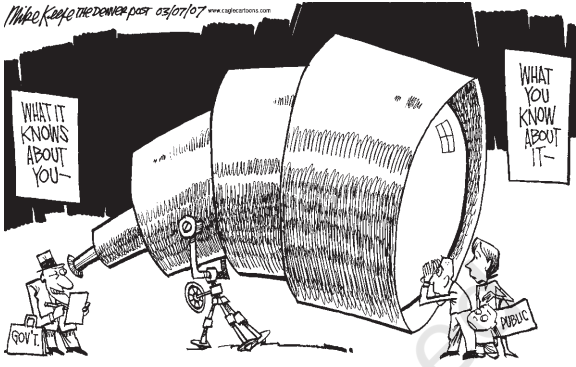
“A strong democracy requires transparency—citizens should know as much about the government as the government knows about them.”
This cartoon perfectly explains an important idea from the chapter “Outcomes of Democracy”—that in a democracy, the government must be open, transparent, and answerable to the people. However, the cartoon shows the opposite situation.
– On the left, the government is using a big, powerful telescope to watch the public.
- This represents “What the government knows about you.”
- It means the government collects a lot of information about common people.
– On the right, the public is trying to look at the government through a tiny lens.
- This is labelled “What you know about it.”
- It shows that citizens get very limited information about how the government works.
The cartoon shows that transparency is weak, making accountability weaker too.
If people cannot see what the government is doing, they cannot question it—this goes against democratic values.
——————————————————————————————-
ECONOMIC GROWTH AND DEVELOPMENT IN DEMOCRACY
From 1950 to 2000, economic growth in many democracies faced ups and downs.
In Contrast, several Dictatorships show high economic growth during this period, due to centralized decision-making and control over resources.
Democracy does not guarantee the fastest growth, but it ensures more stable and secure growth.
Even if growth is not very high, democracy provides:
- Fair distribution of wealth
- More opportunities
- Protection of rights
- Long-term human development
——————————————————————————————
*CASE STUDY ON ECONOMIC GAIN AND INCOME DISTRIBUTION GAIN 2000-2006
“The cartoon shows that economic growth made the rich stronger, while the middle class gained little and the poor gained almost nothing.”
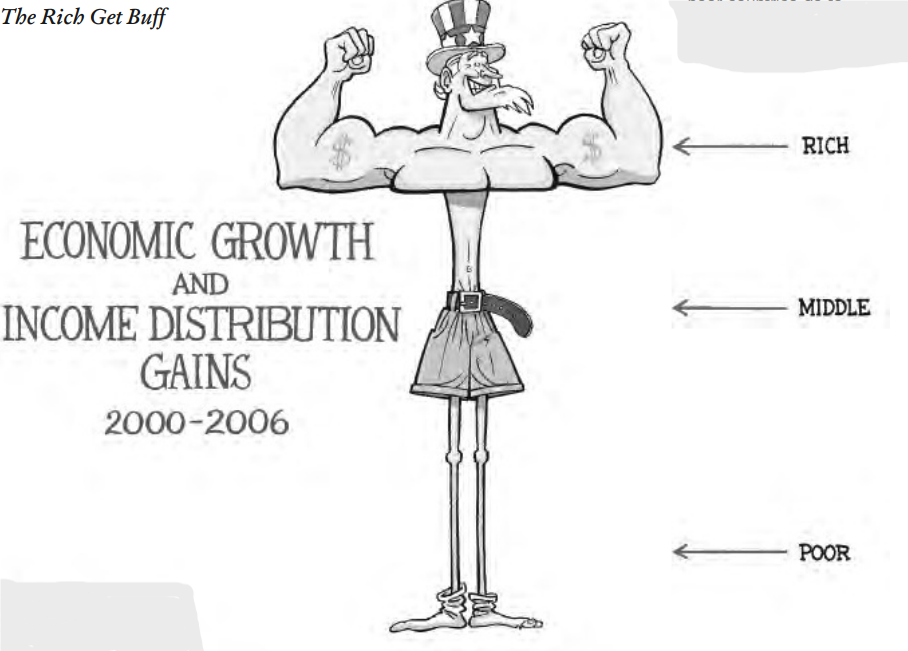
Strong upper body = Rich people
The rich have become stronger and richer. They gained the most from economic growth.
Thin middle body = Middle class
The middle class got some benefits, but not much. Their income didn’t increase very significantly.
Weak legs = Poor people
The poor remain weak. They hardly got any benefit from growth.
-The cartoon highlights unequal distribution of economic growth:
- Economic growth happened in the country,
- But most of the benefits went to the rich,
- The middle class got very little,
- And the poor got almost nothing.
-This problem is called income inequality.
——————————————————————————–
REDUCTION OF INEQUALITY AND POVERTY
Democracy aims not only to grant citizens the right to vote, but also to ensure that everyone has equal possibilities in life. One of the most important effects of democracy is an effort to minimize inequality and poverty, which makes society more just and equitable.
INEQUALITY: Inequality refers to the unequal distribution of wealth, resources, and opportunities among individuals. For example, some individuals have access to better education, jobs, and opportunities than others.
POVERTY: Poverty is defined as a lack of resources to meet basic human requirements such as food, health, education, and housing. The poor frequently have limited options to earn and improve their life.
*How Democracy Works to Reduce Inequality
Democracy promotes not just political equality, but also social and economic equality.
(a) Equal Rights for All
- Every citizen gets equal political rights — one person, one vote, one value. This helps marginalized groups raise their voice.
(b) Policies to Support Weaker Sections
- Democratic governments create special programs for disadvantaged groups.
- For examples:
- Reservation for SC/ST in education and jobs
- Schemes for women and backward classes
- Social justice policies to reduce discrimination
(c) Government Accountability
- Leaders are answerable to the public. They must frame policies that reduce gaps between rich and poor.
(d) Welfare Programs
- Democracies introduce schemes to help the poor meet their basic needs, such as, Subsidized food through ration shops, Free/affordable healthcare, Housing schemes, and Scholarships.
(e) Employment Opportunities
Programs that create jobs for those with low income, such as – Rural employment schemes, Skill development programs, and Support for small businesses and self-employment
(f) Access to Basic Services
- Democracy ensures – More schools and colleges, Better hospitals, Clean water and roads.
—————————————————————————————-
*Case Study on – “Voice of the Poor”
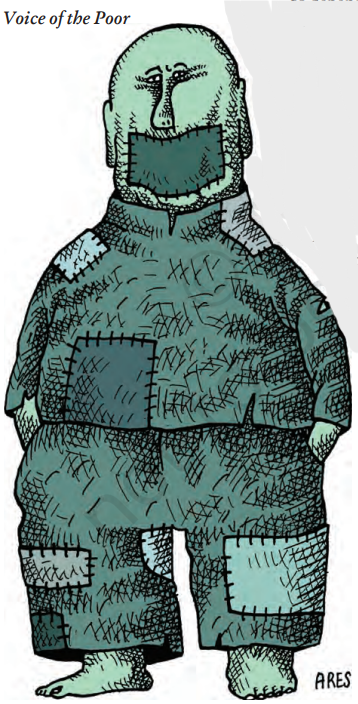
The image shows a poor person standing still in worn-out, patched clothing. This cartoon shows a basic drawback of democracy – even though democracies promise equality and justice, poor people are sometimes sidelined.
– The cartoon suggests that:
- The poor have a “voice,” but it is frequently ineffective in front of the powerful.
- Democratically elected governments should try to reduce poverty, but they are generally less active than expected.
- Poverty impacts millions, particularly in developing nations such as India and Bangladesh.
—————————————————————————————
*Case Study on – “World’s Wealth Owned by a Few”
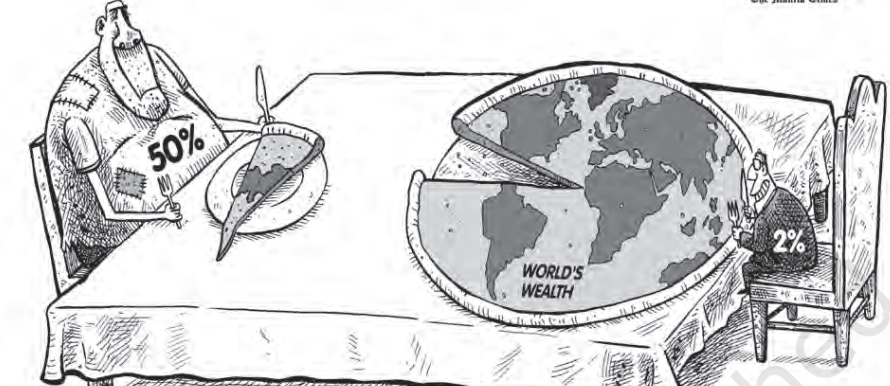
This powerful illustration highlights one of the major challenges democracies face—economic inequality.
The graphic provides a remarkable visual of how wealth is distributed unequally around the world. The cartoon shows an extremely wealthy man taking over half of the world’s wealth, while a much smaller and weaker individual receives only a small share.
This cartoon shows:
- Only a few rich families own a huge share of the world’s wealth.
- The majority of people get a very small share, even though they work hard.
- Democracies do not automatically reduce economic inequality—they require strong policies to do so.
From this, We can conclude that economic inequality can create dissatisfaction and weaken democratic values if not addressed.
————————————————————————————
ACCOMMODATION OF SOCIAL DIVERSITY
Social diversity refers to the different social groups that exist in a society based on religion, language, caste, culture, geography, or ethnicity.
One of democracy’s greatest strengths is its ability to recognize social differences and establish a framework in which diverse groups can coexist peacefully. Rather than imposing “one uniform culture,” democracy seeks to accommodate many communities.
*Features of Accommodation in a Democracy
1. Majority Rule Cannot Mean Rule by One Community
- Democracy means giving importance to the views of the majority,
but this majority should be formed of different social groups, not just one dominant group.
2. Democracy Encourages Mutual Respect
- Different groups learn to – Listen to each other, resolve disputes peacefully, and find common ground. This reduces social tensions and promotes political stability.
3. Power Sharing Helps Reduce Conflicts
- Democracies follow power-sharing arrangements to avoid situations where one group controls everything. Such arrangements protect weaker communities and reduce the risk of conflict.
4. Diversity is Seen as a Strength, not a Problem
- A good democracy treats differences as an opportunity to learn, not as threats.
DIGNITY AND FREEDOM OF CITIZENS
Dignity means self-respect, feeling appreciated, and being regarded as an equal human being. Democracy provides dignity by guaranteeing that every person is valued, regardless of caste, religion, gender, or economic status.
Dignity is important because – it allows people to live with respect, protects individuals from humiliation and discrimination, and gives citizens the confidence to participate in public life freely.
There are the following ways by which democracy Protects Dignity & Freedom:
1. Equality Before the Law
- Every citizen is treated equally, whether rich or poor. This prevents discrimination and gives everyone the right to live with dignity.
2. Fundamental Rights Guarantee Freedom
- Rights like freedom of speech, religion, movement, and expression are protected by the Constitution. These rights allow citizens to live freely and express themselves without fear.
3. Government is Accountable to the People
- Leaders cannot misuse power because citizens can question them through elections, media, and public opinion. This accountability protects people from unfair or disrespectful treatment.
4. Protection of Minority Rights
- Democracy ensures that minorities (religious, linguistic, caste-based) are given protection and respect. This prevents domination by the majority and safeguards the dignity of weaker groups.
5. Freedom to Raise Voice Against Injustice
- Citizens can protest, file complaints, go to court, or speak through the media. It ensures that no one has to silently suffer humiliation or unfair treatment.
6. Power Sharing Reduces Discrimination
- Power is shared among groups through federalism, reservations, and local governments. This gives representation to disadvantaged sections, improving their dignity and confidence.
7. Respect for Women & Marginalized Groups
- Democracy encourages policies against discrimination and unequal practices. women, dalits, and minorities receive more respect, rights, and opportunities.
8. Independent Judiciary Protects Freedoms
- Courts can stop unfair actions by the government or individuals. Citizens can depend on the judiciary to safeguard their dignity and freedoms.