heredity

HEREDITY NOTES Class 10 Science (Biology)

HEREDITY Heredity is a biological process through which parents pass their characteristics to their children. Every living organism, whether a plant, animal, or human, inherits traits from its previous generations. It explains why we share similarities with our family — such as facial features, height, voice, or even certain habits. Heredity is controlled by genes, which are tiny units of information present inside our cells. Because of heredity, the continuity of characteristics is maintained in a species, meaning that the next generation shares many common characteristics with the previous one. VARIATION The process of heredity also brings variations, so even though we resemble our parents, we are not exact copies of them. Variation means the differences in traits or characteristics among individuals of the same species. *Importance of Variation Variations are essential because they: TRAITS Traits are the specific characteristics or features of an organism. They decide how an organism looks, behaves, or functions. Each trait is determined by a pair of genes. Examples: Eye colour, height, hair type, skin colour, blood group, etc. *Difference Between Inherited Traits and Acquired Traits Basis Inherited Traits Acquired Traits Meaning Traits that are passed from parents to offspring through genes. Traits that an organism develops during its lifetime due to environment or experience. Cause Caused by genetic information (DNA). Caused by environment, habits, lifestyle, training, etc. Present From Birth Yes, inherited traits are present from birth. No, they develop after birth. Transfer to Next Generation Yes, inherited traits can be passed to offspring. No, acquired traits are not passed to offspring. Examples Eye colour, hair type, height tendency, blood group. Learning to swim, bodybuilding, scars, tanning of skin. Role in Evolution Play a major role in evolution as they are heritable. Play little or no role in evolution because they aren’t inherited. Based On Genes and alleles. Environment and personal experience. Controlled By Genes on chromosomes. External factors and lifestyle. SOME IMPORTANT TERMS DNA DNA stands for Deoxyribonucleic Acid. DNA is the chemical substance present in the nucleus of every cell. It is a double stranded thread like structure. DNA carries all genetic information that decides the traits of an organism. DNA is made up of – Sugar, Phosphate, and Nitrogenous Bases. It passes from one generation to another. Chromatin and Chromosomes When DNA is in scattered form – this structure is called Chromatin. At the time of Cell Division, Chromatin get condensed. This structure of DNA is called Chromosomes. Basis Chromatin Chromosomes Definition Long, thin, thread-like structure made of DNA and proteins. Condensed, thick, rod-like structure formed from chromatin. Appearance Looks like loose threads. Looks like thick rods. Visibility Not visible clearly under a microscope. Clearly visible during cell division. State of Cell Present in non-dividing cells. Present during cell division (mitosis/meiosis). Structure Uncoiled and extended. Highly coiled and condensed. Function Allows gene expression, DNA replication, and packaging. Ensures accurate distribution of DNA to daughter cells. Composition DNA + proteins (histones). Tightly packed chromatin fibres. Genes Genes are present but loosely arranged. Genes are arranged in a fixed order along chromosome arms. *Chromosome Number – Chromosome number helps in maintaining genetic stability across generations. – Humans have 46 chromosomes (arranged in 23 pairs) – Out of these: – All Cells of Human body are Diploid except Gametes. – Gametes (sperm cell and egg cell) are Haploid Cells. HAPLOID AND DIPLOID A living organism’s cells have a set number of chromosomes. This number determines whether a cell is haploid (n) or diploid (2n). *Haploid *Diploid GENES A gene is a unit of heredity composed of DNA that regulates the expression of a specific trait in an organism. Genes are hereditary units on chromosomes that contain coded information (DNA instructions) for protein production, which determines an organism’s traits and characteristics. In simple words, Genes are small segments of DNA that carry information for a specific trait and are passed from parents to their children. A gene is basically a set of instructions that tells the body how to acquire a particular trait (such as eye color, height, hair type, and so on). Genes are found inside the nucleus of every cell and sit on chromosomes in a fixed, specific position called a locus. Humans have 20,000 to 25,000 genes approximately. These are spread across 23 pairs of chromosomes. ALLELES In genetics, every trait in our body is controlled by two types of a gene called alleles—one inherited from the mother and the other from the father. Allele is an alternative version or form of a gene. These are different variants of a gene that share the same location (locus) on homologous chromosomes. They are paired versions of a gene inherited from parents, with each allele carrying slightly different information, resulting in the formation of distinct features such as eye color, height, or hair type. We have alleles because we inherit one chromosome from our mother and one from our father, and the genes on them are also paired. Genes are the traits, whereas Alleles are Variations of the trait. Difference Between Genes and Alleles Basis Genes Alleles Meaning A gene is a unit of heredity that controls a specific trait. Alleles are different forms or versions of the same gene. Role Determines a particular character (like eye colour). Determines the different expressions of that character (brown/blue eyes). Count Each trait has one gene. Each gene exists in two allelic forms (one from each parent). Location Found at a fixed position on chromosomes. Found at the same position (locus) on homologous chromosomes. Examples Gene for eye colour, gene for height. B & b (brown and blue eye alleles), T & t (tall and short alleles). Nature General information-carrying unit. Specific variations of that information. Function Controls basic development of traits. Controls which form of the trait will be expressed. Dominant Allele Dominant Allele is the stronger one from the two Alleles. It is the stronger form of a gene that expresses its trait even if only one copy is present. It is always written…

Read More
Reproduction

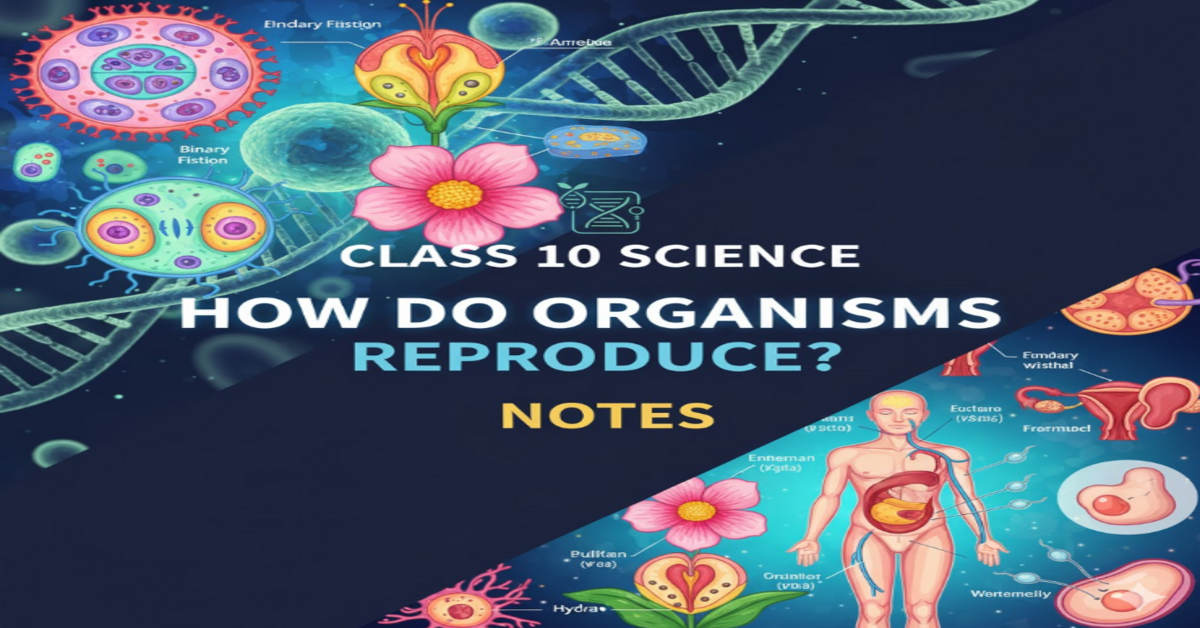
CLASS 10 SCIENCE Chapter- How do Organism Reproduce | NOTES

INTRODUCTION– Reproduction Reproduction is the biological process by which new individuals (offspring) are produced from their parents. It ensures the continuity of life on Earth. Reproduction is a life process, but not essential for survival of an individual — it is essential for the survival of species. DNA (Deoxyribonucleic Acid), present in the nucleus of every cell, is the hereditary molecule that carries genetic information, gets copied during reproduction, and ensures continuity and variation in organisms. TYPES OF REPRODUCTION 1. ASEXUAL REPRODUCTION Asexual reproduction is the type of reproduction in which only one parent is involved and no fusion of gametes takes place.The offspring produced are genetically identical to the parent, i.e., they are exact copies or clones of the parent. *Characteristics of Asexual Reproduction *Advantages of Asexual Reproduction: *Disadvantages of Asexual Reproduction: 2. SEXUAL REPRODUCTION Sexual reproduction is the type of reproduction in which two parents (male and female) are involved and fusion of male and female gametes occurs to form a zygote, which develops into a new organism.The offspring produced show variations because they inherit genetic material from both parents. *Characteristics of Sexual Reproduction: *Advantages of Sexual Reproduction: *Disadvantages of Sexual Reproduction: METHODS OF ASEXUAL REPRODUCTION 1. FISSION In this process, a unicellular organism divides into two or more new individuals. -There are two types of Fission: Binary Fission and Multiple Fission. i. Binary Fission: The parent cell divides into two equal halves. For example: Amoeba ii. Multiple Fission: The parent cell divides into many daughter cells. It usually occurs in unfavourable conditions. For example: Plasmodium (malaria parasite) 2. BUDDING In this method, a small outgrowth (bud) develops on the parent’s body, which grows and later detaches to form a new individual. For Example: Yeast and Hydra 3. FRAGMENTATION In this process, the body of the parent organism breaks into two or more fragments, and each fragment grows into a new organism. It Occurs only in simple multicellular organisms with simple body organization, not seen in complex animals or plants. For Example: Spirogyra (algae) 4. REGENERATION The ability of an organism to regrow lost body parts, and sometimes a whole new organism can be formed from a body fragment. Regeneration occurs through specialized cells that divide and differentiate into new tissues. For Example: Planaria, and Starfish 5. SPORE FORMATION It is a method of asexual reproduction in which the parent produces tiny spherical spores inside a sporangium (spore case).When the sporangium bursts, the spores spread and grow into new organisms under suitable conditions. For Example: Rhizopus (Bread Mould) 6. VEGETATIVE PROPAGATION (in plants) It is the asexual reproduction in plants where new plants are produced from vegetative parts like root, stem, leaf, or bud, instead of seeds. SEXUAL REPRODUCTION Sexual reproduction is the type of reproduction in which two parents are involved, and fusion of male and female gametes occurs to form a zygote, which later develops into a new individual. –Sexual reproduction is the most common mode of reproduction in higher plants and animals. -It involves two parents — one male and one female. -This process leads to the formation of genetically different offspring due to fusion of gametes and mixing of genetic material. -It helps in variation, evolution, and survival of species. SEXUAL REPRODUCTION IN PLANTS Sexual reproduction in plants involves the fusion of male and female gametes, resulting in the formation of a zygote, which grows into a seed and later forms a new plant. This process ensures variation and continuity of species. -Reproductive Organ of the Plant: *Structure of Male and Female Reproductive Parts 1. Male Part – Stamen It consists of: 2. Female Part – Carpel / Pistil It consists of: *Steps involved in sexual reproduction in plants The process occurs in four main stages: STEP 1: POLLINATION Pollination is the process of transferring pollen grains from the anther (male part) to the stigma (female part) of a flower. – Types of Pollination: – Agents of Pollination: Pollination is carried out by wind, water, insects, or birds.(Bees and butterflies are the most common pollinators) STEP 2: FERTILIZATION STEP 3: FRUIT AND SEED FORMATION After fertilization, many changes take place inside the flower: STEP 4: GERMINATION When the seed falls on the soil and gets favourable conditions like air, water, and warmth — it germinates.The embryo inside the seed starts growing into a new plant, completing the life cycle. SEXUAL REPRODUCTION IN HUMAN BEING Reproduction in human beings is a sexual mode of reproduction, involving two parents — a male and a female. It ensures the continuity of human life and the transfer of genetic information from parents to offspring. This process involves the formation of gametes, their fusion (fertilization), and the development of a new individual from the zygote. *PUBERTY -Puberty is the stage when the body becomes capable of reproduction. -It is controlled by hormones and marks physical, physiological, and emotional changes. -Generally occurs between: -Changes at Puberty in Males: – Changes at Puberty in Females: *MALE REPRODUCTIVE SYSTEM The male reproductive system is responsible for the production, storage, and delivery of sperms (male gametes). It also produces the male sex hormone – Testosterone, which controls the development of male features and reproduction. -Testes (singular: Testis): -Vas Deferens (Sperm Duct): -Urethra: -Penis: *FEMALE REPRODUCTIVE SYSTEM The female reproductive system is designed to produce female gametes (ova or eggs), receive sperms from the male, and provide a safe environment for fertilization and development of the baby.It also produces female hormones that control reproductive cycles and secondary sexual characteristics. -Ovaries -Oviducts (Fallopian Tubes) -Uterus (Womb) –Cervix -Vagina *FERTILIZATION OF EGG Fertilisation is the process in which the male gamete (sperm) fuses with the female gamete (egg or ovum) to form a zygote, which is the first cell of a new individual. In humans, fertilisation occurs in the fallopian tube (oviduct) of the female reproductive system. There are two Types of Fertilization: #Humans show internal fertilisation, i.e., fertilisation takes place inside the female body. -Process of Fertilisation: -When the Egg is Fertilised -When the…

Read More
Globalization

CLASS 10 ECONOMICS Chapter- GLOBALIZATION AND INDIAN ECONOMY | NOTES

INTRO- GLOBALIZATION Globalization means the process of integration or interconnection between countries through the movement of goods, services, people, capital (money), and information. In simple terms, it is the process that turns the world into one large market — where countries are connected economically and culturally. “Globalization is the process by which the world’s economies, societies, and cultures are becoming interconnected through increased cross-border trade, investment, and communication.” Globalization has grown to include far more than just trade. This includes: Multinational Corporations (MNCs) are the main driving force behind globalization. MNCs play a central role in connecting national economies and spreading globalization. MULTINATIONAL CORPORATIONS (MNCs) An MNC is a company that owns or controls production and business operations in more than one country. It is also known as Transnational Corporation. *Aims / Objectives of MNCs *Role of MNCs in Globalization *Benefits from MNCs to Local Companies Benefits Explanation / Example 1. Capital Investment MNCs bring foreign money that helps local companies expand business and production. 2. Transfer of Technology Local firms get access to advanced machines and modern production methods. 3. Better Skills and Standards Workers and managers learn new techniques and improve quality of work. 4. Increased Demand for Local Goods MNCs buy raw materials and parts from local suppliers, creating new business. 5. New Business Opportunities Local small businesses grow as suppliers, transporters, or service providers. 6. Access to Global Markets Collaboration with MNCs helps local firms export goods and enter global trade. 7. Improved Competitiveness Local companies upgrade quality and efficiency to compete globally. IMPACT OF GLOBALIZATION Positive Impacts Negative Impacts 1. More foreign investment 1. Unequal benefits 2. Expanded markets 2. Loss to small industries 3. Advanced technology 3. Job insecurity 4. More employment 4. Environmental damage 5. Growth of Indian companies 5. Cultural erosion 6. Better quality & lower prices 6. Rural sector left behind 7. Global exchange of ideas 7. Economic dependence FACTORS THAT ENABLED GLOBALIZATION 1. Rapid Improvement in Technology 2. Liberalization of Foreign Trade and Investment Policy 3. Role of Multinational Companies (MNCs) 4. Growth of Communication Networks 5. Development of Global Financial Systems 6. Trade Agreements and International Organizations 7. Political and Economic Reforms in Developing Countries NEW ECONOMIC POLICY 1991 It was Introduced in 1991 by the government of India under Prime Minister P. V. Narasimha Rao and Finance Minister Dr. Manmohan Singh. The New Economic Policy of 1991 marked a major turning point in India’s economic history. It shifted India from a closed and controlled economy to an open and market-oriented economy. Reason: India faced a serious economic crisis – low foreign exchange, high inflation, and high debt. The main feature of NEP 1991 was LPG policy – Liberalization, Privatization, Globalization.

Read More