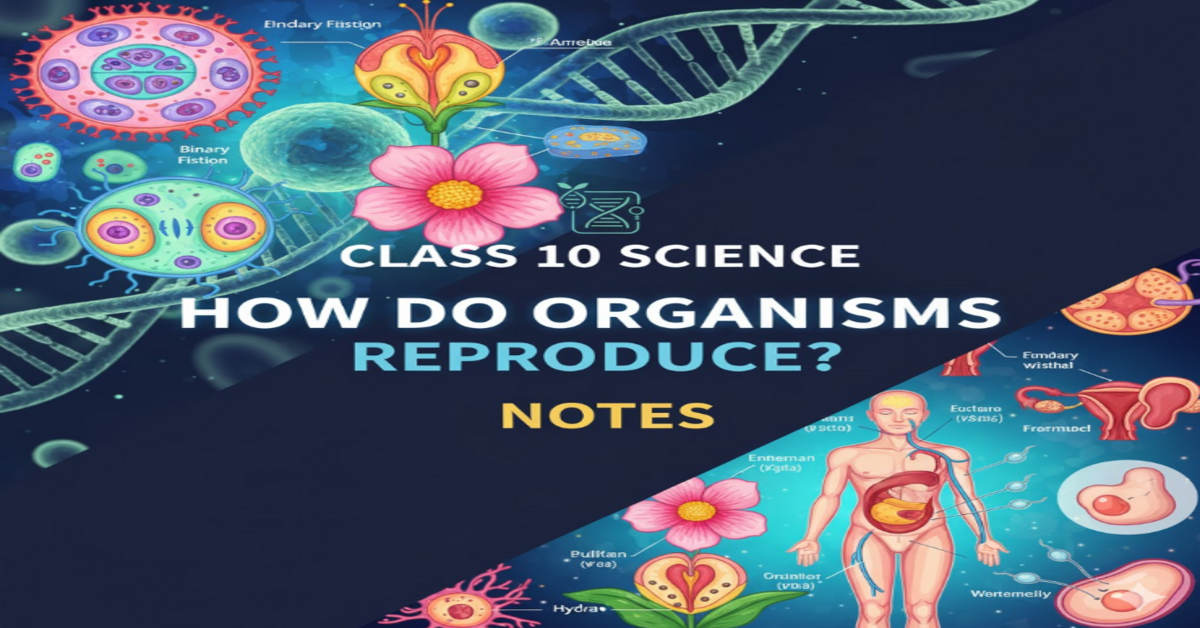
INTRODUCTION– Reproduction Reproduction is the biological process by which new individuals (offspring) are produced from their parents. It ensures the continuity of life on Earth. Reproduction is a life process, but not essential for survival of an individual — it is essential for the survival of species. DNA (Deoxyribonucleic Acid), present in the nucleus of every cell, is the hereditary molecule that carries genetic information, gets copied during reproduction, and ensures continuity and variation in organisms. TYPES OF REPRODUCTION 1. ASEXUAL REPRODUCTION Asexual reproduction is the type of reproduction in which only one parent is involved and no fusion of gametes takes place.The offspring produced are genetically identical to the parent, i.e., they are exact copies or clones of the parent. *Characteristics of Asexual Reproduction *Advantages of Asexual Reproduction: *Disadvantages of Asexual Reproduction: 2. SEXUAL REPRODUCTION Sexual reproduction is the type of reproduction in which two parents (male and female) are involved and fusion of male and female gametes occurs to form a zygote, which develops into a new organism.The offspring produced show variations because they inherit genetic material from both parents. *Characteristics of Sexual Reproduction: *Advantages of Sexual Reproduction: *Disadvantages of Sexual Reproduction: METHODS OF ASEXUAL REPRODUCTION 1. FISSION In this process, a unicellular organism divides into two or more new individuals. -There are two types of Fission: Binary Fission and Multiple Fission. i. Binary Fission: The parent cell divides into two equal halves. For example: Amoeba ii. Multiple Fission: The parent cell divides into many daughter cells. It usually occurs in unfavourable conditions. For example: Plasmodium (malaria parasite) 2. BUDDING In this method, a small outgrowth (bud) develops on the parent’s body, which grows and later detaches to form a new individual. For Example: Yeast and Hydra 3. FRAGMENTATION In this process, the body of the parent organism breaks into two or more fragments, and each fragment grows into a new organism. It Occurs only in simple multicellular organisms with simple body organization, not seen in complex animals or plants. For Example: Spirogyra (algae) 4. REGENERATION The ability of an organism to regrow lost body parts, and sometimes a whole new organism can be formed from a body fragment. Regeneration occurs through specialized cells that divide and differentiate into new tissues. For Example: Planaria, and Starfish 5. SPORE FORMATION It is a method of asexual reproduction in which the parent produces tiny spherical spores inside a sporangium (spore case).When the sporangium bursts, the spores spread and grow into new organisms under suitable conditions. For Example: Rhizopus (Bread Mould) 6. VEGETATIVE PROPAGATION (in plants) It is the asexual reproduction in plants where new plants are produced from vegetative parts like root, stem, leaf, or bud, instead of seeds. SEXUAL REPRODUCTION Sexual reproduction is the type of reproduction in which two parents are involved, and fusion of male and female gametes occurs to form a zygote, which later develops into a new individual. –Sexual reproduction is the most common mode of reproduction in higher plants and animals. -It involves two parents — one male and one female. -This process leads to the formation of genetically different offspring due to fusion of gametes and mixing of genetic material. -It helps in variation, evolution, and survival of species. SEXUAL REPRODUCTION IN PLANTS Sexual reproduction in plants involves the fusion of male and female gametes, resulting in the formation of a zygote, which grows into a seed and later forms a new plant. This process ensures variation and continuity of species. -Reproductive Organ of the Plant: *Structure of Male and Female Reproductive Parts 1. Male Part – Stamen It consists of: 2. Female Part – Carpel / Pistil It consists of: *Steps involved in sexual reproduction in plants The process occurs in four main stages: STEP 1: POLLINATION Pollination is the process of transferring pollen grains from the anther (male part) to the stigma (female part) of a flower. – Types of Pollination: – Agents of Pollination: Pollination is carried out by wind, water, insects, or birds.(Bees and butterflies are the most common pollinators) STEP 2: FERTILIZATION STEP 3: FRUIT AND SEED FORMATION After fertilization, many changes take place inside the flower: STEP 4: GERMINATION When the seed falls on the soil and gets favourable conditions like air, water, and warmth — it germinates.The embryo inside the seed starts growing into a new plant, completing the life cycle. SEXUAL REPRODUCTION IN HUMAN BEING Reproduction in human beings is a sexual mode of reproduction, involving two parents — a male and a female. It ensures the continuity of human life and the transfer of genetic information from parents to offspring. This process involves the formation of gametes, their fusion (fertilization), and the development of a new individual from the zygote. *PUBERTY -Puberty is the stage when the body becomes capable of reproduction. -It is controlled by hormones and marks physical, physiological, and emotional changes. -Generally occurs between: -Changes at Puberty in Males: – Changes at Puberty in Females: *MALE REPRODUCTIVE SYSTEM The male reproductive system is responsible for the production, storage, and delivery of sperms (male gametes). It also produces the male sex hormone – Testosterone, which controls the development of male features and reproduction. -Testes (singular: Testis): -Vas Deferens (Sperm Duct): -Urethra: -Penis: *FEMALE REPRODUCTIVE SYSTEM The female reproductive system is designed to produce female gametes (ova or eggs), receive sperms from the male, and provide a safe environment for fertilization and development of the baby.It also produces female hormones that control reproductive cycles and secondary sexual characteristics. -Ovaries -Oviducts (Fallopian Tubes) -Uterus (Womb) –Cervix -Vagina *FERTILIZATION OF EGG Fertilisation is the process in which the male gamete (sperm) fuses with the female gamete (egg or ovum) to form a zygote, which is the first cell of a new individual. In humans, fertilisation occurs in the fallopian tube (oviduct) of the female reproductive system. There are two Types of Fertilization: #Humans show internal fertilisation, i.e., fertilisation takes place inside the female body. -Process of Fertilisation: -When the Egg is Fertilised -When the…
Read More