Table of Contents
ToggleEconomic Activities
Every person performs different types of activities in daily life. Some activities are done to earn money, while others are done for personal satisfaction or family needs. The activities that are performed to earn income or a livelihood are called economic activities.
Economic activities are activities that people perform to earn income or a livelihood. These activities involve the production, distribution, and consumption of goods and services.
*Why are they important?
- Livelihood: They provide income to support individuals and families.
- National Growth: They contribute to the total production of goods and services in the country (GDP).
- Development: They create opportunities for trade, employment, and better standards of living.
Three Sectors in the Economy
Economic activities are grouped into different sectors based on the nature of work they perform. The economy is broadly divided into three sectors:
- Primary Sector
- Secondary Sector
- Tertiary Sector
Each sector plays an important role in the growth and development of the economy.
1. Primary Sector
The primary sector forms the base of the economy. It includes all those economic activities where we produce goods by exploiting natural resources.
Since most of the natural products we get are from agriculture, dairy, fishing, and forestry, this sector is also called the Agriculture and Related Sector.
–Key Characteristics
- Direct Dependence: The production in this sector depends mainly on natural factors like soil, water, sunlight, and climate.
- Nature-based Products: The output of this sector consists of goods obtained directly from nature.
- Raw Material Provider: It provides the essential raw materials required by the secondary (industrial) sector for further production.
–Why is it called ‘Primary?
It is called ‘primary’ because it forms the base for all other products that we subsequently make. Most of the natural products we get come from agriculture, dairy, fishing, and forestry, which is why it is the starting point of the economic production process.
2. Secondary Sector
The Secondary Sector includes activities in which natural products are changed into other forms through manufacturing. Unlike the Primary Sector, goods in this sector are not obtained directly from nature. Instead, they are produced by processing raw materials into finished goods.
Since this sector is mainly associated with industries, it is also known as the Industrial Sector.
–Key Characteristics
- Transformation: Unlike the primary sector, goods here are not produced by nature; they must be made through a manufacturing process.
- Manufacturing Environment: This process can take place in a factory, a workshop, or even at home.
- Industrial Association: Because this sector is linked with different kinds of industries that have developed, it is also known as the Industrial Sector.
–Why is it Called the Secondary Sector?
It is called the Secondary Sector because:
- It is the next stage after the Primary Sector.
- It uses the raw materials obtained from the Primary Sector.
- It converts natural products into finished or manufactured goods.
3. Tertiary Sector
The Tertiary Sector consists of activities that help people or support other sectors by providing services instead of producing goods.
Since it provides services rather than producing goods, it is also called the Service Sector.
–Key Characteristics
- Supportive Role: These activities help in the development of the primary and secondary sectors.
- Service-Oriented: This sector produces services rather than physical goods.
- Wide Scope: It includes both services that aid in production and other essential services.
Difference between the 3 Sectors
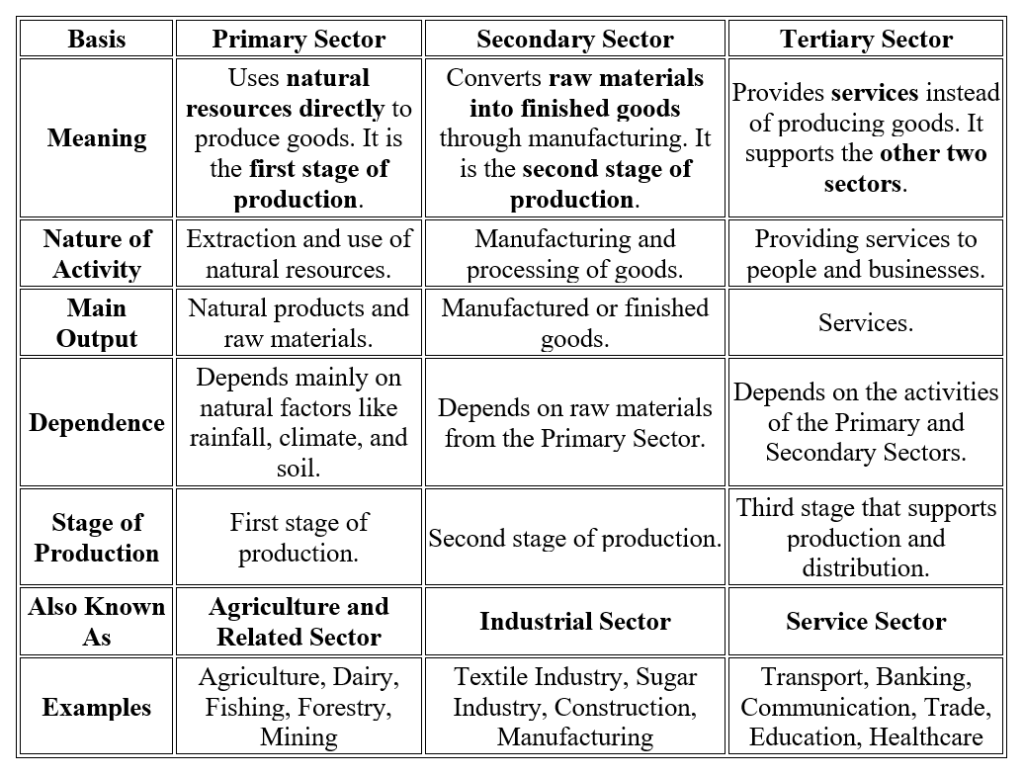
Goods and Services
In economics, all human activities result in the production of either goods or services. These are the fundamental units of production in the three sectors of the economy.
Goods: Physical, tangible items that can be seen and touched. For e.g., cars, computers, nails, furniture.
Services: Intangible actions or work performed by people to help others or support production. For e.g., transport, banking, teaching.
*Types of Goods and Services
1. Intermediate Goods and Services
- These are goods used as raw materials or inputs in the production of other final goods.
- They are used up during the production process and are not sold to the final consumer.
- Example: Wheat sold to a flour mill or flour sold to a biscuit company.
2. Final Goods and Services
- These are goods that have reached their final user and are ready for consumption or investment.
- No further processing is required. Their value is counted in the GDP.
- Example: Biscuits sold to a consumer in a packet.
Comparing the Three Sectors
The Primary, Secondary, and Tertiary Sectors produce a large variety of goods and services. Since all three sectors contribute to the economy, it is important to know:
- How much each sector produces.
- How many people work in each sector.
–Why Do We Compare the Three Sectors?
Comparing the three sectors helps us to:
- Know the contribution of each sector to the economy.
- Compare their share in total production.
- Compare the employment provided by each sector.
- Identify the dominant sector in an economy.
A sector with the highest contribution to production or employment is called the dominant sector.
–How do we count total production?
Calculating the production of thousands of different goods (like cars, computers, and furniture) by adding their quantities is impossible and makes no sense. To address this, economists suggest using the monetary values of goods and services rather than adding up their actual numbers.
–The Precaution: Final Goods vs. Intermediate Goods
A crucial rule when calculating production is to count only final goods and services.
The “Double Counting” Problem: The value of final goods already includes the value of all intermediate goods used to create them. If we count intermediate goods separately from the final good, we would be counting the value of the same items multiple times.
Interdependency of Various Sectors
It means that the three sectors depend on one another for their activities and growth. The output of one sector becomes the input or support for another sector.
- Primary to Secondary: The Secondary sector depends on the Primary sector for raw materials, such as cotton from the farm to produce cloth, or sugarcane to produce sugar.
- Secondary to Primary: The Primary sector relies on the Secondary sector for tools, equipment, and inputs like fertilizers or machines to enhance production.
- Support from Tertiary: The Tertiary sector provides essential services that support both the Primary and Secondary sectors. Like – transport, storage, banking, communication, and trade.
Gross Domestic Product (GDP)
GDP (Gross Domestic Product) is the sum of the production in the three sectors (Primary, Secondary, and Tertiary). It is defined as the value of all final goods and services produced within a country during a particular year.
-GDP shows how big an economy is.
-It considers only the monetary value of final goods and services to avoid double counting.
-In India, a central government ministry, with the help of government departments from all states and union territories, collects data on the volume of goods and services and their prices to estimate the GDP.
#NOTE:
GVA: Gross Value Added (GVA) measures the contribution of the three economic sectors after making adjustments for taxes and subsidies.
Historical Changes in Sectors
In the initial stages of development, the Primary Sector contributed the largest share to GDP. As industries developed, the Secondary Sector started growing. In recent years, the Tertiary Sector has become the largest contributing sector to India’s GDP.
- Primary Sector: Its share in GDP has declined over the years.
- Secondary Sector: Its share has increased, but not as rapidly as the Tertiary Sector.
- Tertiary Sector: Its share has increased significantly and has become the largest contributor to GDP.
*Why Did These Changes Take Place?
1. Decline in the Share of the Primary Sector
- As the economy developed, the importance of agriculture in GDP gradually decreased.
- Although agricultural production increased, other sectors grew at a faster rate.
2. Growth of the Secondary Sector
- Development of industries increased the production of manufactured goods.
- Industrial growth created more employment and contributed more to the economy.
3. Rapid Growth of the Tertiary Sector
- Increase in agricultural and industrial production, which created demand for services like transport, trade, and storage.
- Expansion of education, healthcare, banking, communication, and insurance services.
- Rise in information technology (IT) and other service-based activities.
- Increase in people’s income, leading to a higher demand for various services.
Employment of People in Different Sectors
A large proportion of India’s workforce is employed in the Primary Sector, even though its contribution to GDP has declined over the years.
At the same time, the Secondary and Tertiary Sectors contribute a larger share to GDP, but they employ a comparatively smaller proportion of workers.
*Sector-wise Employment Pattern
1. Primary Sector
- Employs the largest number of people in India.
- Most people are engaged in agriculture and related activities.
- Its share in employment is much higher than its share in GDP.
2. Secondary Sector
- Employs people in manufacturing and industrial activities.
- Provides employment in factories, industries, and construction.
- Its share in employment is lower than the Primary Sector.
3. Tertiary Sector
- Provides employment through services such as transport, banking, education, healthcare, communication, and trade.
- Employment in this sector has increased over time due to the growing demand for services.
Creating More Employment
Since the primary sector (agriculture) remains the largest employer despite a decline in its share of GDP, creating more jobs is essential to improve the economic condition of the people.
*Strategies for Employment Generation
- Irrigation and Infrastructure: Providing loans for seeds, fertilizers, and building small dams or canals can allow farmers to grow more than one crop in a year, creating more jobs.
- Transportation and Connectivity: Improving roads and transportation allows farmers to sell their products in urban markets, which generates employment in transport and trade.
- Agro-based Industries: Setting up local centers for processing agricultural products (e.g., dal mills, honey collection) provides jobs in rural areas rather than just in large urban industries.
- Social Services: Expanding education and healthcare services in rural areas creates numerous jobs for teachers, doctors, nurses, and administrative staff.
- Promotion of Tourism and Crafts: Encouraging local tourism or regional crafts can generate immediate employment for many people.
Right to Work: MGNREGA 2005
To address the problem of unemployment and underemployment, the government has implemented legal measures to guarantee work for those in need. The most significant of these is the Mahatma Gandhi National Rural Employment Guarantee Act (MGNREGA) 2005.
*Key Features of MGNREGA 2005
- Guaranteed Employment: Under this act, all those who are able to, and are in need of, work in rural areas are guaranteed 100 days of employment in a year by the government.
- Failure to Provide Work: If the government fails to provide employment, it will give unemployment allowances to the people.
- Type of Work: The act prioritizes work that will help to increase the production from land in the future.
*Why is it Important?
- Legal Right: It turns the “Right to Work” into a legal guarantee for rural citizens.
- Economic Security: It provides a basic safety net for families who rely on seasonal or manual labour, helping to reduce rural poverty.
- Focus on Development: By linking employment to productive work (like land improvement), it ensures that the work done contributes to long-term economic development.
Classification of Sectors: Working Conditions
Economic activities can be classified based on the nature of employment and the working conditions of the people involved. This divides the economy into two distinct sectors: the Organized Sector and the Unorganized Sector.
1. Organized Sector
This sector covers enterprises or places of work where the terms of employment are regular and people have assured work.
- Registration: These units are registered by the government and have to follow its rules and regulations (e.g., Factories Act, Minimum Wages Act).
- Benefits: Employees enjoy security of employment, fixed working hours, and extra pay for overtime.
- Facilities: Workers get benefits like paid leave, payment during holidays, provident fund, and medical benefits.
- Examples: Government employees, registered factory workers, and bank staff.
2. Unorganized Sector
This sector is characterized by small and scattered units that are largely outside the control of the government.
- Regulations: Rules and regulations exist but are not followed by employers, as there is no government registration for these units.
- Job Conditions: Jobs here are low-paid, often irregular, and provide no security of employment.
- Lack of Benefits: There is no provision for overtime, paid leave, or medical/social security benefits.
- Examples: Casual workers in construction, shops, street vendors, and landless agricultural laborers.
*Protecting Workers in the Unorganized Sector
Since employment in the unorganized sector is characterized by low wages, lack of job security, and an absence of benefits, there is an urgent need for government protection.
–Rural Areas: Protection is needed for landless agricultural laborers, small and marginal farmers, sharecroppers, and artisans.
- The government can support these workers by providing timely delivery of seeds, agricultural inputs, credit, storage facilities, and marketing outlets.
–Urban Areas: Protection is needed for workers in small-scale industries, construction workers, trade and transport workers, street vendors, head-load workers, and garment makers.
- These workers require government assistance with raw material procurement and the marketing of finished products.
Sectors in Terms of Ownership
Economic activities can also be classified based on who owns the assets and is responsible for the delivery of services. This categorizes sectors into Public and Private ownership.
1. Public Sector
In the public sector, the government owns most of the assets and provides all the services.
–Features
- Owned and controlled by the Government.
- The government is responsible for management and decision-making.
- Established to provide essential public services and promote public welfare.
- The main objective is public welfare, not profit.
2. Private Sector
In the private sector, ownership of assets and delivery of services is in the hands of private individuals or companies.
–Features
- Owned by private individuals or companies.
- Managed by the owners.
- The main objective is to earn profit.
- Decisions are taken by the owners or management.