What is Constitution
A Constitution is a set of fundamental rules and principles that defines how a country is governed, distributes powers among different organs of government, and protects the rights of its citizens.
Why do we need a Constitution?
A Constitution serves several important purposes that help a country function smoothly and ensure an orderly and stable system of governance. These include:
- Provides a framework for the government and defines how it should function.
- Protects the Fundamental Rights and freedoms of citizens.
- Prevents the misuse of power by placing limits on the government.
- Resolves conflicts between different organs and levels of government.
- Maintains peace, stability, and unity in the country.
- Reflects the ideals and values that the nation wants to achieve.
- Ensures accountability by making the government responsible to the people.
- Provides stability and continuity in the system of governance.
Functions of the Constitution
A Constitution performs several important functions that help a country function in an organized and democratic manner. It lays down the basic principles for governance and ensures harmony, stability, and justice in society.
1. Coordination and Assurance
The Constitution provides a common set of basic rules that everyone in society must follow. These rules create coordination among people and give citizens confidence that the country will be governed in a fair and orderly manner.
2. Allocation of Power
The Constitution clearly defines who has the authority to make decisions in a country. It also explains how the government is formed and distributes powers among different organs and levels of government.
3. Limitation on the Power of Government
The Constitution places limits on the powers of the government. It ensures that the government cannot act beyond these limits or violate the rights and freedoms of citizens.
4. Aspirations and Goals of a Society
The Constitution reflects the aspirations, values, and goals of the people. It guides the government to work towards building a just, equal, and democratic society while promoting coordination among citizens.
5. Defining National Identity
The Constitution expresses the identity and core values of the nation. It unites people of different religions, languages, cultures, and regions by promoting unity, equality, and respect for diversity.
Authority of the Constitution
To understand the authority of a Constitution, we must look beyond the fact that it is the supreme law of a country. Its real authority depends on whether people accept, respect, and follow it. To judge the authority of any Constitution, three important questions can be asked:
- What is a Constitution?
- How effective is a Constitution?
- Is a Constitution just?
The answers to these questions depend on three key factors that give a Constitution its authority.
1. Mode of Promulgation
The authority of a Constitution depends on how it is adopted or brought into force. A Constitution gains greater acceptance when it is framed through a democratic and participatory process, where the people or their representatives take part in its making. This gives the Constitution legitimacy and earns the trust of the people.
2. Substantive Provisions of the Constitution
The authority of a Constitution also depends on its content and principles. Its provisions should protect the rights of citizens, promote justice, liberty, equality, and reflect the aspirations of society. When the Constitution meets the needs and expectations of the people, they willingly accept and respect it.
3. Balanced Institutional Design
A Constitution must create a balanced institutional structure by clearly distributing powers among different organs of government. It should establish a system of checks and balances so that no institution becomes too powerful. This balance ensures accountability, prevents the misuse of power, and helps the government function effectively.
How Was the Indian Constitution Made?
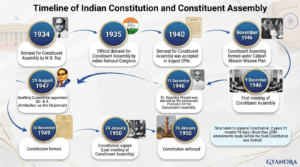
The Constitution of India was not prepared in a single day. It was made through a careful, democratic, and systematic process by the Constituent Assembly. Every provision of the Constitution was discussed, debated, and improved before it was finally adopted.
*Formation of the Constituent Assembly
- The Constitution was drafted by the Constituent Assembly, which was formed in 1946.
- It was originally elected for undivided India and held its first meeting on 9 December 1946.
- After the Partition of India, the Assembly was reorganised and continued its work as the Constituent Assembly of India.
*Detailed Discussion and Debates
- The Constitution was not written by one person or in a short period.
- Every Article was discussed in detail, and members freely shared their views and suggestions.
- Different opinions were carefully considered before any final decision was taken.
- This made the Constitution democratic and acceptable to different sections of society.
*Drafting the Constitution After the discussions, the Drafting Committee prepared the draft of the Constitution.
- The committee was chaired by Dr. B. R. Ambedkar, who played an important role in giving the Constitution its final shape.
- The draft was again discussed in the Assembly, and necessary changes were made before its approval.
*Adoption and Enforcement
- After completing all discussions and revisions, the Constituent Assembly adopted the Constitution on 26 November 1949.
- On 24 January 1950, 284 members signed the final Constitution.
- Finally, the Constitution came into force on 26 January 1950, and India became a Republic.
Composition of the Constituent Assembly
The Constituent Assembly was formed to prepare the Constitution of India. Although it was not elected through universal adult franchise, it was designed to represent different regions, communities, and political views of the country.
*Election of the Members
- The members of the Constituent Assembly were indirectly elected by the Provincial Legislative Assemblies under the Government of India Act, 1935.
- The election was based on the system of Proportional Representation by the Single Transferable Vote (STV).
- The representatives of the Princely States were selected through consultation.
*Composition of the Assembly
- The composition of the Assembly was decided according to the Cabinet Mission Plan (1946).
- Seats were allotted to the Provinces and Princely States according to their population.
- The Provinces received 292 seats, while the Princely States were allotted 93 seats.
- In the Provinces, seats were divided among the General, Muslim, and Sikh communities according to their population.
*Changes After Partition
- After the Partition of India, the members from the areas that became Pakistan left the Constituent Assembly.
- As a result, the total strength of the Assembly was reduced to 299 members.
*A Representative Assembly
- Although the Assembly was not elected by universal adult franchise, serious efforts were made to make it representative.
- It included members from different religions, regions, and communities, including 26 members from the Scheduled Castes.
- This ensured that the views of different sections of Indian society were included while making the Constitution.
*Role of the Indian National Congress
- After Partition, the Indian National Congress held about 82% of the seats in the Assembly.
- However, the Congress itself had leaders with different opinions and ideologies.
- This encouraged healthy discussions and helped in preparing a balanced Constitution.
Principle of Deliberation
Deliberation means discussing an issue carefully, listening to different opinions, and making decisions through reasoned debate.
Key Points:
- The authority of the Constitution comes not only from the way it was adopted, but also from the careful discussions and debates held in the Constituent Assembly.
- Members were expected to think beyond their personal or community interests and work for the welfare of the entire nation.
- There were differences of opinion on many important issues, such as:
- The role of the Central Government.
- The powers of the Judiciary.
- The right to property.
- The official language of the country.
- Universal Adult Franchise (Right to Vote).
- Instead of creating conflicts, these differences were resolved through open discussions and logical arguments.
- Members were encouraged to give reasons for their views and also respect the opinions of others. This made the Constitution more balanced and democratic.
Procedures
The Constituent Assembly followed clear and democratic procedures while drafting the Constitution. Every proposal was discussed before it was accepted.
*Systematic Working
- The Constitution was prepared in 2 years, 11 months, and 18 days.
- During this period, the Constituent Assembly held 11 sessions and met for 166 days.
- Out of these, 114 days were spent discussing the Draft Constitution clause by clause.
*Committee System
- The Assembly formed different committees to study various subjects in detail.
- Their reports were discussed before preparing the final draft.
- The Drafting Committee, headed by Dr. B. R. Ambedkar, prepared the draft Constitution.
*Careful Decision-Making
- Every Article of the Constitution was discussed in detail before being accepted.
- Members could suggest amendments, raise questions, and express their opinions freely.
- Every suggestion received a careful response before the final decision was taken.
Inheritance of the Nationalist Movement
The Indian Constitution was not created only by the Constituent Assembly. It was deeply influenced by the Indian National Movement, which had already discussed the country’s future, values, and system of governance during the struggle for independence.
*Foundation in the National Movement
- The Constitution was built on the ideas and principles developed during the freedom struggle.
- For many years, national leaders discussed important questions about how India should be governed and what kind of society should be created.
- The Constituent Assembly gave these ideas a practical and constitutional form.
*Vision for an Independent India
- During the nationalist movement, leaders debated issues such as:
- The form of government
- The values the nation should follow
- The social and economic inequalities that should be removed
- These discussions became the guiding principles while framing the Constitution.
*Role of the Objectives Resolution
- Jawaharlal Nehru introduced the Objectives Resolution in the Constituent Assembly on 13 December 1946.
- It clearly stated the aims, ideals, and aspirations of independent India.
- The Objectives Resolution became the foundation for many important provisions of the Constitution.
- It expressed the core values of Justice, Liberty, Equality, and Democracy.
- Many of its ideas were later included in the Preamble and other provisions of the Constitution.
*Values Inherited from the National Movement
The Constitution reflects the core values of the nationalist movement, such as:
- Equality
- Liberty
- Democracy
- Sovereignty
- A spirit of unity and respect for all people
These values guide the working of the Indian Constitution even today.
Provisions Adopted from Other Constitutions
The makers of the Indian Constitution studied the constitutions of many countries and adopted several useful features according to the needs of India.
Constitution | Provisions Adopted |
British Constitution | • First-Past-the-Post System (FPTP) |
United States Constitution | • Fundamental Rights |
Canadian Constitution | • Quasi-Federal System of Government |
Irish Constitution | • Directive Principles of State Policy (DPSPs) |
French Constitution | • Ideals of Liberty, Equality, and Fraternity |
USSR Constitution | • Fundamental Duties |
Australian Constitution | • Concurrent List |