Table of Contents
ToggleIntroduction – Water Resources
→ ¾ of Earth’s surface is covered with water, but only a small part is usable freshwater.
→ 97.5% of Earth’s water is in oceans and seas.
→ Only 2.5% is available as freshwater.
→ About 70% of freshwater is frozen in ice caps and glaciers.
→ Less than 30% of freshwater is stored as groundwater.
→ Freshwater comes from precipitation, surface run-off and groundwater.
→ The hydrological cycle continuously renews and recharges freshwater.
→ Water is therefore a renewable resource.
→ India receives about 4% of global precipitation.
→ Water availability varies with regions and seasons.
→ By 2025, nearly 2 billion people were predicted to face absolute water scarcity.
Water Scarcity
Water scarcity means a situation where the availability of water is less than the demand for it.
*Reasons for Water Scarcity
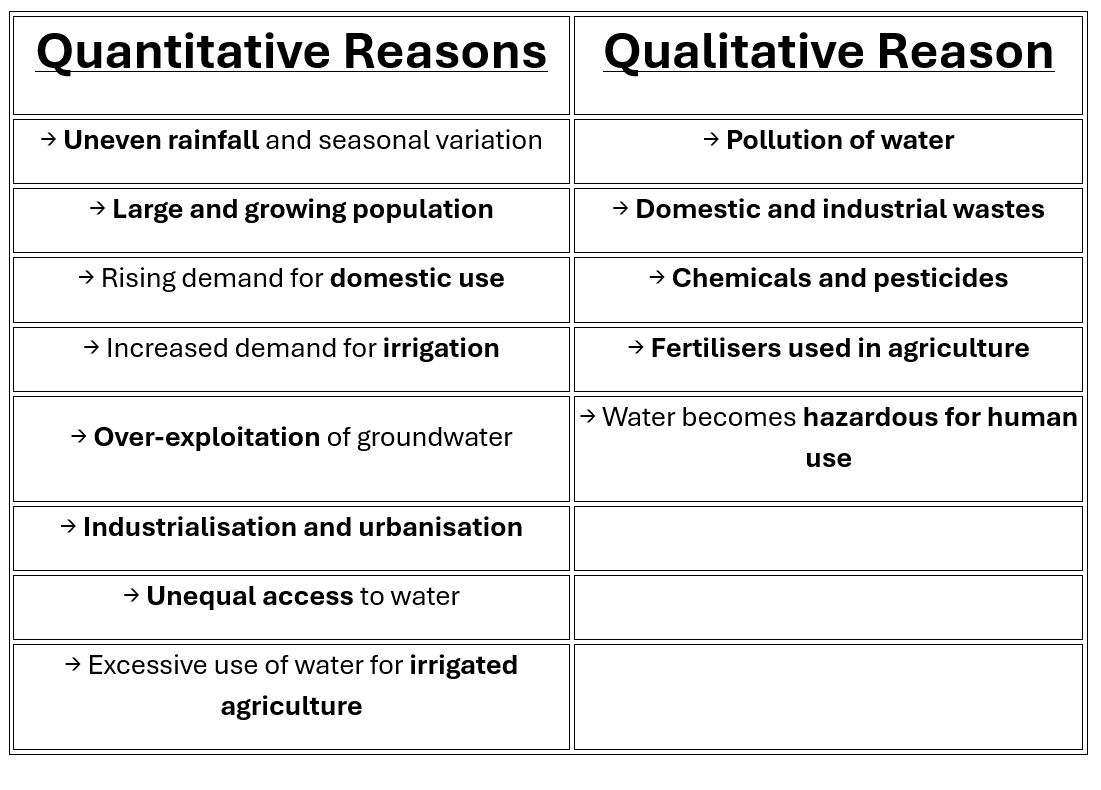
Water Stress
→ Water stress occurs when the available water resources are under heavy pressure due to increasing demand and over-exploitation.
→ It is mainly linked with growing population, excessive water use and depletion of water resources.
→ Falling groundwater levels can further increase water stress.
Need for Water Conservation and Management
Water resources need to be conserved and properly managed to prevent their depletion and misuse.
→ Conserve water to meet present and future needs.
→ Protect health from water-related hazards.
→ Ensure food security through adequate water supply.
→ Support livelihoods and productive activities.
→ Prevent degradation of natural ecosystems.
→ Control over-exploitation of water resources.
→ Avoid depletion of water resources.
→ Prevent ecological crises caused by mismanagement.
→ Ensure the sustainable use of water resources.
Jal Jeevan Mission (JJM)
The Jal Jeevan Mission (JJM) was launched in August 2019 by the Government of India to improve the quality of life and ease of living, especially for people living in rural areas.
→ Goal: Provide every rural household with assured potable piped water.
→ 55 LPCD: Provide 55 litres per capita per day of water.
→ Ensure a functional household tap connection (FHTC).
→ Provide water on a regular and long-term basis.
→ Safe Water: Ensure water of the prescribed quality for drinking.
→ Har Ghar Jal: The mission is popularly known as JJM – Har Ghar Jal.
→ Community Participation: States and local communities play an important role in planning, managing and maintaining rural water supply systems.
→ Main Focus: Improve public health, quality of life and ease of living in rural areas.
Atal Bhujal Yojana (Atal Jal)
Atal Bhujal Yojana (Atal Jal) is a Government of India groundwater-management scheme focused on water-stressed areas and community participation.
→ Launched: 2020
→ Implemented by: Government of India, with support from the World Bank.
→ Main Focus: Groundwater conservation and management.
→ Coverage: 7 states — Gujarat, Haryana, Karnataka, Madhya Pradesh, Maharashtra, Rajasthan and Uttar Pradesh.
→ It covers 8,220 water-stressed Gram Panchayats in 229 blocks/talukas across 80 districts.
→ It promotes community participation in groundwater management.
→ It aims to change the approach from water consumption → water conservation and smart water management.
Multipurpose River Projects and Integrated Water Resources Management
Multipurpose river projects help in storing and managing water for different uses. After Independence, they were promoted as a means of development and progress through integrated water resources management.
Hydraulic Structures in Ancient India
India has a long tradition of managing water through dams, reservoirs, lakes, embankments and canals.
→ 1st Century B.C.: Sringaverapura near Allahabad had a sophisticated water-harvesting system.
→ Chandragupta Maurya’s period: Dams, lakes and irrigation systems were extensively built.
→ Sophisticated irrigation works were found in Kalinga, Nagarjunakonda, Bennur and Kolhapur.
→ 11th Century:Bhopal Lake, one of the largest artificial lakes of its time, was built.
→ 13th–14th Century: Hauz Khas tank, Delhi, was built by Allauddin Khilji to supply water to the Siri Fort area.
Dams
0r
Multipurpose River Projects
→ A dam is a barrier across flowing water that obstructs, directs or retards its flow.
→ It often creates a reservoir, lake or impoundment.
→ Most dams have a spillway or weir through which water can flow.
–Why are Dams Called Multipurpose Projects?
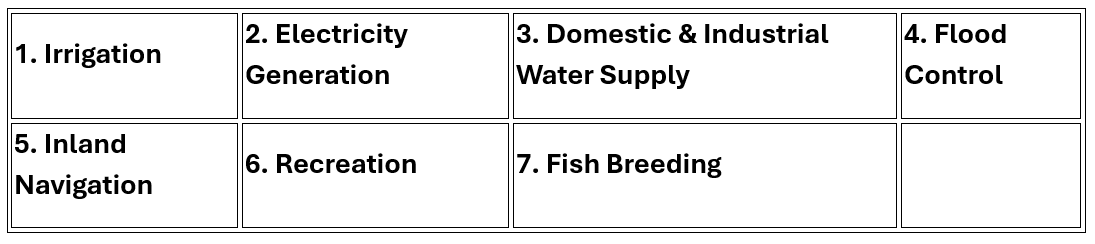
Dams were traditionally built to store river and rainwater for irrigation. Today, the stored water is used for several purposes. Hence, they are called multipurpose projects.
–Examples
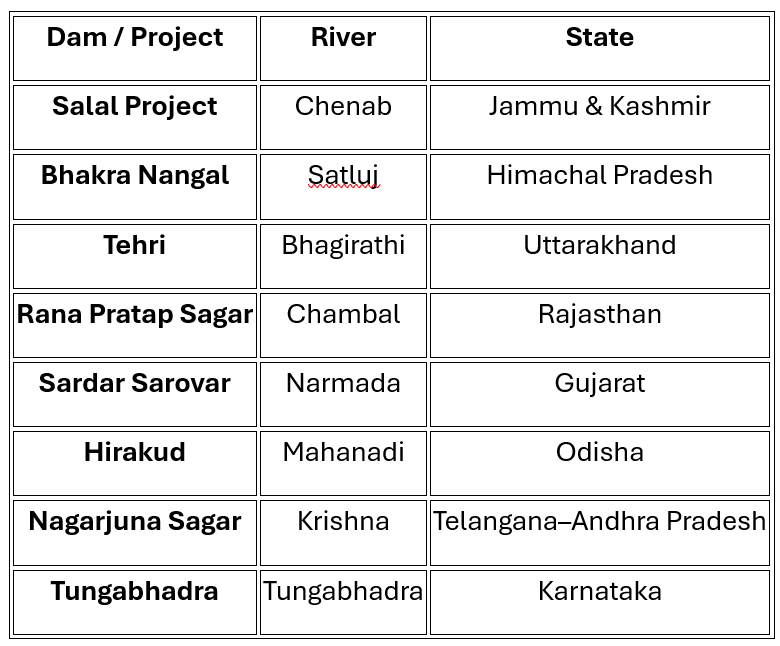
→ Bhakra–Nangal Project → Hydel power + irrigation.
→ Hirakud Project → Water conservation + flood control.
–Major Dams
–Jawaharlal Nehru and Dams
→ Jawaharlal Nehru called dams the “temples of modern India.”
→ They were expected to connect agricultural and village development with industrialisation and urban growth.
–Advantages of Multipurpose River Projects
→ Irrigation for agricultural fields.
→ Hydroelectricity generation.
→ Domestic and industrial water supply.
→ Flood control.
→ Inland navigation.
→ Recreation and fish breeding.
→ Supply water to water-scarce areas.
–Disadvantages of Multipurpose River Projects
→ Affect the natural flow and sediment flow of rivers.
→ Cause sedimentation in reservoirs.
→ Affect aquatic habitats and fish migration.
→ Submerge vegetation and soil.
→ May increase flood risks due to sedimentation.
→ May fail to control floods during excessive rainfall.
→ Cause soil erosion and land degradation.
→ May cause earthquakes, diseases and pests.
→ Excessive water use may cause pollution.
→ Cause displacement and loss of livelihoods.
→ Encourage water-intensive crops and soil salinisation.
–Movement Against Multipurpose River Projects
→ Large dams have faced growing scrutiny and opposition because of their social and environmental impacts.
→ Sardar Sarovar Project on the Narmada River became an important example of opposition to a large project.
→ It covers Maharashtra, Madhya Pradesh, Gujarat and Rajasthan.
→ The project aims to provide water to drought-prone and desert areas.
→ The project also led to concerns related to displacement, livelihoods and environmental impacts.
Rainwater Harvesting
Because of the disadvantages and rising resistance to multipurpose projects, rainwater harvesting emerged as a viable alternative, both socio-economically and environmentally.
Ancient communities developed methods according to local rainfall, soil, ecological conditions and water needs.
→ Guls/Kuls → Diversion channels in the Western Himalayas for agriculture.
→ Inundation channels → Used in the flood plains of Bengal for irrigation.
→ Khadins → Rain-fed storage structures in Jaisalmer.
→ Johads → Similar storage structures in other parts of Rajasthan.
→ Tankas → Underground tanks traditionally used for drinking water in Bikaner, Phalodi and Barmer.
Rooftop Rainwater Harvesting
→ Rainwater falling on sloping rooftops is collected through pipes and stored in underground tankas.
→ The first spell of rain was usually not collected because it cleaned the roofs and pipes.
→ Later showers were collected and stored for drinking water.
–Modern Rooftop Harvesting
→ Rooftop water can be collected through PVC pipes.
→ It may be filtered using sand and bricks.
→ Water can be stored in a sump for immediate use.
→ Excess water can be sent to a well for groundwater recharge.
–Examples
→ Tamil Nadu → First state to make rooftop rainwater harvesting compulsory for all houses; legal provisions exist for defaulters.
→ Shillong, Meghalaya → Rooftop harvesting is very common; about 15–25% of household water requirements come from it.
→ Gendathur, Mysuru, Karnataka → Nearly 200 households installed rooftop harvesting systems.
→ In western Rajasthan, the practice has declined because of water availability from the Indira Gandhi Canal, though some households still maintain tankas.